Owned and operated by a cf veteran

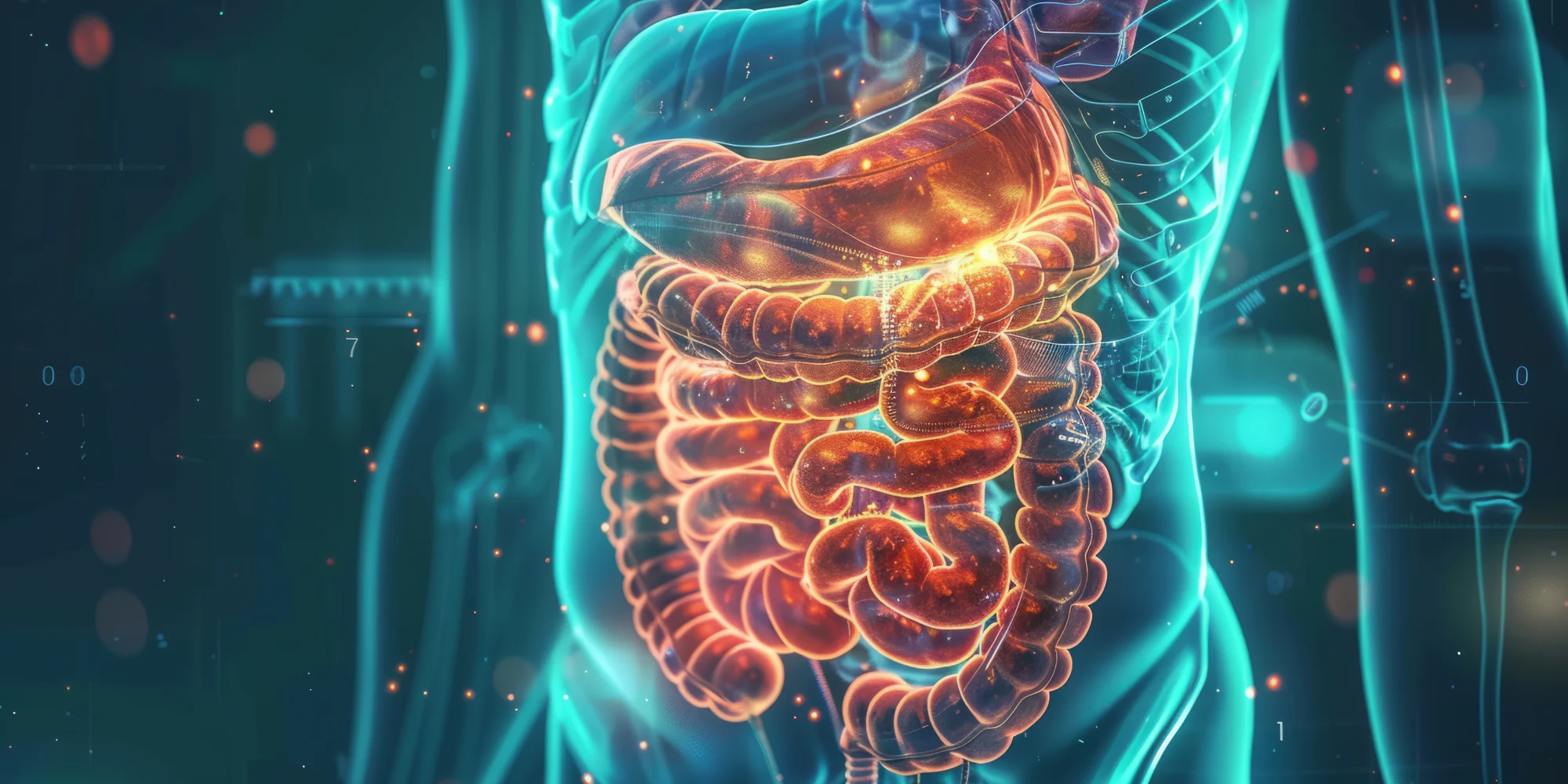
IBS treatment starts with knowing what IBS is. This guide shows the signs, the remedies with real proof, and what each gut peptide does, in plain words.
- 1 in 8 people in North America have IBS
- 4 types of IBS, and each one is treated a bit differently
- 9 gut peptides explained, with the proof for each
- 1 peptide drug is already prescribed for IBS in Canada
There is no one cure for IBS. The best IBS treatment is a mix of small steps. The steps with the most proof are psyllium fibre, peppermint oil capsules, the low FODMAP diet and gut-brain therapy. Your doctor can add medicine. Peptides like BPC-157 and KPV help the gut lining in animal studies. But IBS does not damage the gut, and no research peptide has been tested for IBS in people yet.
- The short version
- What IBS is
- IBS symptoms
- The 4 types
- IBS flare-ups
- Red flags
- How IBS is found
- IBS vs IBD
- Remedies with proof
- Low FODMAP diet
- Ten worst foods
- Psyllium fibre
- Peppermint oil
- Gut-brain therapy
- Probiotics
- Medicines
- Glutamine
- Peptides for IBS
- What each peptide does
- GLP-1 and IBS
- Myths
- Can IBS be cured?
- An 8-week plan
- Questions
The short version
- IBS is common. About 1 in 8 people in North America have it. More women than men get it.
- IBS is real, but the gut is not damaged. The gut and brain send mixed-up signals. The gut gets touchy and moves too fast or too slow.
- Know the red flags. Blood in your poop, weight loss you can’t explain, or pain that wakes you up is not normal IBS. See a doctor.
- Start with the basics. Psyllium fibre, peppermint oil capsules and a food diary help many people. They are cheap and easy to try.
- The low FODMAP diet works for many people. In one well-known study, it cut gut symptoms about in half.
- Your mind and gut are wired together. Gut-directed hypnotherapy and CBT help more than most people expect.
- One peptide drug is proven. Linaclotide is a prescription peptide for IBS with constipation.
- Research peptides are early. BPC-157, KPV, LL-37 and others help the gut lining in mice and rats. None has been tested for IBS in people yet.
What IBS is (and what it is not)
IBS stands for irritable bowel syndrome. It is a problem with how your gut works, not with how it looks. If a doctor looks inside your gut, it usually looks normal. There is no swelling, no ulcer and no damage.
So why does it hurt? Doctors now call IBS a disorder of the gut-brain connection. Your gut has its own web of nerves. It talks to your brain all day long. In IBS, that talk gets loud and mixed up. Normal gas or stretching can feel like real pain. The gut can push food along too fast, which gives you diarrhea. Or it can move too slow, which gives you constipation.
IBS does not turn into cancer. It does not shorten your life. But it can make life hard. Many people plan their day around a bathroom. That is why IBS treatment matters.
About 1 in 10 people who get a bad stomach bug go on to have IBS a year later. This is called post-infectious IBS. It matters later in this guide, because it is the kind of IBS where the gut lining may be a bit leaky.
IBS symptoms: what it feels like
The main IBS symptom is belly pain that is tied to your bowel movements. The pain may start when you need to go. It often eases a bit after you go. Other common signs are:
- Cramps or belly pain, most often low in the belly.
- Bloating, where your belly feels tight or looks bigger by the end of the day.
- Gas.
- Diarrhea, constipation, or both, sometimes in the same week.
- Mucus in your poop (a clear or white slime).
- A feeling that you did not finish after you go.
- Urgency, where you need a bathroom right now.
Many people also feel tired, have back pain, feel sick to their stomach, or have trouble sleeping. These do not prove IBS, but they are common with it.
IBS symptoms in women
Women get IBS more often than men. Many women notice their IBS gets worse just before or during their period. Hormones change how fast the gut moves and how much pain you feel. Keep your period dates in your food and symptom diary. It can show you a pattern you would miss.
Where IBS pain is
IBS pain is most often in the lower belly. It can be on the left, the right or across the middle. It often moves around. Pain that always sits in one small spot, or pain that is getting worse over weeks, needs a doctor’s check.
The 4 types of IBS
Doctors sort IBS by what your poop is like on your bad days. The type matters, because some IBS treatment helps one type and makes another worse.
| Type | What bad days look like | Short name |
|---|---|---|
| IBS with constipation | Hard, lumpy poop. Going less often. Lots of straining. | IBS-C |
| IBS with diarrhea | Loose, watery poop. Rushing to the bathroom. | IBS-D |
| Mixed IBS | Both hard and loose days, often in the same week. | IBS-M |
| Unsorted IBS | IBS that does not fit the other three. | IBS-U |
Your type can change over time. That is normal. It is one more reason to keep a simple diary.
IBS flare-ups: triggers and how long they last
An IBS flare-up (some people call it an IBS attack) is a stretch of bad days. Pain, bloating and bathroom trouble all get worse at once. A flare can last a few hours. Most last a few days. Some drag on for a week or more.
Flares usually have a trigger. The trigger is not the same for everyone. That is why a diary helps so much. These are the common ones:
What to do during an IBS flare-up
Calm the gut
Use heat on your belly. Sip water or peppermint tea. Eat small, plain meals.
Calm the body
Try slow belly breathing for five minutes. A short walk helps gas move.
Write it down
Note what you ate, how you slept and how stressed you were. Look for the pattern later.
If a flare comes with fever, blood, vomiting or pain that keeps getting worse, it may not be IBS. Get checked.
Red flags: when it is NOT just IBS
IBS never causes bleeding or weight loss. Other gut problems do. See a doctor soon if any of these apply to you:
- Blood in your poop Or poop that is black and looks like tar.
- Weight loss Losing weight without trying.
- Waking up at night Pain or diarrhea that wakes you from sleep.
- A fever Along with your gut symptoms.
- Low iron (anemia) Found on a blood test.
- New symptoms after 50 Gut changes that start at age 50 or older.
- Family history Of colon cancer, Crohn’s, colitis or celiac disease.
- Vomiting or trouble swallowing Vomiting that keeps coming back, or food that sticks.
These signs do not mean something is badly wrong. They mean a doctor should look before you call it IBS.
How IBS is diagnosed in Canada
There is no single test for IBS. Your doctor finds it from your story and a few simple checks. Doctors use a set of rules called the Rome IV criteria. In plain words, you likely have IBS if:
- You have had belly pain at least one day a week for the last 3 months, and
- The pain is tied to at least two of these: going to the bathroom, a change in how often you go, or a change in how your poop looks, and
- It all started at least 6 months ago.
The Canadian Association of Gastroenterology (Canada’s group of gut doctors) gives clear advice on tests. They suggest a blood test for celiac disease, since it can look just like IBS. They advise against routine food allergy tests and breath tests for IBS. People under 50 with no red flags usually do not need a colonoscopy. People whose symptoms start at 50 or older should have one.
IBS vs IBD: not the same thing
People mix these two up all the time. The names are close, but they are very different. This is also the key to understanding peptides for IBS, which comes later.
| Question | IBS | IBD (Crohn’s and colitis) |
|---|---|---|
| Is the gut damaged? | No. It looks normal. | Yes. There is swelling, sores and damage. |
| Blood in poop? | No. | Often. |
| Weight loss? | No. | Often. |
| How it is found | Symptoms and ruling other things out. | Stool and blood tests, scope, scans. |
| Main treatment | Diet, fibre, gut-brain therapy, some medicine. | Strong anti-swelling medicine, sometimes surgery. |
Why this matters: most gut peptide research is done on colitis, which is a type of IBD. Scientists hurt the gut of a mouse on purpose, then see if a peptide helps it heal. That tells us a lot about damaged guts. It tells us much less about IBS, where the gut is not damaged.
IBS treatment: remedies with real proof
There are many IBS remedies online. Some work. Many do not. The chart below shows how much proof sits behind the main options. It is based on the Canadian gut doctors’ 2019 IBS guideline and the trials behind it.
Based on the 2019 Canadian Association of Gastroenterology IBS guideline. “Strong advice” means the guideline says “we recommend”. “Worth trying” means “we suggest”. Rx means you need a prescription. Dots show the strength of advice, not how well it works for you.
You do not need to do all of these. Most people start with one or two, give each a fair try of about 4 weeks, and keep what helps. The next sections take them one at a time.
The low FODMAP diet in 3 steps
FODMAPs are types of sugars and fibres that some guts can’t break down well. They pull water into the gut and feed gut germs, which make gas. In a touchy IBS gut, that gas and stretch turns into pain and bloating.
The low FODMAP diet was built by Monash University in Australia. In one of its best-known studies, people with IBS had their gut symptom scores cut about in half on the diet, compared with a normal diet.
Halmos and others, Gastroenterology, 2014. 30 people with IBS, 3 weeks on each diet, scored on a 100 mm scale.
The low FODMAP diet is not meant to last forever. It has three steps:
Cut
Cut high FODMAP foods for 2 to 6 weeks. See if you feel better.
Test
Add foods back one group at a time. Find which ones cause trouble.
Keep
Eat as wide a diet as you can. Only avoid the foods that hurt you.
This diet is tricky to do alone. A dietitian makes it much easier. Many work benefit plans in Canada cover dietitian visits. The Monash FODMAP app also lists which foods are high or low.
Ten worst foods for IBS
Every gut is different. But these ten foods cause trouble for more people with IBS than any others. Each one has an easy swap.
| Food | Why it bothers IBS | Try instead |
|---|---|---|
| Onions | High in fructans, a gas-making fibre. | Green part of green onions, chives |
| Garlic | Also high in fructans. | Garlic-infused oil |
| Wheat bread and pasta | Fructans again, in big amounts. | Sourdough spelt, rice, oats |
| Beans and lentils | Full of GOS, which feeds gas. | Small amounts of canned, rinsed lentils |
| Milk and soft cheese | Lactose, a milk sugar many can’t digest. | Lactose-free milk, hard cheese |
| Apples and pears | Extra fructose and sugar alcohols. | Oranges, grapes, strawberries |
| Sugar-free gum and candy | Sorbitol and xylitol pull water into the gut. | Regular gum in small amounts |
| Fried and fatty food | Fat makes the gut squeeze harder. | Baked or grilled food |
| Coffee and energy drinks | Caffeine speeds up the gut. | Decaf, or one small coffee |
| Alcohol and fizzy drinks | They irritate the gut and add gas. | Still water, peppermint tea |
You do not have to cut all ten. Test them. You may find only two or three bother you.
Psyllium fibre (and why bran can backfire)
Psyllium is a soft fibre from a plant seed. You may know it as Metamucil. It soaks up water and turns into a gel. That gel makes hard poop softer and loose poop firmer. So it can help both IBS-C and IBS-D.
The Canadian gut doctors give psyllium a strong “we recommend”. In the trials they looked at, for every 7 people who took it, 1 more person got relief than with a dummy pill.
Not all fibre is the same. Wheat bran is a rough fibre. It can make gas and bloating worse, and the Canadian guideline advises against it for IBS.
Soluble fibre foods for IBS include oats, chia seeds, ground flax, oranges, kiwi and carrots. They work in the same gentle way.
Peppermint oil capsules
Peppermint oil relaxes the smooth muscle in the gut wall. That can ease cramps and spasms. It works best as a coated capsule that opens in the gut, not the stomach.
A big review in the British Medical Journal pooled four trials with 392 people. People taking peppermint oil were less than half as likely to still have IBS symptoms as people on a dummy pill. The Canadian guideline suggests trying it.
The main side effect is heartburn. If you already get heartburn, peppermint oil may not be for you. Peppermint tea is gentle and pleasant, but it is much weaker than the capsules.
Gut-brain therapy: hypnotherapy and CBT
This one surprises people. Talking and focus therapies are some of the best IBS treatments we have. They do not mean the pain is “in your head”. They work on the nerve link between your gut and your brain, the same link that is out of tune in IBS.
- Gut-directed hypnotherapy uses calm, guided focus to turn down gut pain signals. It is not stage hypnosis. You stay awake and in control.
- CBT (cognitive behavioural therapy) teaches you to change the stress and worry loops that feed flares.
In a Swedish trial of 119 people with IBS, about 7 in 10 who had one-on-one gut-directed hypnotherapy got real relief. So did almost 6 in 10 in group sessions.
Randomised trial, Alimentary Pharmacology and Therapeutics, 2022. 119 adults with IBS. There was no dummy-treatment group in this trial.
You can find this therapy through a psychologist, some hospital gut clinics, and phone apps built for IBS. Many work benefit plans in Canada cover a psychologist.
Probiotics for IBS
Probiotics are live “good” germs in pills or foods like yogurt and kefir. The idea is to fix the germ mix in the gut. The proof is mixed. The Canadian gut doctors suggest they may be worth a try. The American guideline advises against them. One reason for the mixed results is that each product has different germs, so one study can’t speak for them all.
If you want to try one, here is a fair way to do it. Pick one product. Take it every day for 4 weeks. Keep your diary. If nothing changes, stop and save your money.
Medicines your doctor may offer
If the basics are not enough, your doctor has more tools. Which one they pick depends on your IBS type.
| Main problem | Medicine options | What they do |
|---|---|---|
| Pain and cramps | Antispasmodics such as hyoscine | Relax gut muscle spasms. |
| Pain that won’t quit | Low-dose tricyclics (TCAs) | Turn down gut pain nerves. The dose is much lower than for depression. |
| IBS-C | Linaclotide, lubiprostone | Pull water into the gut and ease pain. |
| IBS-D | Eluxadoline, rifaximin | Slow the gut or change the gut germ mix. |
| Short-term diarrhea | Loperamide (Imodium) | Slows the gut for a day out. Not advised every day. |
All of these have side effects. Your doctor or pharmacist can help you weigh them.
Glutamine: gut-lining support with real human proof
Glutamine is not a peptide. It is a single amino acid, one of the building blocks that peptides are made from. The cells lining your gut use it as fuel.
It belongs in this guide because it has something most “gut healing” products do not: a good trial in people with IBS. The trial took 106 people who got IBS with diarrhea after a stomach bug. All of them had a leaky gut lining on a lab test. After 8 weeks, about 8 in 10 on glutamine got real relief. On a dummy powder, it was about 1 in 17.
Zhou and others, Gut, 2019. 106 adults, randomised against a dummy powder. The leaky gut test also went back to normal on glutamine. One trial only, and only in this IBS subgroup.
This is one trial, in one kind of IBS. It still needs to be repeated. But it shows that fixing a leaky gut lining can help some people with IBS, at least when IBS started after an infection.
Peptides for IBS: what the research really shows
Peptides are short chains of amino acids. Your body makes thousands of them. Many of them work in the gut. They tell the gut when to move, when to release water, and how to fix its lining.
That is why people ask about peptides for IBS. Here is the honest picture. Most gut peptide research is on damaged, swollen guts, like colitis. As you saw above, IBS is not that. So a peptide that helps a hurt mouse gut heal will not always help IBS.
Here is where the gut lining idea may fit IBS, and where it does not:
The chart below shows how much gut research sits behind each peptide. One of them is already a prescription drug for IBS. The rest are research compounds.
Our summary of the published research as of 2026. “A lot” means trials in people with IBS. No research peptide on this list has been tested for IBS in people. Dots are a rough guide, not a score from a lab.
| Peptide | What it does in the gut | Best studied in | Fit for IBS |
|---|---|---|---|
| Linaclotide | Pulls water into the gut, calms pain nerves | People with IBS-C | Proven for IBS-C |
| BPC-157 | Helps the gut lining and blood vessels repair | Rats with gut injury | Unknown |
| KPV | Calms swelling signals inside gut cells | Mice with colitis | Unknown |
| LL-37 | Fights germs, guards the lining | Mice with colitis | Unknown |
| TB-500 | Repair and scar control | Mice with colitis | Unknown |
| GHK-Cu | Tightens the lining, calms swelling | Mice with colitis | Unknown |
| Thymosin Alpha-1 | Balances the immune system | Infection and immune research | Unknown |
| VIP | Tells the gut to release water and relax | Gut and lung research | May worsen IBS-D |
| Larazotide | Tightens gaps in the gut lining | People with celiac | Big trial stopped |
What each peptide does
Linaclotide: the peptide already prescribed for IBS
Linaclotide is a peptide made of 14 amino acids. It is sold in Canada as a prescription drug for IBS with constipation. It works inside the gut and barely gets into the blood. It pulls water into the bowel, which softens poop. It also seems to calm the pain nerves in the gut wall.
In a 26-week trial of 804 people with IBS-C, about 1 in 3 on linaclotide met the main goal for relief of both pain and constipation. On a dummy pill, it was about 1 in 7. The main side effect is diarrhea. About 1 in 22 people stopped it for that reason.
Chey and others, American Journal of Gastroenterology, 2012. Phase 3 trial, 804 adults with IBS-C.
Linaclotide shows something important. A peptide can be a real IBS treatment when it is tested the right way. It is also the only peptide the Canadian gut doctors strongly recommend for IBS.
BPC-157: the gut-lining peptide
BPC-157 is a chain of 15 amino acids. It was first found as part of a protein in human stomach juice. It stays stable in stomach acid, which is rare for a peptide. That is one reason it has been studied so much for the gut.
In rats, BPC-157 has helped heal many kinds of gut damage. These include stomach ulcers, damage from pain pills like ibuprofen, colitis, fistulas (tunnels that form between the gut and skin) and joins in the bowel after surgery. It seems to work by helping new blood vessels grow and by acting on nitric oxide, a gas the body uses to control blood flow.
In people, a version called PL 14736 went as far as early testing for ulcerative colitis. That was many years ago, and full results have not been published. There has never been a trial of BPC-157 for IBS.
Our take: BPC-157 has the deepest gut research of any research peptide. Its best fit is a hurt gut lining, which is not what most IBS is. Read more in our BPC-157 explained guide and our BPC-157 Canada guide. See the BPC-157 10mg research vial. Note: BPC-157 is on the World Anti-Doping Agency’s banned list, so tested athletes should know that.
KPV peptide: the anti-swelling tripeptide
KPV is tiny. It is only 3 amino acids: lysine, proline and valine. It is the tail end of a larger hormone called alpha-MSH, which helps control swelling in the body.
What does KPV peptide do in the gut? In a well-known study, KPV got inside gut cells through a door called PepT1. The inflamed colon makes much more of this door than a healthy colon does. Once inside, KPV turned down the main swelling switches in the cell (called NF-kB and MAP kinase). In mice with two kinds of colitis, KPV given by mouth made the colitis less severe. Later studies packed KPV into tiny particles that open in the colon, with similar results in mice.
There are no KPV studies in people with IBS or colitis yet. Our take: KPV is one of the most interesting gut peptides, and it is small and easy to study. But like BPC-157, its proof is in swollen guts, not IBS. See the KPV 10mg research vial.
LL-37: the germ-fighting peptide
LL-37 is the only peptide of its kind that humans make. It is part of the body’s first line of defence against germs. It is found in the gut lining, the skin and the lungs. It can break open the outer wall of some bacteria.
In a 2011 study, mice that could not make their version of this peptide got much worse colitis than normal mice. The peptide also showed up more in the inflamed colon of people with colitis. This hints that it helps guard the gut lining and keep gut germs in check.
Our take: LL-37 is studied for germ balance, which links it to the idea of gut germ trouble in some IBS. There are no IBS trials. See the LL-37 10mg research vial, and our Thymosin Alpha-1 guide, which compares LL-37 with other immune peptides.
TB-500: repair and scar control
TB-500 is a lab-made peptide based on thymosin beta-4, a repair peptide found in almost every cell. A 2026 study found the gene for thymosin beta-4 was turned down in the colons of people with IBD. Mice missing it got worse colitis. When mice were given thymosin beta-4 by mouth, they lost less weight, had less damage to the gut lining and formed less scar tissue. Not every study agrees, though. A 2023 mouse study found that too much of it may weaken the gut’s mucus layer.
Our take: interesting for gut repair, but still mouse-level, and again in colitis, not IBS. Read BPC-157 vs TB-500 and our TB-500 Canada guide.
GHK-Cu: the copper peptide
GHK-Cu is best known for skin. But a 2025 mouse study tested it on colitis. Mice given GHK-Cu lost less weight, had less swelling in the colon and had a tighter gut lining. The study pointed to a repair switch called SIRT1.
Our take: one mouse study is a very early start. See the GHK-Cu 100mg research vial.
KLOW: the blend
KLOW is a blend that puts four of these peptides in one vial: KPV, BPC-157, TB-500 and GHK-Cu. People like blends because they hit several targets at once. But no study has tested this blend itself for the gut or for IBS. The research above is on each peptide alone. See KLOW 80mg.
Thymosin Alpha-1: the immune balancer
Thymosin Alpha-1 helps the immune system find the right balance. It can wake up a weak response or calm an over-active one. It is used as a medicine in some countries for hepatitis B. There is very little gut research on it, and none in IBS. Learn more in our Thymosin Alpha-1 guide.
VIP: a gut signal to be careful with
VIP stands for vasoactive intestinal peptide. Your gut makes it. It tells the gut to relax and to release water and salt. Too much VIP causes heavy, watery diarrhea. A 2014 study found higher VIP levels in the gut lining of women with IBS-D.
Our take: VIP is a real gut peptide, but for IBS with diarrhea it points the wrong way. It is studied mostly for the lungs and immune system. Read our VIP peptide guide.
Larazotide: the lesson on “leaky gut” peptides
Larazotide is a peptide made to close gaps in the gut lining, the problem often called “leaky gut”. It went all the way to a big final-stage trial in celiac disease. In 2022 that trial was stopped because it was not doing better than a dummy pill.
This matters for anyone reading big claims online. A peptide can look great in early studies and still fail in people. That is why this guide shows where the proof stops.
GLP-1 peptides and IBS
GLP-1 is a gut peptide that slows the stomach and cuts hunger. Drugs like semaglutide (Ozempic), tirzepatide (Mounjaro) and the research peptide retatrutide all act on it.
Here is a twist. An early drug in this family, called ROSE-010, was tested for IBS pain. In a trial, people took it during an IBS pain attack. About 1 in 4 got fast, strong pain relief within an hour, twice as many as with a dummy shot.
Hellström and others, Alimentary Pharmacology and Therapeutics, 2009. Randomised, blinded trial in adults with IBS.
But for most people, GLP-1 drugs are more likely to stir up the gut than calm it. Nausea, constipation, diarrhea and burps are the most common side effects. If you have IBS and are thinking about or researching these drugs, expect your gut to need extra care, especially early on. Read more in our guides on retatrutide and digestion, sulphur burps and diarrhea, and electrolytes.
IBS myths
Can IBS be cured permanently?
Many people search for how to cure IBS permanently. The honest answer is that there is no known cure. But that is not the whole story.
IBS tends to come and go. Many people have long, quiet stretches with few symptoms. Some find that once they know their triggers and have a plan, IBS becomes a small part of life. IBS that starts after a stomach bug often gets better over the years.
So the goal is not a cure. The goal is control. Most people can get there with a mix of the steps in this guide.
A simple 8-week IBS plan
Here is one way to put it all together. Change one thing at a time, so you know what works.
Week 1: Check
See your doctor. Rule out red flags and ask about a celiac test.
Weeks 1-2: Track
Keep a food, sleep, stress and poop diary. Eat regular meals.
Weeks 3-4: Basics
Add psyllium slowly. Try peppermint oil capsules for cramps.
Weeks 3-6: Food
Still bad? Start the low FODMAP “cut” step, ideally with a dietitian.
Weeks 5-8: Mind
Start gut-directed hypnotherapy or CBT. Add foods back one at a time.
Week 8: Review
Go over your diary with your doctor. Ask about medicine if you need more help.
Move a little every day. A 20 to 30 minute walk helps gas move and eases stress. Sleep matters too. A tired gut is a touchy gut.
IBS treatment questions
What is the best treatment for IBS?
There is no single best one. The steps with the most proof are psyllium fibre, peppermint oil capsules, the low FODMAP diet and gut-directed hypnotherapy or CBT. Doctors can add medicine, like linaclotide for IBS-C or a low-dose tricyclic for pain.
How can I calm an IBS flare-up fast?
Put heat on your belly, sip water or peppermint tea, and eat small plain meals. Slow belly breathing and a short walk help too. Peppermint oil capsules can ease cramps.
How long does an IBS flare-up last?
Most flares last a few hours to a few days. Some last a week or more. A flare with fever, blood or vomiting needs a doctor.
Can IBS be cured permanently?
There is no known cure. But most people can control it well, and many have long stretches with few symptoms. IBS that starts after a stomach bug often improves over time.
What are the first signs of IBS?
Belly pain tied to bowel movements, plus bloating, gas, and diarrhea, constipation or both. It usually comes and goes for months.
What are IBS symptoms in women?
The same as in men, but women get IBS more often. Many women find symptoms get worse around their period.
What foods trigger IBS?
The most common are onions, garlic, wheat, beans, milk, apples, pears, sugar-free gum, fried food, coffee and alcohol. Triggers differ, so test them one at a time.
Is BPC-157 good for your gut?
In rats, BPC-157 helps heal many kinds of gut damage. It has not been tested for IBS in people, and IBS does not damage the gut. It is a research compound, not an approved IBS treatment.
What does KPV peptide do?
KPV is a 3-amino-acid peptide that enters gut cells and turns down swelling signals. It eased colitis in mice. It has not been tested in people with IBS.
What is the best peptide for gut issues?
For IBS in people, the only proven peptide is linaclotide, a prescription drug for IBS-C. Among research peptides, BPC-157 has the most gut studies, followed by KPV and LL-37, but all of that is animal research.
Is there a peptide approved for IBS in Canada?
Yes. Linaclotide is a prescription peptide for IBS with constipation. Ask your doctor about it.
Does peppermint oil help IBS?
Yes, for many people. In pooled trials, people on peppermint oil capsules were less than half as likely to still have symptoms as those on a dummy pill. Heartburn is the main side effect.
Do probiotics help IBS?
Sometimes. The proof is mixed. Try one product for 4 weeks. If nothing changes, stop.
What is the difference between IBS and IBD?
IBS does not damage the gut. IBD (Crohn’s and colitis) causes swelling, sores, bleeding and weight loss. They are treated very differently.
Can stress cause IBS?
Stress does not cause IBS alone, but it is one of the biggest triggers of flare-ups. That is why gut-brain therapy works so well.
Can GLP-1 drugs like retatrutide make IBS worse?
They can. Nausea, constipation, diarrhea and burps are common side effects of this drug family. If you have IBS, your gut may need extra care, especially in the first weeks.
 BPC-157 10mg$75
 KPV 10mg$72
 LL-37 10mg$55
 GHK-Cu 100mg$64.99
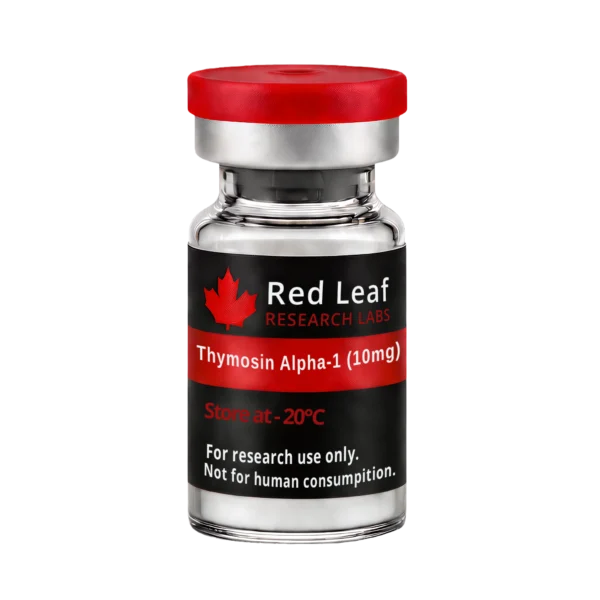 Thymosin Alpha-1 10mg$88
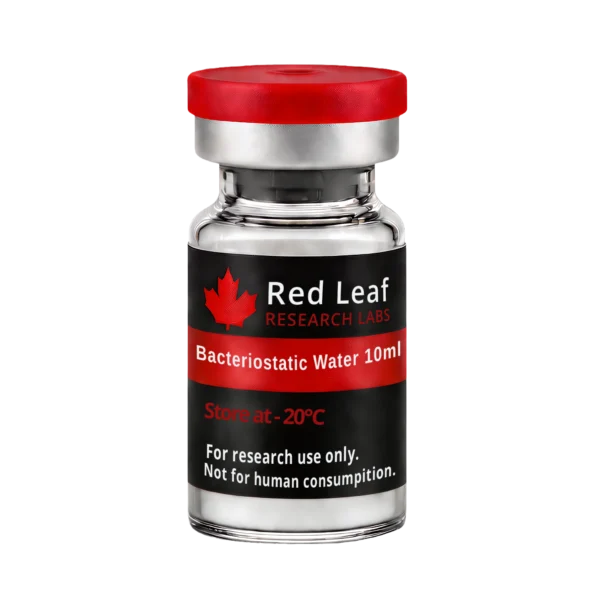 Bacteriostatic WaterFrom $10
Every Red Leaf research vial is made for lab research, and our lab reports come with a verify link. Free express shipping on Canadian orders over $250. Questions about a batch or a lab report? Ask us before you order.
Research use only. All products sold by Red Leaf Research Labs are laboratory materials supplied for in-vitro research and are not for human or veterinary use. Nothing on this page is medical advice, a dose, or a protocol. BPC-157, KPV, LL-37, TB-500, GHK-Cu, KLOW, Thymosin Alpha-1 and VIP are not approved to treat IBS or any other condition in Canada. Prescription drugs mentioned here should only be used under a doctor’s care. Full wording on our legal terms page.