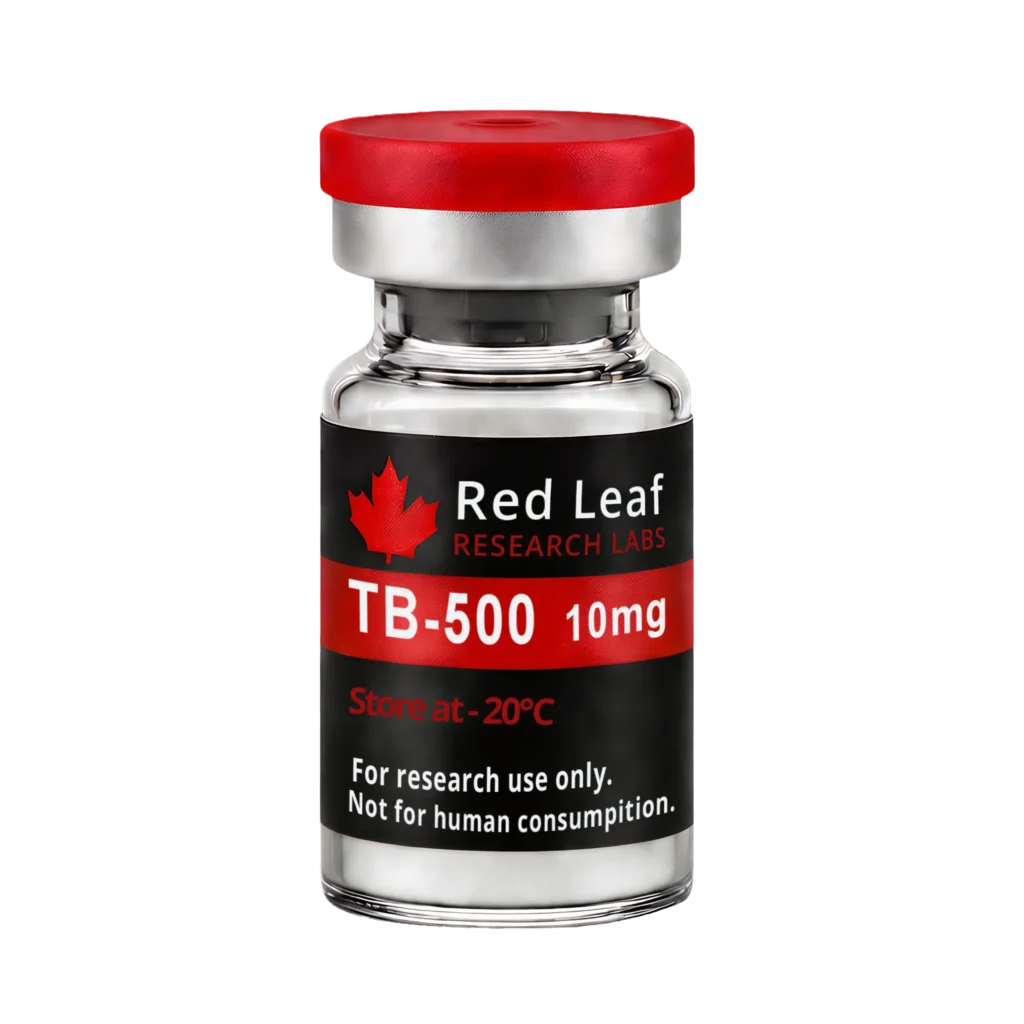
LL-37 research: quick summary
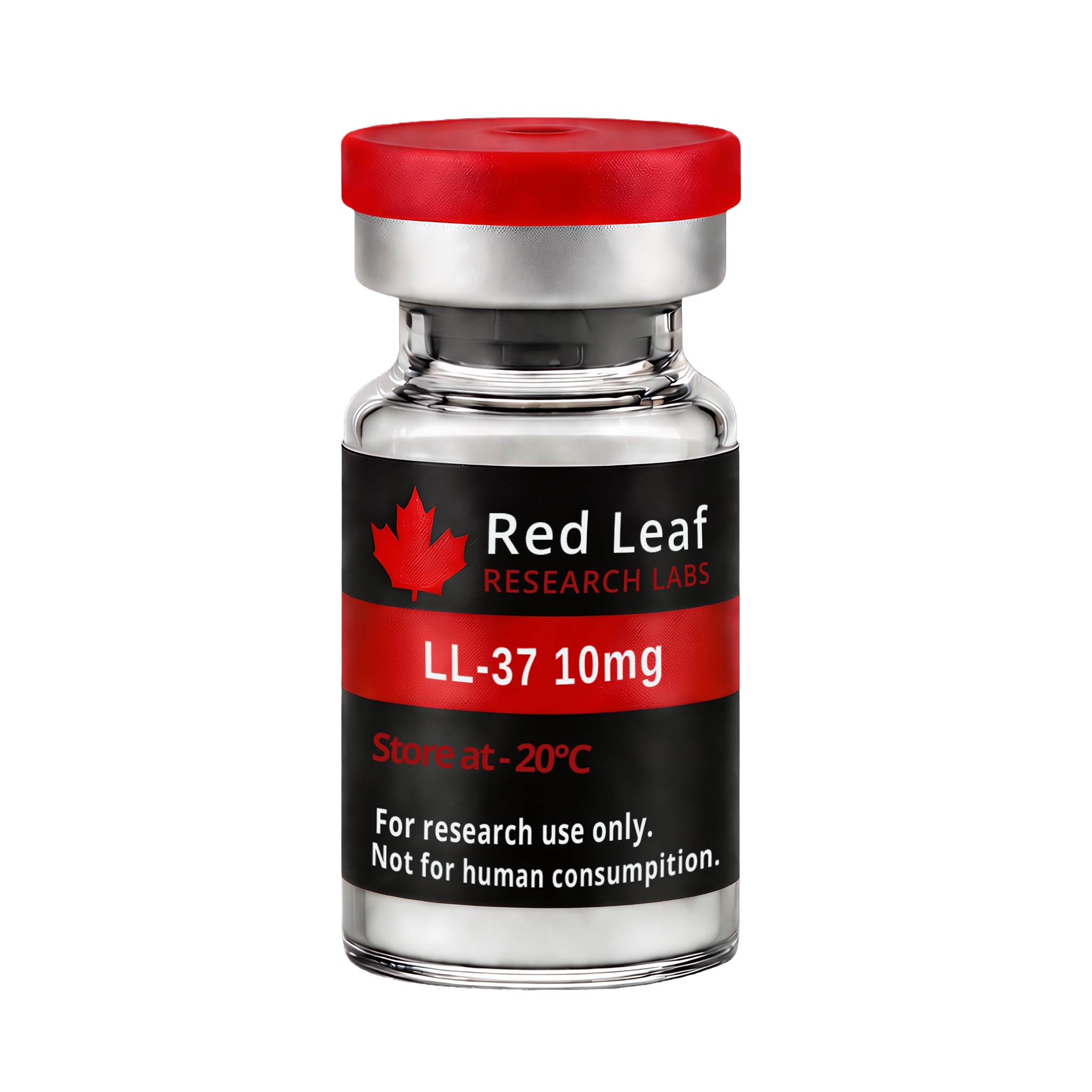
LL-37 is the 37-residue C-terminal fragment of the human cathelicidin precursor hCAP18, supplied by Red Leaf Research Labs as a 10 mg lyophilized research material. Published laboratory work describes it as a cationic amphipathic peptide studied in membrane and receptor systems. It is not an authorized medicine in Canada, is for laboratory research use only, is not for human or veterinary use, and carries no dosing or protocol information.
LL-37 Canada: LL-37 10mg Research Product
LL-37 is held by Red Leaf Research Labs in a 10 mg lyophilized fill, available to qualified laboratory purchasers in Canada. Material, current-lot paperwork and dispatch terms follow.
Traffic here arrives on buy LL-37 Canada, LL-37 peptide Canada and cathelicidin LL-37 Canada. Those strings are noted because they get typed, not because the vial serves what they suggest. A personal-health motive belongs with a clinician.
Red Leaf Research Labs supplies LL-37 as a research chemical. It is not offered for administration to people or animals, no dosing accompanies it, and no claim is made about its activity.
LL-37 10mg Research Format and Options
| Attribute | Detail |
|---|
| Research format | One vial, 10 mg LL-37, lyophilized |
| Physical state | Dried cake or powder, sealed glass vial |
| Analytical documentation | Lot-specific independent report, methods named |
| Fulfilment | Domestic carriage to research addresses |
| Intended use | Laboratory research only; not for human or veterinary use |
Ten milligrams is a packaging decision. The fill size implies nothing about how much any piece of work should use.
LL-37 Research Specifications
- Compound name: LL-37
- Alternative name(s): Cathelicidin LL-37, human cathelicidin antimicrobial peptide, hCAP18(134-170)
- Research shorthand: LL-37
- Peptide/compound class: Cathelicidin-family cationic amphipathic host-defence peptide
- Receptor or pathway interest: Anionic lipid bilayers; formyl peptide receptor 2 (FPR2/ALX) in cell studies
- Structural origin: C-terminal domain of hCAP18, the CAMP gene product, released by proteolysis; sequence LLGDFFRKSKEKIGKEFKRIVQRIKDFLRNLVPRTES
- CAS: 154947-66-7 (free base)
- Molecular formula: C205H340N60O53 (free base)
- Molecular weight: approximately 4493.3 g/mol (free base)
- Physical format: Freeze-dried solid
- Available research quantity: 10 mg per vial
- Intended use: Laboratory research use only
- Fulfilment: Canadian domestic carriage
What Is LL-37?
LL-37 is a linear peptide of 37 residues, named for the two leucines opening its sequence. The CAMP gene encodes a precursor, hCAP18, made of a conserved cathelin domain and a variable C-terminal segment; LL-37 is that segment after cleavage. Its high lysine and arginine content gives a net positive charge at neutral pH, and the structural literature describes it folding into an amphipathic alpha helix in membrane-mimetic conditions.
LL-37 is most often confused with hCAP18, the full precursor, several times its length; a report naming hCAP18 is not describing this material. Second is the defensins, a separate family of host-defence peptides, beta-sheet rich and disulfide-stabilised rather than helical. Third are truncated derivatives such as KR-12.
LL-37 and Membrane Interaction Research
Published work on LL-37 centres on how a cationic amphipathic helix behaves at a lipid interface. Studies in model bilayers have measured partitioning into membranes with anionic headgroups, helicity changes by circular dichroism on binding, and leakage from vesicle preparations. A separate strand reports engagement of formyl peptide receptor 2 in cultured cells.
All of that describes measurements in synthetic bilayers, vesicle preparations and cultured cells. Membrane interaction or receptor activity in a model does not establish that any effect occurs in a person.
Why Buy LL-37 10mg in Canada from a Domestic Research Supplier?
Time in transit is the practical case. A vial that clears customs, waits on a tarmac and then sits in a sorting hub gathers hours nobody recorded a temperature for.
The second point is who answers the telephone. Queries here are narrow: which salt form the lot was isolated as, whether 10 mg means peptide or gross weight.
Neither describes the contents of the vial. Shorter freight raises no purity and replaces no report.
How This LL-37 Canada Page Improves on Typical Competitor Listings
Many listings reuse a template and change the name. This page differs in five ways.
- The copy describes LL-37 specifically, naming its precursor, residue count and cationic character, not generic peptide language.
- The analytical basis is stated, not asserted: a report tied to the lot in stock, naming its methods.
- Nothing on this page asserts an effect, a benefit or a safety property, in hedged form or plain.
- The regulatory position is explicit: an endogenous human sequence is not an approved product; this vial is a research chemical.
- Structural relationships are named, precursor and derivatives alike, so a purchaser can see what LL-37 is not.
How to Evaluate an LL-37 Certificate of Analysis
Two features complicate this document. The sequence is long enough that deletion impurities are common, and basic enough that the counterion carries real mass.
- Compound identity: LL-37 against CAS 154947-66-7, with salt form written out, since acetate and trifluoroacetate change what a milligram contains.
- Lot reference: a lot code matching the vial, not a specimen document.
- Analysis date: the day testing ran, read against synthesis.
- Test methods: separation and identity techniques named apart; 37 residues need a gradient resolving single-residue deletions.
- Measured quantity: whether 10 mg is net peptide or gross weight with counterion and water.
- Purity result: the number, the detector, and the method behind it.
- Laboratory verification: the testing laboratory named, and whether it stands apart from the seller.
A mass near 4493 fits the free base. A higher figure probably describes a salt, and that difference should be explained rather than assumed.
LL-37 10mg Lyophilized Research Format
Freeze-drying takes the frozen material to low pressure and lets the ice leave as vapour. Amide bonds need water in order to hydrolyse, and removing it is why this format travels.
Two properties of the sequence shape what follows. Net positive charge at neutral pH is described in handling literature as promoting adsorption onto glass and polypropylene, so material can be lost to surfaces rather than to chemistry. Acetate and trifluoroacetate salts of basic peptides are also reported as hygroscopic. Storage procedures belong to the receiving institution; none are issued here.
How to Buy LL-37 in Canada for Qualified Research
- Confirm eligibility. Check that your organization may take delivery of research chemicals for lawful work.
- Review documentation. Read the current lot report, noting salt form before comparing prices.
- Select quantity. Decide how many 10 mg vials the written plan needs.
- Check shipping route. Match route and transit window to the hours goods-in is staffed.
- Record receipt. Enter lot code, arrival date and cake condition in the inventory record.
All five items are procurement and record-keeping. None is experimental guidance.
LL-37 Availability in Canada: Research vs. Consumer Searches
LL-37 is an endogenous human sequence, and that draws a particular kind of search traffic. A molecule occurring naturally in the body is not thereby an approved product, and a synthetic vial of that sequence is not a supplement, a cosmetic ingredient or a medicine. It has not been assessed by Health Canada for use in a person.
Peptides of this family have appeared in early-stage investigational programmes, so the name occurs in clinical literature. Those involve specified formulations made to pharmaceutical standards under oversight. The vial here is a reagent, not a version of any such product. A personal-health interest in LL-37 belongs with a licensed clinician.
LL-37 10mg Canada Procurement Checklist
| Check | What to confirm |
|---|
| Purpose | Laboratory research in an eligible organization |
| Identity | CAS 154947-66-7 on label and report, salt form written out |
| Distinctness | The 37-residue fragment, not hCAP18, a defensin or a KR-12 truncation |
| Quantity | Vial count, and whether 10 mg means peptide content |
| Documentation | Lot-specific report naming the method behind each figure |
| Verification | Independent re-analysis decided before the order is placed |
| Handling | Containers and storage settled in advance, the peptide being adsorptive |
Explore LL-37 Research Information
Background reading: how peptides work, research peptide terminology, and third-party testing.
LL-37 research FAQ
Does Red Leaf Research Labs provide dosing information?
No. No dosing information, reconstitution volume, concentration, route or protocol is provided for this or any product.
Working out concentration for this vial? Our peptide reconstitution calculator converts vial size and bacteriostatic water volume into mg per mL and U-100 syringe units.
Is LL-37 the same as cathelicidin?
Not exactly. Human cathelicidin refers to the hCAP18 precursor and its processed products; LL-37 is its 37-residue C-terminal fragment.
What is the difference between LL-37 and KR-12?
KR-12 is a shorter construct derived from part of the LL-37 sequence, with a different molecular weight and identifier.
What documentation comes with the 10mg vial?
A third-party report covers the lot in stock, keyed to its lot code and naming the techniques used.
Can Red Leaf Research Labs advise on experimental design?
No. Choice of model, working concentrations, controls and endpoints all rest with the buyer.
Research use only. LL-37 10 mg is supplied strictly for laboratory research. It is not an authorized medicine in Canada, is not for human or veterinary use, and carries no dosing or protocol information. A personal-health question about cathelicidin peptides belongs with a licensed clinician.


 Owned and operated by a cf veteran