
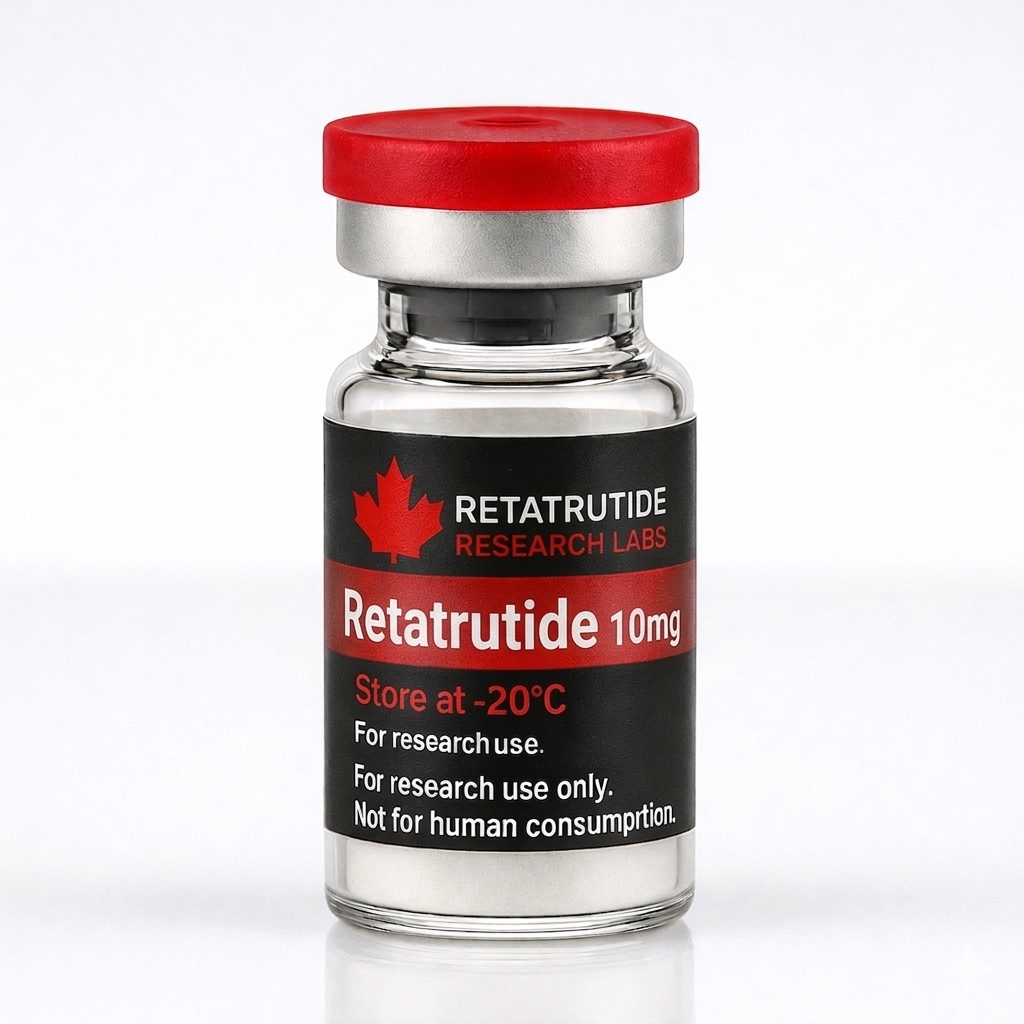
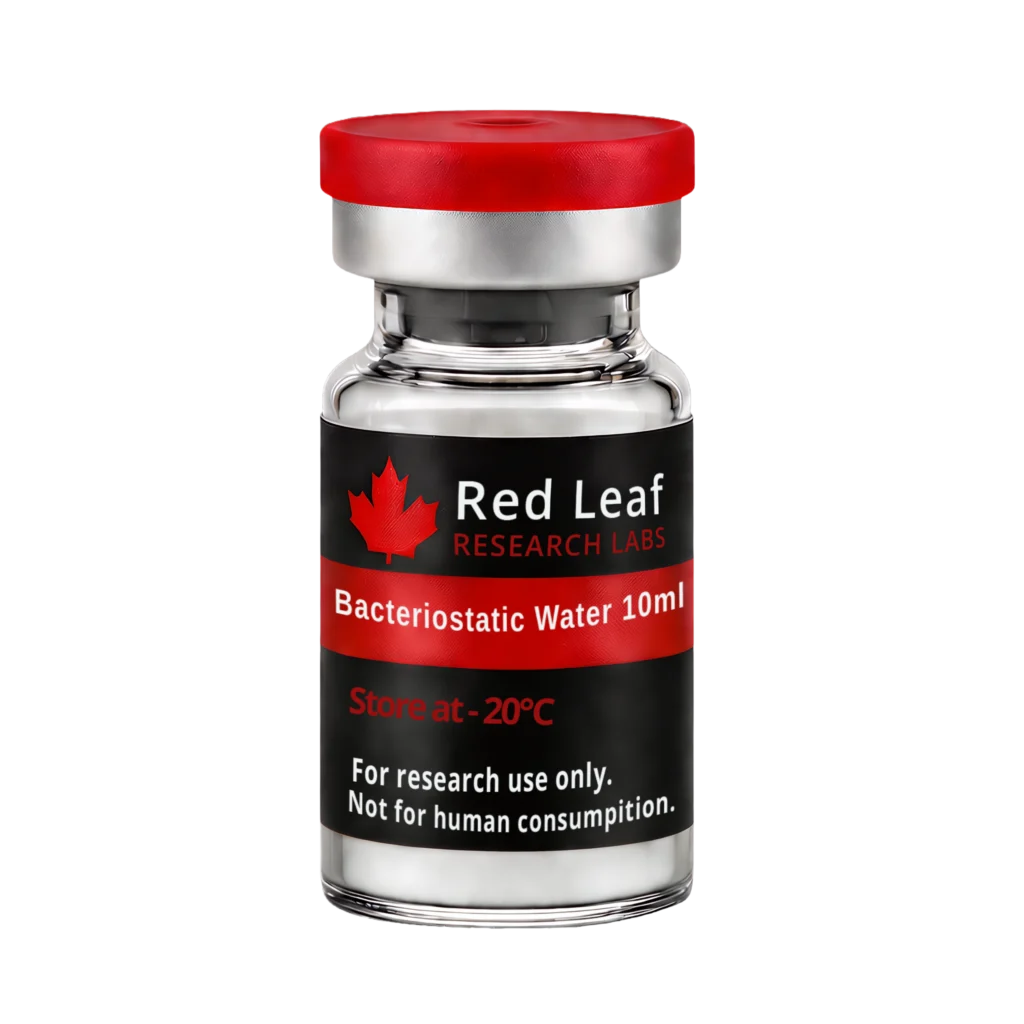
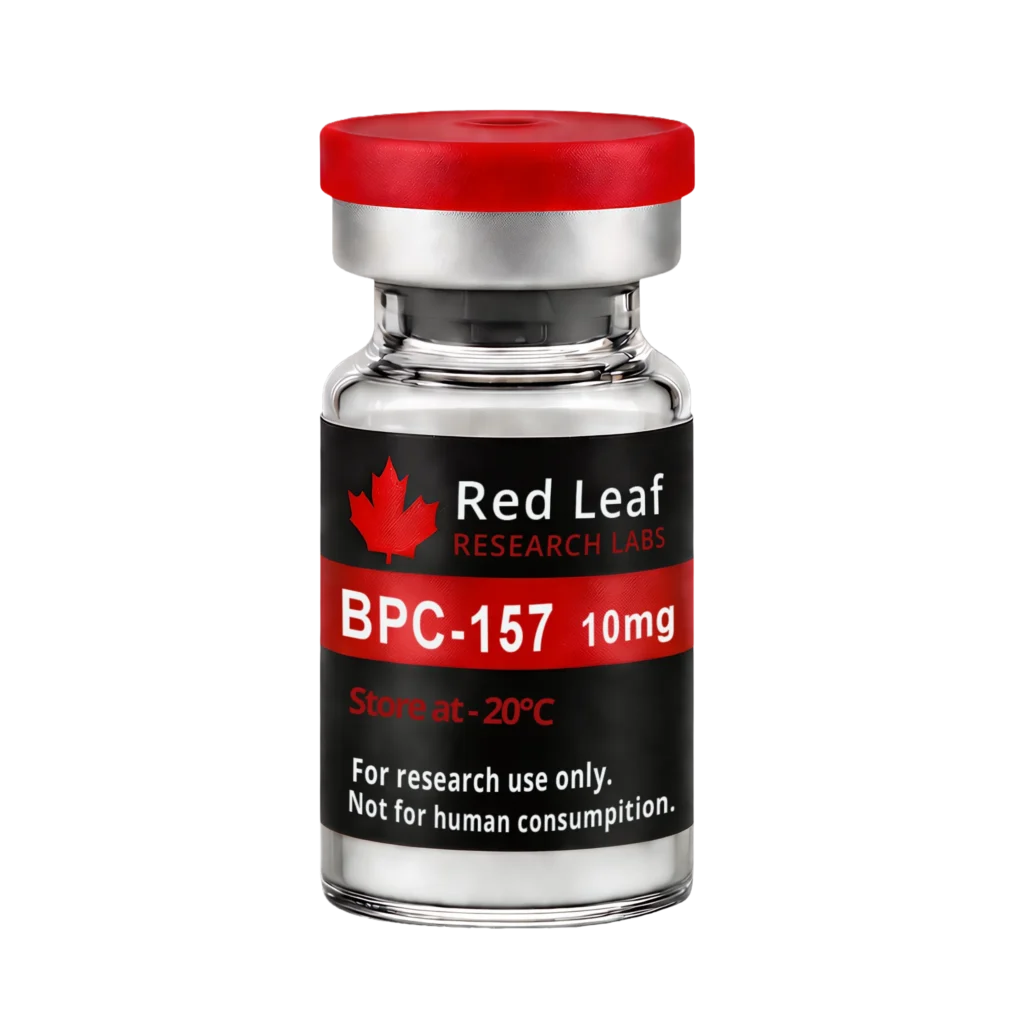

Red Leaf Research Labs is a Canadian research peptide supplier. We ship peptides across Canada from inside the country, so nothing crosses a border on the way to you. Every batch is tested by an independent laboratory, and the report sits on the product page where you can open it and check it against the lab's own copy.
If you are looking for where to buy peptides in Canada, the short answer is that you have three routes: a Canadian supplier, an overseas supplier, or a compounding pharmacy with a prescription. Each one behaves differently on price, on shipping time, and on how easily you can verify what is in the vial. This page walks through all three, then explains exactly what to check before you buy from any of them.
Everything on this site is supplied strictly for laboratory research use. It is not sold for use in humans or animals, and you will not find dosing instructions anywhere on it.
Tested by an outside labEvery batch goes to a third-party lab. We do not test our own product.
Reports you can verifyEach product page links to the lab's own copy, not a PDF we typed.
Ships from CanadaDomestic courier. No customs, no border holds, no seizure risk.
Free express over $350Tracked express shipping to every province and territory.
100%of batches tested by an outside laboratory
1–3business days express to most Canadian addresses
$350order value for free tracked express shipping
0borders crossed — every order ships domestically
Where to buy
Where to buy research peptides in Canada
People searching for peptides Canada, Canadian peptides or peptides for sale in Canada usually land in the same place: a wall of near-identical websites, all claiming the same purity, none of them explaining how you would ever check. So here is the honest map of the options first.
Route oneA Canadian research supplier
Ships inside Canada. No customs, no border, no seizure risk. Delivery is measured in days, not weeks.
You can usually see the lab report before you pay, and there is a real company you can reach if something goes wrong.
This is what Red Leaf is.
Route twoAn overseas supplier
Often cheaper on the sticker price. Then add shipping time, currency conversion, and the chance the parcel is held at the border.
The bigger problem is verification. A lab report from a company you cannot phone, for a lab you cannot look up, is a picture of a document.
Route threeA pharmacy, with a prescription
This is the medical route and it is a completely different thing. It starts with a doctor, not a website.
If what you want is treatment rather than research material, this is the only route that makes sense, and no research supplier should tell you otherwise.
For anyone comparing the best place to buy peptides online in Canada, the deciding factor is almost never the price on the listing. It is whether you can independently confirm what arrived. Two vials at the same price are not the same purchase if only one of them comes with a report you can verify at the source.
What makes a Canadian peptide supplier worth using
There are a lot of Canadian peptide sites. Most of them look the same. The differences that actually matter are small and boring, and they are the ones below.
- Third-party testing, not in-house testing. A company testing its own product and grading itself is not evidence. The report should come from a laboratory with no financial interest in the result.
- Batch-matched reports. A report for a different batch tells you nothing about the vial you were sent. The batch number on the report should match the batch you are buying.
- Verification at the lab, not at the seller. Good labs let you look a report up on their own website. If the only copy lives on the seller's server, it is unverified by definition.
- Domestic shipping. A Canadian address on the website is not the same as a Canadian warehouse. Ask where the parcel actually ships from.
- No outcome claims. The moment a research supplier starts describing what a compound will do to a person, it has stopped being a research supplier.
- A reachable company. A name, a location, and a way to speak to someone. This matters most on the day an order goes wrong.
A note on price. Cheap peptides in Canada are not automatically bad, and expensive ones are not automatically good. Price tells you almost nothing on its own. A low price with no lab report is not a bargain, it is an unknown. A high price with no lab report is worse.
Before you order
What to check before you buy peptides from anyone
This section applies whether you buy from us or not. Run these five checks on any peptide supplier in Canada and most of the noise disappears.
- 1Is there a certificate of analysis at all? A real report from a laboratory that is not the seller. If there is no report, you are trusting a printed label and nothing else.
- 2Does the report match the batch you are buying? Check the batch or lot number on the report against the one on the listing. A report for some other batch is decoration.
- 3Can you verify it yourself, at the lab? The good laboratories publish a lookup on their own site. A link that loops back to the seller's own server is not verification.
- 4Does the page make claims about results in a body? Research material is sold for laboratory work. If a page is telling you what it will do to a person, treat everything else on that page with suspicion.
- 5Is there a real company behind it? A business name, a location, and a way to reach a person. Anonymous storefronts are anonymous for a reason.
Every Red Leaf product page carries its own report with a verification link so you can check it at the laboratory rather than with us. The complete set is on our independent testing and certificates of analysis page.
Green flags and red flags
If you only remember one part of this page, make it this one. These are the signals that separate a supplier worth using from one worth closing the tab on.
Green flags
- A batch-specific certificate of analysis, published before you buy
- A named third-party laboratory you can look up independently
- A verification link that resolves at the laboratory, not the seller
- Both HPLC purity and mass spectrometry identity on the report
- A clearly stated Canadian shipping origin
- A named company with a real point of contact
- Research-use-only language applied consistently, not buried in a footer
Red flags
- No certificate of analysis, or one with no laboratory named
- A single generic report reused across every product
- Batch numbers that do not match the report
- Any claim about what a compound will do in a person
- Dosing charts, protocols or before-and-after photographs
- No company name, no address, no way to reach a human
- Prices far below everyone else with no explanation of why
Two vials at the same price are not the same purchase if only one of them comes with a report you can verify at the source.
The one rule worth carryingHow to read a certificate of analysis
A COA looks intimidating and mostly is not. There are four things on it worth your attention, and the rest is instrument settings.
1. The identity line
Does the report name the compound you ordered? Sounds obvious. It is the most common thing that quietly does not match.
2. The purity figure
Usually given as a percentage from HPLC. Anything above 98% is good. The figure matters far less than whether an independent lab produced it.
3. The mass result
Mass spectrometry confirms the molecule weighs what that peptide should weigh. This is the check that catches a substitution.
4. The batch and the date
The batch number ties the report to your vial. The date tells you the report is not five years old and recycled.
Anatomy of a certificate of analysis
Here is what you are actually looking at when you open a report, and what each line is doing.
Certificate of AnalysisThird-party laboratory
1Product identityCompound name as ordered
2Purity, by HPLCReported as a percentage
3Identity, by mass spectrometryMeasured mass vs expected mass
4Batch or lot numberMust match the vial you receive
5Laboratory and dateWho tested it, and when
- 1
Identity lineDoes it name the compound you ordered? This is the most common mismatch, and the easiest to miss because it looks like a formality.
- 2
Purity figureHow much of the material is that one substance. Useful, but only as trustworthy as the laboratory that produced it.
- 3
Mass resultConfirms the molecule weighs what it should. This is the check that catches a substituted compound.
- 4
Batch numberTies the report to your vial. Without a match, the report describes somebody else's material.
- 5
Laboratory and dateA named lab you can look up, and a date recent enough to belong to this batch rather than a recycled one.
Illustration only. The panel above shows the structure of a report, not a real result. Every Red Leaf product page carries its own genuine certificate with a link to the laboratory's own copy.
If you want to see this on a real document rather than in the abstract, open any product on the site and scroll to its report. The full catalogue is on one page.
Getting it to you
Delivery and packaging across Canada
Orders leave from inside Canada. That single fact removes the two things that go wrong most often with peptides ordered online: customs holds and long international transit. A parcel going to Halifax and a parcel going to Victoria travel on the same domestic network.
| Option | Typical transit | Tracking | Cost |
|---|
| Express | 1 to 3 business days to most addresses | Yes, from dispatch | Free on orders over $350 |
| Standard | 2 to 7 business days depending on province | Yes | Flat rate at checkout |
Express is the right choice for anything temperature-sensitive or anything you need on a schedule. Standard is fine for a restock. Remote and northern addresses add a day or two on either option, which is a function of the courier network rather than of us.
What the packaging looks like
- Plain outer packaging. No branding, no product names, nothing on the outside that describes the contents.
- Vials protected individually. Each one is wrapped so it is not moving around inside the box.
- Temperature-controlled materials where the compound needs them. Not on everything, because not everything needs it, and pretending otherwise is theatre.
- Free reusable hard-shell casings on orders that warrant them, so vials survive the courier network rather than merely leaving here intact.
- Tracking sent when the parcel moves, not when the order is placed.
Why domestic shipping matters more than it sounds. A parcel crossing into Canada can sit at a facility for days at an unpredictable temperature, and can be opened or held. A domestic parcel does none of that. It is the least glamorous advantage of buying peptides in Canada and probably the most practical one.
The catalogue
Shop research peptides by category
The catalogue is organised by research area. Every product in every category ships from Canada with its own third-party report.
Metabolic & GLP-1Retatrutide, Tirzepatide, Semaglutide, Cagrilintide and related metabolic research compounds.
Growth Hormone SecretagoguesCJC-1295, Ipamorelin, Tesamorelin, HGH and GH research blends.
Repair & ImmuneBPC-157, TB-500, Thymosin and the repair-focused research material.
Longevity & CellularEpitalon, NAD+, MOTS-c and cellular research compounds.
Cognitive & SleepSemax, Selank, DSIP and nootropic research peptides.
Sexual & Hormonal HealthPT-141, Kisspeptin and hormonal research compounds.
Skin & CosmeticGHK-Cu, Melanotan and dermal research material.
Supplies & SolventsBacteriostatic water and laboratory consumables.
Best-SellingThe compounds Canadian researchers reorder most often. If you would rather see everything at once, the full catalogue sits on one page with search and filtering, and the peptide calculator does the reconstitution arithmetic for you.
By location
Buying peptides in Toronto, Calgary, Vancouver and elsewhere
People search by city out of habit, and it is worth saying plainly that in this case the city usually changes nothing.
Research peptides are shipped, not collected. There is no counter to walk up to and no "peptides near me" storefront to visit. An order to Toronto, Calgary, Vancouver, Edmonton, Montreal, Ottawa, Winnipeg, Halifax or Victoria goes out on the same day and travels on the same domestic courier network.
| Destination | Express, typical | Standard, typical |
|---|
| Toronto & the GTA | 1 to 2 business days | 2 to 4 business days |
| Montreal & Quebec | 1 to 2 business days | 2 to 4 business days |
| Calgary & Edmonton | 1 to 3 business days | 3 to 5 business days |
| Vancouver & the Lower Mainland | 1 to 3 business days | 3 to 5 business days |
| Ottawa, Winnipeg, Halifax | 2 to 3 business days | 3 to 6 business days |
| Northern & remote addresses | 3 to 5 business days | 5 to 8 business days |
Transit estimates are courier figures for business days after dispatch and exclude weekends and holidays.
Every province and territory
Coverage is national. There is nowhere in Canada we do not ship, and the province does not change the price of shipping.
BCBritish Columbia
ABAlberta
SKSaskatchewan
MBManitoba
ONOntario
QCQuebec
NBNew Brunswick
NSNova Scotia
PEPrince Edward Is.
NLNfld. & Labrador
YTYukon
NTNorthwest Terr.
NUNunavut
So the practical answer to "where can I buy peptides in Calgary" or "where to get peptides in Toronto" is the same answer for both: order from a supplier that ships domestically, and the city stops mattering.
The legal question
Are peptides legal in Canada?
This is the question underneath most peptide searches, so here is the plain version.
Research peptides sold for laboratory use are not prohibited in Canada. They are sold as research chemicals, for in-vitro laboratory work, and they are not sold as medicines.
The same compounds sold for human use are a different matter entirely. Selling a peptide for people to take, making health claims about it, or supplying it as a treatment without authorisation is not permitted. Several of these compounds are prescription drugs in Canada when they are sold for medical use, and Health Canada has issued public warnings about products marketed as unapproved treatments online.
That line is the entire basis on which this catalogue exists. It is also why you will not find dosing charts, protocols, before-and-after photographs or outcome claims anywhere on this site, and why any research supplier that does publish them should worry you rather than reassure you.
The short form. Buying research peptides in Canada for laboratory work is not illegal. Selling or buying them as medicine, without authorisation, is a different activity with different rules. If you want a compound as a treatment, the route is a physician.
Pricing
What research peptides cost in Canada
Prices vary enormously across the Canadian market, and the spread usually has less to do with quality than people assume. Three things drive the number.
How hard the molecule is to make
A five amino acid chain and a 191 amino acid protein are not comparable manufacturing problems. Longer and more complex means more expensive, every time.
Whether testing is being paid for
Independent testing costs money per batch. A supplier not paying for it has a real cost advantage and no way to prove anything.
Where it ships from
Domestic stock carries inventory cost. Drop-shipping from overseas does not, which is why the cheapest listings are usually the ones with the longest delivery times.
Compare on cost per milligram rather than on the price of the vial. A 10mg vial at $59 and a 5mg vial at $79 are not close, even though the second one looks like a small step up. Read the size before you read the price.
Comparison
Red Leaf compared with overseas peptide suppliers
Most of the peptide listings a Canadian buyer finds online are not Canadian. They are overseas operations with a Canadian-sounding name, and the difference only becomes obvious after you have paid. Here is the comparison laid out honestly, including the places where an overseas supplier genuinely wins.
| Canadian supplier | Overseas supplier |
|---|
| Sticker price | Higher | Often lower |
| Delivery time | 1 to 7 business days | 2 to 6 weeks, sometimes longer |
| Customs risk | None, the parcel never leaves Canada | Real, and the loss is yours |
| Temperature in transit | Days, domestic network | Weeks, uncontrolled, often unknown |
| Lab report | Batch-matched, verifiable at the lab | Often generic, often unverifiable |
| If something is wrong | A company in your jurisdiction | An email address that may not reply |
| Currency | Canadian dollars, no conversion | Conversion plus card foreign-transaction fees |
The fair summary is that overseas suppliers win on headline price and lose on almost everything else. Whether that trade is worth it depends entirely on how much the material matters to your work. If a failed batch costs you a month, the cheaper vial was not cheaper.
The hidden costs people forget to add
- Currency conversion and card fees. A price quoted in USD lands on a Canadian card two to five per cent higher than the number on the screen.
- Reshipping after a lost parcel. Some suppliers reship, many do not, and the ones that do build that cost into the next order.
- Time. Six weeks of waiting is a real cost if the work is on a schedule.
- Re-testing. If you cannot verify the supplier's report, you either trust it or pay a laboratory yourself. One independent test costs more than the saving on most vials.
After it arrives
Storing research peptides after delivery
How material is handled after it arrives matters as much as how it was made. A well-made peptide stored badly is no longer a well-made peptide.
Before reconstitution
Lyophilised peptide, the dry powder in the vial, is the stable form. Kept cold, dark and sealed, it is durable. The two things that degrade it are moisture and repeated temperature swings, which is why a vial that has been in and out of a fridge a dozen times is in worse shape than one that was simply left cold.
After reconstitution
Once a peptide is in solution it becomes considerably less stable, and the clock starts. Solution stability varies by compound, which is exactly why no single storage instruction applies across a catalogue and why we do not publish one.
A boundary worth restating. We supply material and its documentation. We do not publish protocols, dosing, or preparation instructions, because doing so would mean describing use rather than supplying research material. Laboratories should follow their own validated procedures.
What to do the moment a parcel arrives
- Check the packaging before you open it. Note any damage, and photograph it if there is any.
- Confirm the batch numbers on the vials against the certificates of analysis for those batches.
- Record what you received — supplier, identity, batch, date received, packaging condition and storage location.
- Get it into storage promptly rather than leaving the box on a bench for a day.
Purity
What purity figures actually mean
Every peptide website in Canada advertises high purity. The figures are almost identical across sites, which should tell you that the number by itself is not doing much work.
Why 99% is not a guarantee
A purity percentage answers one narrow question: of the material in this vial, what proportion is the peptide named on the label? It does not tell you what the other one per cent is. It does not tell you whether the batch tested is the batch you received. And it certainly does not tell you anything if the number was typed by the seller rather than produced by a laboratory.
This is why the identity of the testing laboratory matters more than the digits. A 98% figure from an independent lab you can look up is worth considerably more than a 99.9% figure from nobody in particular.
HPLC and mass spectrometry, in plain terms
HPLC answers "how much"
High-performance liquid chromatography separates everything in the sample and measures the proportions. It produces the purity percentage. It is good at telling you how much of the material is one single substance.
Mass spec answers "what"
Mass spectrometry weighs the molecule. If the weight matches what that peptide should weigh, the identity is confirmed. This is the test that catches a substituted compound, which HPLC alone would not.
A complete report has both. A report with only a purity figure has confirmed how much of something is present without confirming what it is.
Getting it wrong
Common mistakes when buying peptides online in Canada
These come up constantly, and every one of them is avoidable.
- Buying on price alone. The cheapest listing is usually cheapest because something was skipped, and testing is the easiest thing to skip.
- Accepting a report that does not name a laboratory. A document with no lab on it is a design exercise.
- Not checking the batch number. A genuine report for a different batch is extremely common and tells you nothing.
- Assuming a .ca domain means a Canadian warehouse. A domain costs a few dollars. Ask where it ships from.
- Trusting a site that makes outcome claims. A supplier willing to break that rule is telling you what it is willing to do.
- Comparing vial prices instead of cost per milligram. Sizes vary far more than prices do.
- Ordering a large quantity first. Order once, verify the documentation, then scale up.
Who buys
Who buys research peptides in Canada
The catalogue serves a narrower group than the search volume suggests.
Academic and institutional laboratories
University and hospital research groups working on signalling, metabolism and cellular pathways, who need documentation that satisfies an institutional record-keeping requirement.
Independent and commercial research
Private laboratories and R&D groups running in-vitro work, where batch consistency across repeat orders matters more than the price of any single vial.
Analytical and reference use
Laboratories that need a characterised reference material with a verifiable certificate of analysis attached to a known batch.
If you are not in one of those groups and you are looking for a treatment, this catalogue is not the right place, and the honest answer is that a physician is.
Plain English
Peptide terms, translated
The vocabulary around research peptides is doing a lot of work to sound more complicated than it is. Here is the short version of the words you will meet while shopping.
- Research use only (RUO)
- Sold for laboratory work. Not a medicine, not approved for people or animals, and not sold for that purpose.
- Certificate of analysis
- A laboratory's report on a specific batch: what it is, how pure it is, and when it was tested.
- HPLC
- High-performance liquid chromatography. Separates the sample and measures proportions. Produces the purity percentage.
- Mass spectrometry
- Weighs the molecule to confirm identity. Catches substitutions that a purity figure alone would not.
- Lyophilised
- Freeze-dried. The stable powder form a peptide arrives in, before anything is added to it.
- Reconstitution
- Adding a solvent to the powder to put it into solution. Stability drops once this happens.
- Bacteriostatic water
- Water with a preservative added, used as a solvent in laboratory work.
- Batch or lot
- One production run. Reports are batch-specific, which is why the number has to match.
- Secretagogue
- A compound that signals the body to release something it already makes, rather than supplying it directly.
- Peptide vs protein
- Both are amino acid chains. Peptides are the short ones. There is no hard boundary, and the distinction is mostly one of size.
Ordering
How ordering works
1
Choose your compoundBrowse by research category or search the full catalogue on one page.2
Open the lab reportCheck the batch, the purity figure and the verification link before you pay, not after.3
Check outExpress is free over $350. Standard is a flat rate. Both are tracked.4
Track it to your doorTracking is emailed when the parcel actually moves. Domestic transit, no border.Why Red Leaf
Why buy research peptides from Red Leaf Research Labs
We are Canadian-owned and operated, run by a former Canadian Armed Forces member who has been in business since 2005. That is not a marketing line, it is why the operation is built the way it is: verifiable documentation, domestic stock, and a person who answers when something goes wrong.
Independent testing on every batch
Batches are tested by an outside analytical laboratory. We do not grade our own homework, and the batch-specific report is published with the product so you can read it before ordering.
Canadian stock, Canadian dispatch
Orders ship domestically by express courier. Nothing crosses a border on the way to you, which removes customs delay and seizure risk entirely.
Consistent synthesis, documented
Every batch is produced under controlled synthesis and independently tested for purity, so batch-to-batch consistency is something you can check rather than something you are asked to believe.
Real support, from a real person
Ally handles Canadian orders and customer support directly. Baba Kahn oversees international operations, logistics and laboratory coordination.
Professional pricing where it applies
Discounted pricing may be available to eligible subject-matter experts, physicians, nurses, cosmetologists, emergency-service workers and Canadian Armed Forces members.
No claims we cannot support
No dosing charts, no protocols, no outcome promises. Research material is sold as research material, and that boundary is the reason the catalogue can exist.
Everything else
Frequently asked questions
Every question we get asked, in one place.
Buying and shipping in Canada
Where can I buy research peptides in Canada?
From a Canadian research supplier that publishes independent lab reports and ships domestically. Red Leaf Research Labs is one. The test that separates suppliers is not price, it is whether you can verify a batch report at the laboratory rather than only on the seller's own website.
You can browse the full catalogue on one page with search and filtering.
Where do you ship from, and where are Canadian orders dispatched?
Orders are shipped domestically from within Canada by express courier. Nothing crosses an international border on the way to you, so there is no customs delay and no seizure risk.
How long does delivery take across Canada?
Express is typically one to three business days to most Canadian addresses, and it is free on orders over $350. Standard is typically two to seven business days depending on province. Northern and remote addresses add a day or two on either option.
Do you ship to every province and territory?
Yes. Orders go to every province and territory in Canada, including northern and remote addresses.
Can I buy peptides in Toronto, Calgary, Vancouver, Montreal or Edmonton?
Yes, and the city makes no practical difference. Research peptides are shipped rather than collected, so there is no counter to visit. An order to any major Canadian city travels on the same domestic courier network and arrives on the same timetable.
Will I receive order updates and a tracking number?
Yes. Tracking information is emailed after an order has been processed and shipped, so the number is live when you receive it rather than pending for days.
What packaging will my order arrive in?
Plain outer packaging with no branding or product names on the outside. Vials are individually protected, temperature-controlled materials are used where a compound requires them, and reusable hard-shell casings are included on orders that warrant them.
Do you offer professional or service-member discounts?
Discounted pricing may be available to eligible subject-matter experts, cosmetologists, physicians, nurses, emergency-service workers and members of the Canadian Armed Forces. Eligibility and identification requirements apply. Contact Ally through WhatsApp to ask about it.
Testing, quality and certificates of analysis
Are your research peptides independently tested?
Yes. Batches are tested for purity by an independent analytical laboratory, not in-house. Where available, the batch-specific certificate of analysis is displayed with the product images so you can review the testing data before ordering.
Does Red Leaf provide certificates of analysis?
Yes. COAs are published on the product pages, and the complete set is on our independent testing and certificates page. Each report carries a verification link so you can confirm it at the laboratory rather than with us.
How do you ensure batch-to-batch consistency?
Each batch is produced using controlled synthesis processes and independently tested for purity. The batch-specific report is published with the product, so consistency is documented rather than asserted.
How should a Canadian laboratory evaluate peptide quality?
Check four things on the certificate of analysis: that the identity line names the compound you ordered, that the purity figure comes from an independent laboratory, that the mass spectrometry result matches the expected molecular weight, and that the batch number and date tie the report to the vial in front of you.
How does Red Leaf Research Labs ensure product quality?
Controlled synthesis, independent third-party purity testing on each batch, batch-specific documentation published before purchase, and domestic storage and dispatch so material is not sitting in an uncontrolled environment at a border facility.
Why do product labels sometimes look different?
Labels may vary because of changes to our printing equipment or the temporary use of labels produced by an affiliated Red Leaf Research Labs company. These cosmetic differences do not necessarily indicate a change to the product. Contact customer support if you need help confirming a label.
What records should a laboratory keep?
Record the supplier, product identity, batch or lot details, date received, packaging condition, storage location and the relevant analytical documentation, according to the laboratory's own procedures.
Products and handling
What are research peptides?
Research peptides are short chains of amino acids used in laboratory studies involving biological pathways, cellular signalling and other biochemical processes. Red Leaf Research Labs supplies high-purity peptides strictly for research use only. They are not intended for human consumption, medical treatment, diagnosis or veterinary use.
How do I choose the correct research peptide?
Start from the research question rather than from the product list. Browse by category, read the compound's documentation, and check that the batch report matches what you need. We cannot select a compound for you, because that would require knowing your protocol.
Why might a research peptide become cloudy or change colour after reconstitution?
Cloudiness, discolouration or texture changes can result from solvent compatibility, concentration, temperature, storage conditions or handling. Different research compounds may require different validated laboratory protocols, so do not assume that one preparation method is appropriate for all of them.
Do you provide tutorials or usage instructions?
No. Red Leaf Research Labs supplies compounds for research use only and does not provide medical advice, dosing information or instructions for human or veterinary use. Researchers should rely on validated protocols from their own institution.
Are research peptides sold for human use?
No. Everything on this site is supplied strictly for in-vitro laboratory research. Nothing here is a drug, a food, a cosmetic or a supplement, and nothing here is sold for use in humans or animals.
Legal and company
Are peptides legal in Canada?
Research peptides sold for laboratory use are not prohibited in Canada. Selling the same compounds for human use, or making health claims about them, is a different activity and is not permitted without authorisation. Several of these compounds are prescription drugs in Canada when supplied for medical use. If you want a compound as a treatment, the route is a physician, not a website.
Who owns Red Leaf Research Labs?
Red Leaf Research Labs is Canadian-owned and operated by a former Canadian Armed Forces member who has been in business since 2005. Ally, our Canadian Customer Service Manager, handles customer and order support. Baba Kahn oversees international operations, logistics and laboratory coordination.
What websites are affiliated with Red Leaf Research Labs?
PeptideFactoryCanada.com and PurpleMoonPeptides.com are affiliated backup websites operated by Red Leaf Research Labs. They help maintain access to our products and customer-support resources if one of our websites is temporarily unavailable.
What countries does Red Leaf Research Labs work with?
Red Leaf Research Labs conducts business with organizations and suppliers in Canada, the United States, the Netherlands, China, the Cayman Islands, Denmark, the United Arab Emirates, Sri Lanka and Pakistan. Product availability, shipping and service options may vary by location.
Who should I contact about an order or product issue?
For Canadian orders and customer-support issues, contact Ally through the WhatsApp button available throughout the website. Include your order number and a brief description of the issue. Please do not send payment details or other sensitive information through WhatsApp.
Every compound ships from Canada with an independent lab report you can verify yourself.
All products supplied by Red Leaf Research Labs are intended strictly for in-vitro laboratory research use. They are not drugs, foods, cosmetics or supplements. They are not intended to diagnose, treat, cure or prevent any disease or condition, and they are not for use in humans or animals. Nothing on this page is medical advice. Purchasers are responsible for ensuring their use of these materials complies with all applicable laws and institutional requirements.