Owned and operated by Baba Kahn, a CF veteran

Oxytocin, depression and social bonding: what is the real link? The oxytocin peptide is a tiny hormone your body makes, and scientists study it for mood and bonding. This oxytocin peptide guide for Canada explains what the research shows and how to buy it for lab use. Plain words and lots of pictures.
- 9 building blocks
- 1953 first made in a lab
- 42 trials in one 2026 review
- 0 approvals for depression
Oxytocin is a small peptide hormone made of 9 amino acids. Your brain makes it, and it helps the womb squeeze during birth and helps milk flow during breastfeeding.
It is often called the “love hormone” because animal studies link it to bonding. However, many exciting human results did not hold up when other scientists repeated them.
For depression, however, the picture is mixed. A few small studies look hopeful, but a 2026 review of 42 trials found no clear overall benefit. So it is not a treatment for depression.
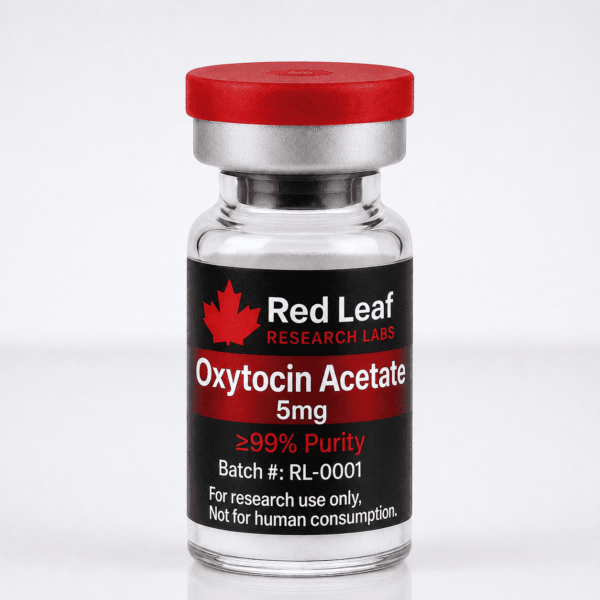
In Canada, oxytocin is an approved hospital medicine, but only for birth. Red Leaf also sells oxytocin acetate 5mg as a dry research powder, for lab use only.
What is the oxytocin peptide?
Think of a peptide like a short bracelet of beads. Each bead is an amino acid. In other words, amino acids are the small parts that build every protein in your body.
The oxytocin peptide has just 9 beads. However, it has a special shape. Two of its beads hold on to each other with a sulfur bridge, so six beads form a ring. The last three hang off like a tail.
Each bead is one amino acid, shown by its one-letter code. Also, this is a simple drawing, not to scale.
Because it is so small, oxytocin is easy to make in a lab today. In fact, it was the first peptide hormone that scientists ever built from scratch, back in 1953.
Where does the oxytocin peptide come from in the body?
Oxytocin is made in a small part of the brain called the hypothalamus. Then it travels a short way down to the pituitary gland, which releases it into the blood.
From the blood, it then reaches the womb and the breasts. At the same time, oxytocin also works inside the brain, where scientists think it helps with social signals and stress.
A simple drawing. In fact, the hypothalamus and pituitary sit deep in the brain, just behind your eyes.
The name comes from Greek words that mean “quick birth”, because its first known job was to speed up labour.
What does the oxytocin peptide do?
Oxytocin has a few clear jobs and a few that are still being studied. So here they are, from best known to least known.
Birth
It makes the womb squeeze during labour. In fact, that is where its name comes from.
Breastfeeding
It helps push milk out when a baby feeds. This is called the let-down reflex.
Parent and baby
It is released during skin-to-skin contact. So scientists link it to early bonding.
Bonds between mates
In some animals, for example prairie voles, it helps pairs stay together.
Social signals
It may help the brain notice faces and feelings. However, human results are mixed.
Stress and mood
Some studies link it to calmer stress responses. This is also why depression researchers study it.
Oxytocin peptide and social bonding
The story of oxytocin and social bonding started with a small animal called the prairie vole. Prairie voles pick one partner and usually stay together for life. Their cousins, montane voles, however, do not.
A simple drawing. Prairie voles have more oxytocin receptors in the brain’s reward areas than montane voles.
Then, in the 1990s, scientists found that prairie voles have more oxytocin receptors in the brain’s reward areas. A receptor is like a lock, and oxytocin is the key. When scientists blocked oxytocin in female prairie voles, they did not bond with a partner as usual.
But in 2023, there was a twist. Scientists bred prairie voles with no working oxytocin receptors at all, and these voles still paired up and cared for their pups. So oxytocin matters, but other brain systems can also do the job.
Oxytocin, dogs and hugs
Here is a fun one. For example, in a 2015 study from Japan, dogs and their owners gazed into each other’s eyes. Afterwards, oxytocin went up in both the dogs and the owners.
Based on a 2015 study from Japan. However, wolves raised by people did not show the same loop.
Similarly, a 2005 US study found that women who got more hugs from their partners had higher oxytocin levels. Also, mothers release oxytocin during skin-to-skin contact with a newborn.
Is the oxytocin peptide really the “love hormone”?
Not quite. The nickname is catchy, but the human research is messier than the headlines.
The big claim
2005 · Switzerland. In a money game, people who got an oxytocin nose spray trusted a stranger with more money than people who got a dummy spray. As a result, the “trust hormone” idea took off.
The doubts
2015 · USA. Later, a careful review found that the trust result did not repeat well. It also found problems with how oxytocin is measured in blood.
The big repeat
2020 · Europe. A large, pre-planned repeat of the trust study found no effect, even though one of the original scientists helped run it.
So oxytocin and social bonding are linked, especially in animals. Still, a spray of it does not make people trust or love each other on command.
The oxytocin peptide through the years
Here is how scientists learned what we know today, step by step.
- 1906British scientist Henry Dale finds that an extract of the pituitary gland makes the womb squeeze.
- 1953Later, American chemist Vincent du Vigneaud works out oxytocin’s structure and makes it in a lab.
- 1955Du Vigneaud wins the Nobel Prize in Chemistry, because oxytocin was the first peptide hormone ever built this way.
- 1990sStudies in prairie voles link oxytocin to pair bonds. Soon, newspapers call it the “love hormone”.
- 2005Then a study in the journal Nature says an oxytocin nose spray made people trust strangers more.
- 2015Dogs and owners who gaze at each other both show more oxytocin. Meanwhile, a review warns the trust results do not hold up well.
- 2020However, a large, careful repeat of the trust study finds no effect.
- 2023Prairie voles bred without oxytocin receptors still pair up. So other brain systems can step in.
- 2024A small Montreal study tests oxytocin with talk therapy for depression. Also, a German study tests it for loneliness.
- 2026A review of 42 trials finds no clear overall benefit for mental disorders, with a small signal in schizophrenia.
Dates come from the studies listed in the sources at the end of this page.
Oxytocin and depression: what do studies show?
Why link oxytocin and depression at all? Depression often comes with feeling cut off from other people. Because oxytocin is linked to bonding and stress, scientists wondered if it could help. So they tested this in two main ways: by measuring oxytocin in the blood, and by giving it as a nose spray.
Green means it helped or a link was found, while amber means mixed. Grey means no clear effect, so check the sources for details.
The biggest review so far
In 2026, a team at Concordia University in Montreal pooled 42 nose-spray trials for mental disorders. Here is what they found, in short:
Interestingly, trials with more women in them also showed bigger effects. That is why some scientists think oxytocin may act differently in women and men.
Why are the results so mixed?
- Blood is not the brain. So oxytocin in the blood may not match what is happening in the brain.
- Nose sprays are tricky. Scientists still debate how much of a spray reaches the brain.
- Small studies. Many trials had only a few dozen people, so chance can easily fool them.
- Context matters. Oxytocin may help most when it is paired with real social support, such as therapy.
In fact, oxytocin in Canada is a big research topic, because both the 2024 pilot study and the 2026 review came from teams in Montreal.
How far up the science ladder is the oxytocin peptide?
New medicines climb a ladder of tests. Oxytocin is unusual, because it sits at the top for one use and near the bottom for others.
Oxytocin is a real medicine for birth. However, its use for mood, loneliness and bonding is still early science.
Is the oxytocin peptide legal in Canada?
Yes, but it depends on what kind of oxytocin you mean. So here is how oxytocin in Canada breaks down.
Oxytocin injection is approved in Canada to start or strengthen labour and to control bleeding after birth. Also, only doctors and nurses give it, in hospital.
However, oxytocin is not approved anywhere to treat depression, loneliness or social problems. So far, it is only being tested in studies.
Peptides can be sold for real lab research. However, Health Canada looks at the whole picture: the website, the claims and who is buying.
Also, in April 2026, Health Canada warned Canadians not to inject peptides bought online. It also said a “research use only” label does not make a product OK for people.
Ways your body releases oxytocin naturally
In fact, your body makes its own oxytocin every day. For example, studies have linked these moments with a natural release:
These are links seen in studies, so treat them as healthy habits rather than a treatment for depression.
So the simple things, like time with people you love or with your dog, are part of how this system works. Still, they are not a cure for depression, so keep talking to your doctor.
How to check an oxytocin peptide vial
If you buy oxytocin peptide in Canada for lab research, the vial is only as good as its testing. Use this checklist before you buy:
- Ask for the lot file. It is often called a COA. Also, its batch number should match the one on your vial.
- Check the purity test. For example, a test called HPLC shows how pure the powder is.
- Check the identity test. Then a test called mass spectrometry confirms the vial really holds oxytocin.
- Check who tested it. The lab should be independent, rather than the seller.
- Look at the powder. Research oxytocin should be a dry white powder in a sealed vial, rather than a liquid.
Our guide on spotting bad peptide sellers shows more warning signs. Also, see how our testing works.
How to store oxytocin peptide powder
Dry peptide powder is a bit like ice cream, because it lasts longest when it stays cold. Still, always follow the storage line on your vial label.
- Keep the vial cold, dark and dry until you need it.
- Keep the cap closed tight, so moisture stays out.
- Let a cold vial warm up to room temperature before you open it. This stops water drops from forming inside.
- Also, keep the batch number, so you can match the vial to its lot file.
- Ordering in summer? Read how we ship peptides in Canadian heat.
Buying oxytocin peptide in Canada
When you search to buy oxytocin peptide in Canada, you will find sellers in Canada, the US and overseas. However, for a Canadian lab, a Canadian seller has some clear upsides. Here is what to look for in an oxytocin Canada seller.
Buy in Canada
No border delays, customs holds or surprise fees. Also, prices are in Canadian dollars.
Read the lot file
Before you buy, check the purity and identity tests.
Match the batch
When the vial arrives, its batch number should match the file.
Keep it cold
Then store the sealed vial as the label says.
Also, Red Leaf ships peptides Canada-wide by express from Ontario. For more tips, read where to buy peptides in Canada and how to switch peptide suppliers safely.
More guides on peptides like oxytocin
Each of these guides covers a peptide that is often studied next to oxytocin.
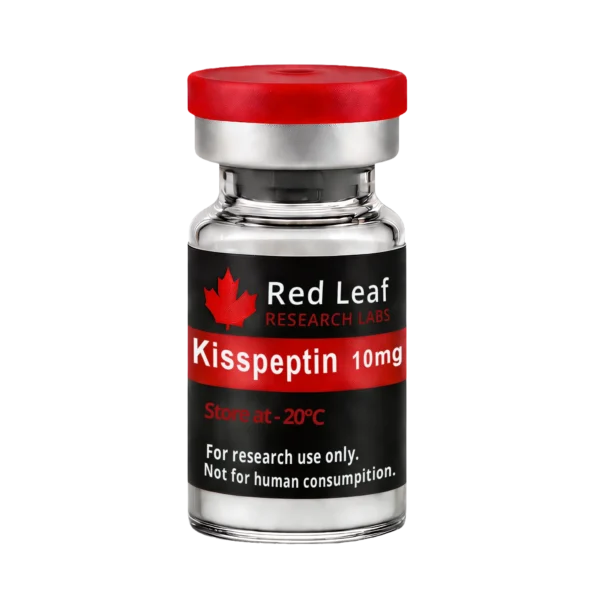
Kisspeptin
Another brain hormone peptide, linked to puberty and fertility. Read the kisspeptin guide.
Selank
A peptide studied for calm and focus. Read the Selank guide.
Semax
A brain peptide with a Soviet history. Read the Semax guide.
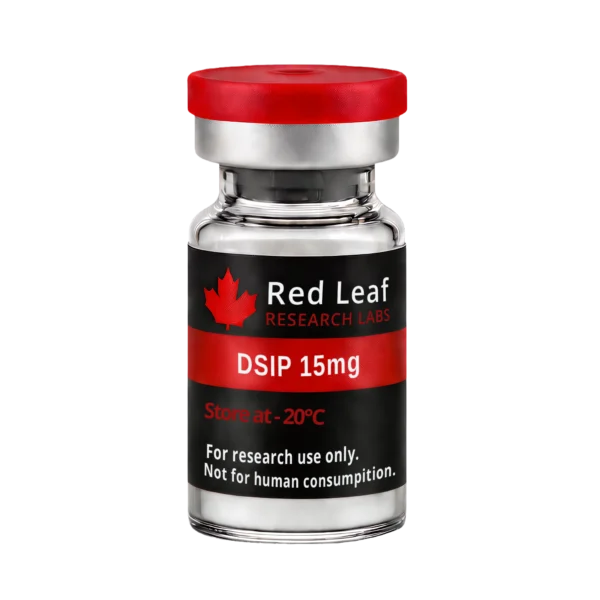
DSIP
The “sleep peptide” and what labs study it for. Read the DSIP guide.
Peptide myths
25 myths, busted in a quick quiz. Take the quiz.
Peptides vs steroids
How they differ, in plain words. Read the guide.
Oxytocin peptide in our shop
Want to buy oxytocin peptide in Canada from a seller you can check? If so, our oxytocin acetate comes as 5 mg of dry powder in a sealed vial, for lab research only. Also, here are a few related brain peptides.

Questions people ask about the oxytocin peptide
What is the oxytocin peptide?
Oxytocin is a small peptide hormone made of 9 amino acids. The body makes it in the brain, then releases it into the blood. It helps with birth and breastfeeding, and scientists also study it for bonding, trust and mood.
Is oxytocin the love hormone?
That is a nickname, but it is too simple. Animal studies link oxytocin to bonding. However, many human results, such as the famous trust study, did not hold up when repeated.
Does the oxytocin peptide help depression?
Not clearly. Studies on oxytocin and depression are mixed: some small studies found a link or a benefit, while others found none. A 2026 review of 42 trials found no clear overall benefit for mental disorders. So oxytocin is not a treatment for depression.
Is oxytocin approved in Canada?
Yes, but only for birth. In Canada, oxytocin injection is a hospital medicine used to start or strengthen labour and to control bleeding after birth. However, it is not approved for depression, loneliness or social problems.
What is the difference between oxytocin and oxytocin acetate?
Oxytocin acetate is oxytocin with a small acetate part attached, which is a common salt form for peptides. So our research vial is sold as oxytocin acetate.
Can you buy oxytocin peptide in Canada?
Yes, as a research material for lab use. So Red Leaf sells oxytocin acetate 5mg to researchers in Canada. However, it is not sold for use in people or animals.
How can I raise oxytocin naturally?
Studies link oxytocin release to birth, breastfeeding, skin-to-skin contact, hugs and even eye contact with your dog. These are healthy habits, but they do not treat depression.
Who discovered oxytocin?
Henry Dale found its effect on the womb in 1906. Then, in 1953, Vincent du Vigneaud worked out its structure and made it in a lab. He then won the 1955 Nobel Prize in Chemistry.
What should I do if I feel depressed?
Talk to your doctor or a mental health professional, because depression can be treated. If you are in crisis or thinking about suicide, call or text 9-8-8 any time in Canada.
Oxytocin is a tiny peptide hormone with real, proven jobs in birth and breastfeeding. It also plays a part in bonding, especially in animals. However, its use for depression and loneliness is still early science, and the biggest review so far found no clear overall benefit. So if you feel low, talk to your doctor, or call or text 9-8-8.
Oxytocin (5mg)See our test sheetsSources
History and how oxytocin works
- Dale HH. On some physiological actions of ergot. Journal of Physiology, 1906; 34(3): 163–206.
- du Vigneaud V, Ressler C, Swan JM, et al. The synthesis of an octapeptide amide with the hormonal activity of oxytocin. Journal of the American Chemical Society, 1953; 75(19): 4879–4880.
- The Nobel Prize in Chemistry 1955: Vincent du Vigneaud. View on NobelPrize.org
- Fresenius Kabi Canada. Oxytocin Injection USP, prescribing information. May 2020. Read the monograph
Bonding, trust and dogs
- Insel TR, Young LJ. The neurobiology of attachment. Nature Reviews Neuroscience, 2001; 2(2): 129–136.
- Berendzen KM, Sharma R, Mandujano MA, et al. Oxytocin receptor is not required for social attachment in prairie voles. Neuron, 2023; 111(6): 787–796. Read a plain-language story
- Nagasawa M, Mitsui S, En S, et al. Oxytocin-gaze positive loop and the coevolution of human-dog bonds. Science, 2015; 348(6232): 333–336.
- Light KC, Grewen KM, Amico JA. More frequent partner hugs and higher oxytocin levels are linked to lower blood pressure and heart rate in premenopausal women. Biological Psychology, 2005; 69(1): 5–21.
- Kosfeld M, Heinrichs M, Zak PJ, et al. Oxytocin increases trust in humans. Nature, 2005; 435(7042): 673–676.
- Nave G, Camerer C, McCullough M. Does oxytocin increase trust in humans? A critical review of research. Perspectives on Psychological Science, 2015; 10(6): 772–789. View on PubMed
- Declerck CH, Boone C, Pauwels L, et al. A registered replication study on oxytocin and trust. Nature Human Behaviour, 2020; 4(6): 646–655.
- Heinrichs M, Baumgartner T, Kirschbaum C, Ehlert U. Social support and oxytocin interact to suppress cortisol and subjective responses to psychosocial stress. Biological Psychiatry, 2003; 54(12): 1389–1398.
Depression and loneliness
- Skrundz M, Bolten M, Nast I, et al. Plasma oxytocin concentration during pregnancy is associated with development of postpartum depression. Neuropsychopharmacology, 2011; 36(9): 1886–1893.
- Taghizadeh Z, Rezaei N, Bostani Khalesi Z. The role of serum oxytocin levels in the third trimester of pregnancy in the incidence of postpartum depressive symptoms. Scientific Reports, 2026; 16: 22438. View on PubMed Central
- De Cagna F, Fusar-Poli L, Damiani S, et al. The role of intranasal oxytocin in anxiety and depressive disorders: a systematic review of randomized controlled trials. Clinical Psychopharmacology and Neuroscience, 2019; 17(1): 1–11. View on PubMed Central
- Ellenbogen MA, Cardoso C, Serravalle L, Vadaga K, Joober R. The effects of intranasal oxytocin on the efficacy of psychotherapy for major depressive disorder: a pilot randomized controlled trial. Psychological Medicine, 2024; 54(9): 2122–2132. View on PubMed
- Berger R, Hurlemann R, Shamay-Tsoory S, et al. Oxytocin-augmented modular-based group intervention for loneliness: a proof-of-concept randomized controlled trial. Psychotherapy and Psychosomatics, 2024; 93(3): 169–180. Read the study
- Bonnieux J, Gumuchian ST, Harboun A, et al. Does intranasal oxytocin reduce symptoms of mental disorders? A meta-analysis of clinical trials. Neuroscience & Biobehavioral Reviews, 2026; 187: 106749. View on PubMed
Rules and support in Canada
- Health Canada. Think twice before injecting peptides bought online: unauthorized products can seriously harm your health. Public advisory RA-81874, April 9, 2026. Read the advisory
- 9-8-8: Suicide Crisis Helpline, Canada. Call or text 9-8-8, any time. Visit 988.ca
Research use only. Oxytocin acetate and every other compound named here are sold by Red Leaf Research Labs as laboratory materials for in-vitro research. They are not approved for cosmetic, treatment, injection, ingestion or any human or animal use. Nothing on this page is medical advice, a dose, or a protocol. Study findings are described from published research so readers can see what was measured. If you are struggling with your mood, please talk to a health professional. Rules are current to November 18, 2026. Full wording on our legal terms page.