Owned and operated by Baba Kahn, a CF veteran

How to Spot Irresponsible Peptide Suppliers in Canada
Choosing between peptide suppliers in Canada should not come down to polished product photos, aggressive discounts, or loud claims about purity. A responsible research supplier makes verification easy: clear batch information, independent testing, transparent sourcing practices, and review signals that hold up under scrutiny. This guide explains how to spot irresponsible peptide suppliers in Canada, including red flags in testing, sourcing, SEO and link schemes, logistics, and potentially manipulated reviews or sales claims, so researchers can make calmer, better-informed decisions.
Quick answer: how do you identify irresponsible peptide suppliers in Canada?
Irresponsible peptide suppliers in Canada are the ones whose claims you cannot independently verify. The clearest warning signs are missing or seller-controlled lab reports, testing that is not tied to a specific product or batch, third-party reports that cannot be confirmed on the testing lab’s own website, vague sourcing answers, no temperature or cold-chain handling, review and backlink profiles that look manufactured, and defensive responses to ordinary verification questions.
Key takeaways
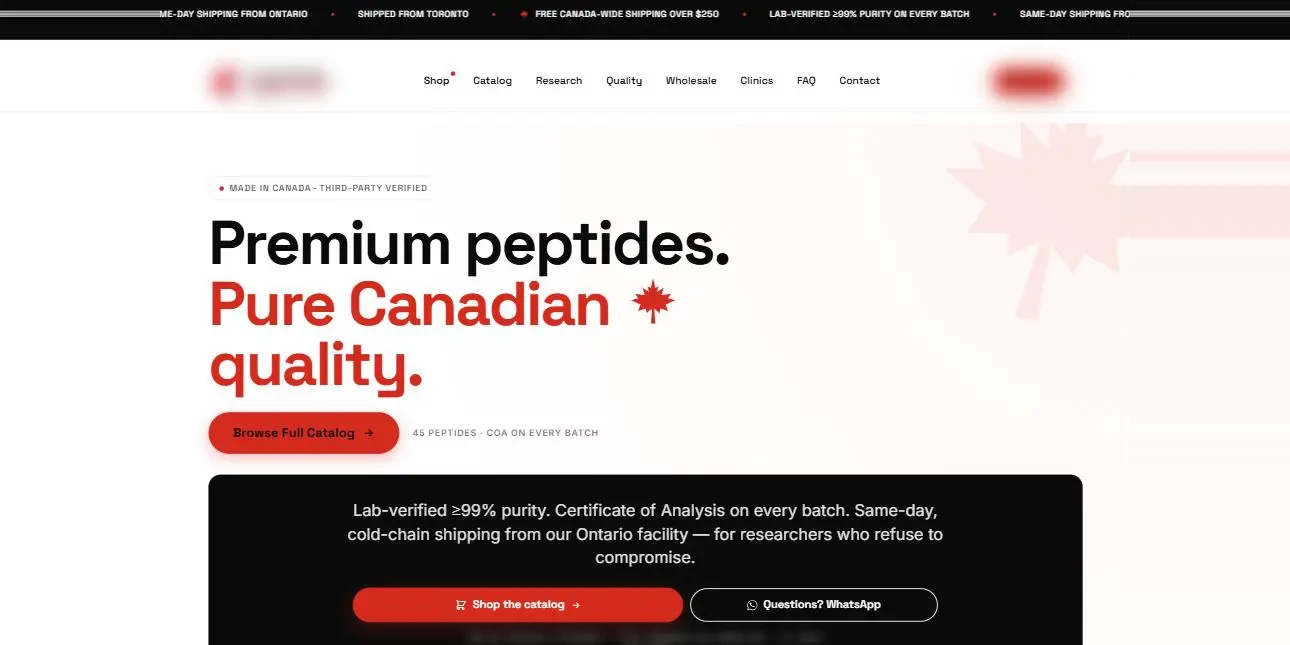
- A copied storefront is now one of the clearest tells. Structure, palette, claim sets and category names can all be lifted from an established supplier in an afternoon — see the side-by-side comparison below.
- Third-party testing is the dividing line. Internal COAs the seller creates and controls are documentation, not independent verification.
- A usable lab report connects the claim to the sample. It should identify the product, the batch or sample, the lab, the date, and the method rather than function as a decorative badge.
- Verify at the source. If a supplier shares a Janoshik report, confirm it on Janoshik’s own website using the report’s verification key, QR code, or task details.
- Vague sourcing is a red flag. Responsible suppliers can describe how products are sourced, handled, and documented without evasion.
- Deep discounts on grey-market overseas peptides are a lure, not a bargain, when the documentation behind them is thin or unverifiable.
- Handling is part of credibility. Many peptides are sensitive to temperature, light, moisture, and time in transit, so cold-chain practice belongs in your evaluation.
- Search visibility is not credibility. PBNs, link farms, and paid placements can make a seller look recommended without proving anything about the product.
- Read reviews alongside documentation. Testimonials about shipping and service verify nothing about identity or purity, though a thin review profile is not by itself proof of manipulation in this space.
- Watch how they answer questions. A supplier who deflects, stalls, or shames you for asking about COAs is showing you how accountability will go later.
How can you spot irresponsible peptide suppliers in Canada?
You can spot an irresponsible supplier by looking for gaps between what they claim and what they let you verify. If a peptide seller advertises high purity, fast domestic shipping, or lab tested products but does not provide batch-specific, independently verifiable documentation, that is a serious warning sign. The best peptide supplier reviews are not just about customer service; they should also help you confirm whether the supplier’s testing, sourcing, and public reputation are credible.
A trustworthy supplier should make it easy to answer basic questions before you order. What batch is being sold? Which independent lab tested it? Can the report be verified directly with the testing lab? Does the company explain what its certificates actually prove and what they do not prove?
Irresponsible peptide suppliers Canada-wide often rely on shortcuts. They may post vague certificates, hide behind “COA available on request”, flood search results with thin review pages, or use fake testimonials to look more established than they are. None of those tactics prove that a product is accurately represented.
Lack of third-party testing is the biggest red flag
The most important red flag is a lack of third-party testing. Supplier-created documents may look official, but they are not the same as independent analytical reports. If a company tests its own products, controls the paperwork, and gives customers no outside verification path, the buyer is left trusting marketing instead of evidence.
Third-party testing matters because it separates the seller’s claim from the lab’s analysis. For research peptides, common verification concerns include identity, purity, and tested quantity. A proper report should connect to a specific sample or batch, not simply make a broad statement about a product name.
Janoshik reports are one reputable example of third-party testing in the peptide space. Janoshik states that reports in its database can be verified through its Verify tab or by QR code, and its site lists peptide testing among its services. This matters because a Janoshik report is most useful when the reader can confirm the report through Janoshik’s own verification system rather than relying only on a supplier-hosted image or PDF. (janoshik.com)
A responsible supplier does not make you chase basic proof. The report should be easy to find, readable, and connected to the product being offered. If the supplier says “tested” but provides no lab name, no batch connection, no task number, no unique key, or no direct verification option, treat that as a meaningful warning sign.
When a “new” supplier is a copy of an established one
Not every warning sign is a missing lab report. One of the newer patterns in the Canadian research-peptide market is a storefront that arrives fully formed — the palette, the header, the announcement ticker, the trust claims, the category structure, the policy cards and the product-card layout all lifted from a supplier that has been trading for years. Nothing on the site looks improvised, because very little of it is original.
Below is one such operation, compared against this store section by section. It runs two storefronts on two domains and both are included here. We have not named either one, have not linked to them, and have removed the logo, brand name, domain, phone number, batch prefixes and vial labelling from every screenshot. The point is the pattern, not the operator — because the pattern is what you can use to protect yourself.
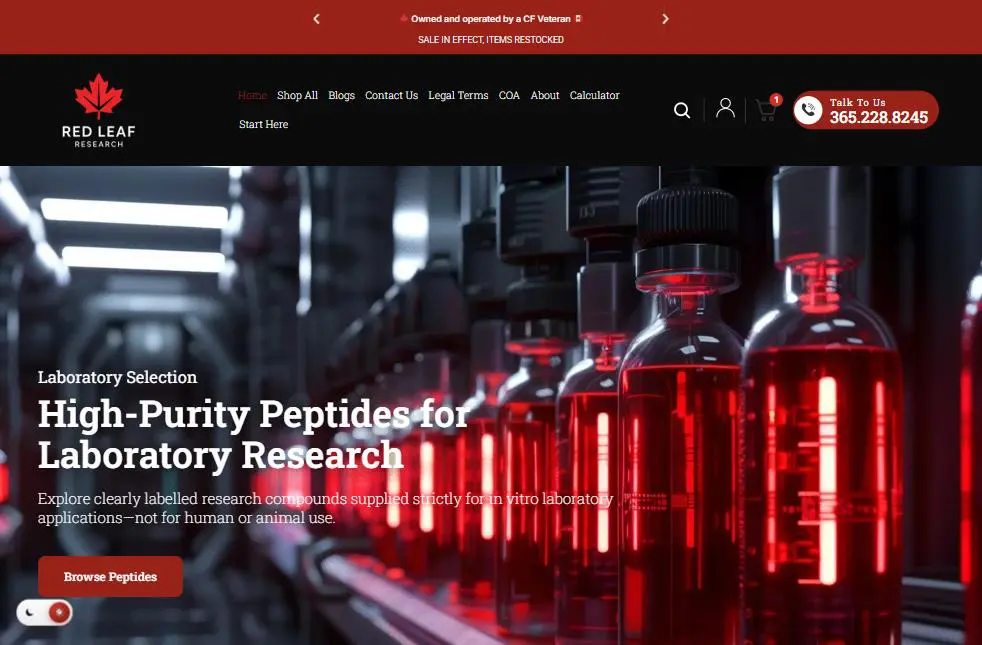

What to notice: a red scrolling announcement ticker across the top carrying free-shipping and testing claims, a maple-leaf wordmark at top left, a red pill-shaped contact button at top right, and a headline that splits a two-line claim across black and red type. Four structural decisions in the first 200 pixels of the page, in the same order.
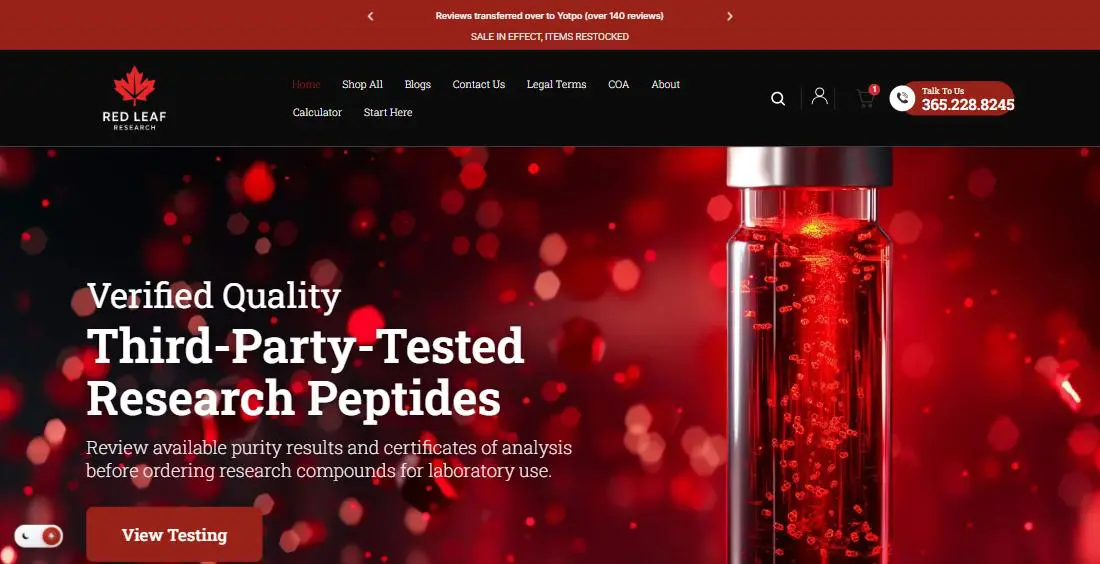
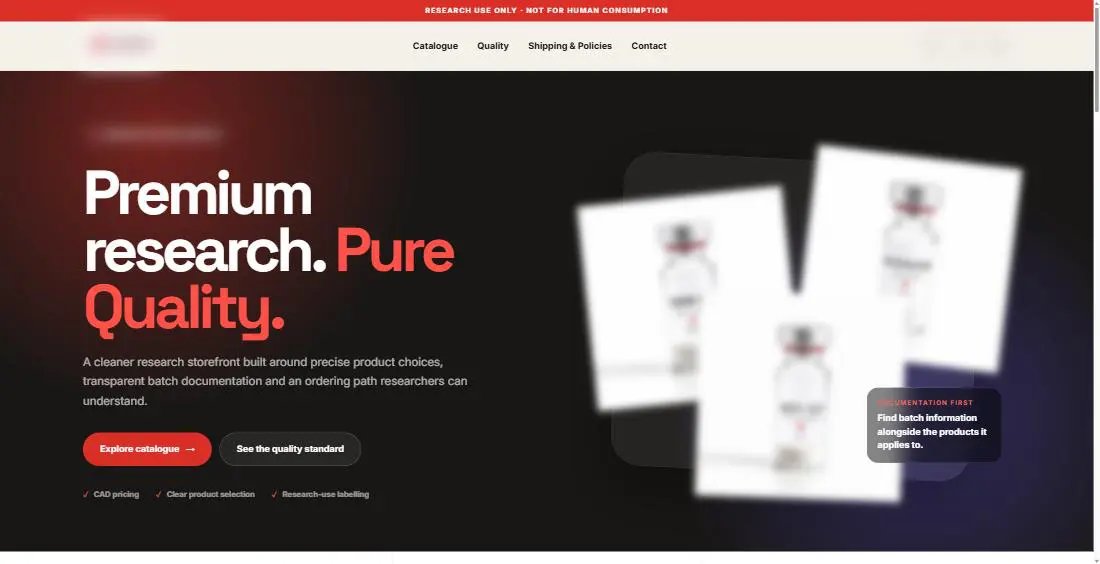
What to notice: the same operator runs a second storefront on a different domain, and it wears the same clothes. A full-width red research-use bar above a near-black hero, a two-line headline broken white / red at exactly the same point, a red primary button beside a dark secondary one, and a row of red tick marks underneath carrying the CAD-pricing, clear-labelling, research-use promises. Our own hero makes the same three promises in the same three places.
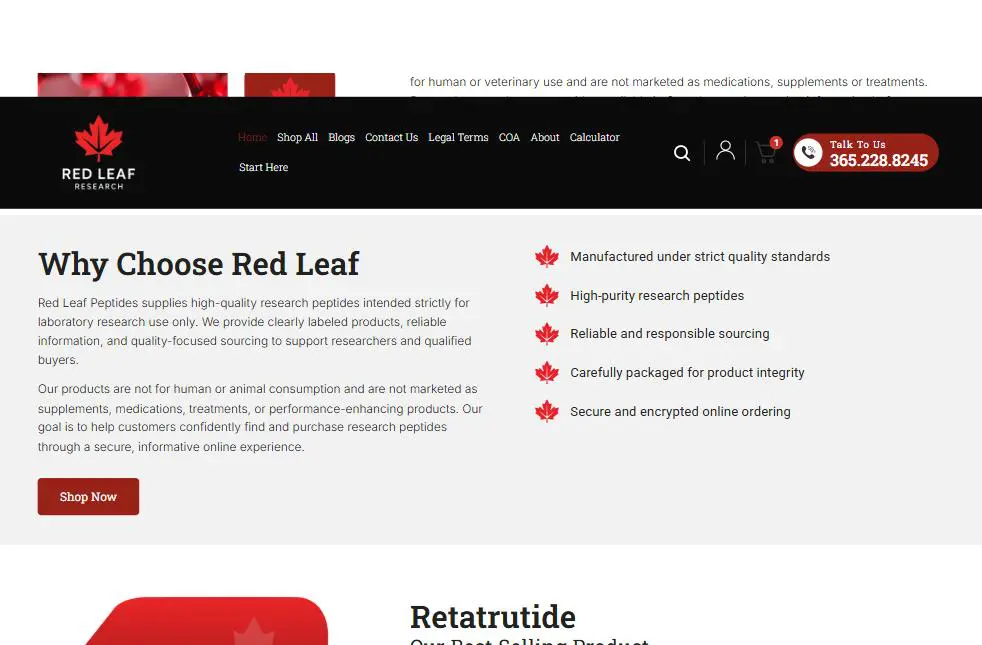
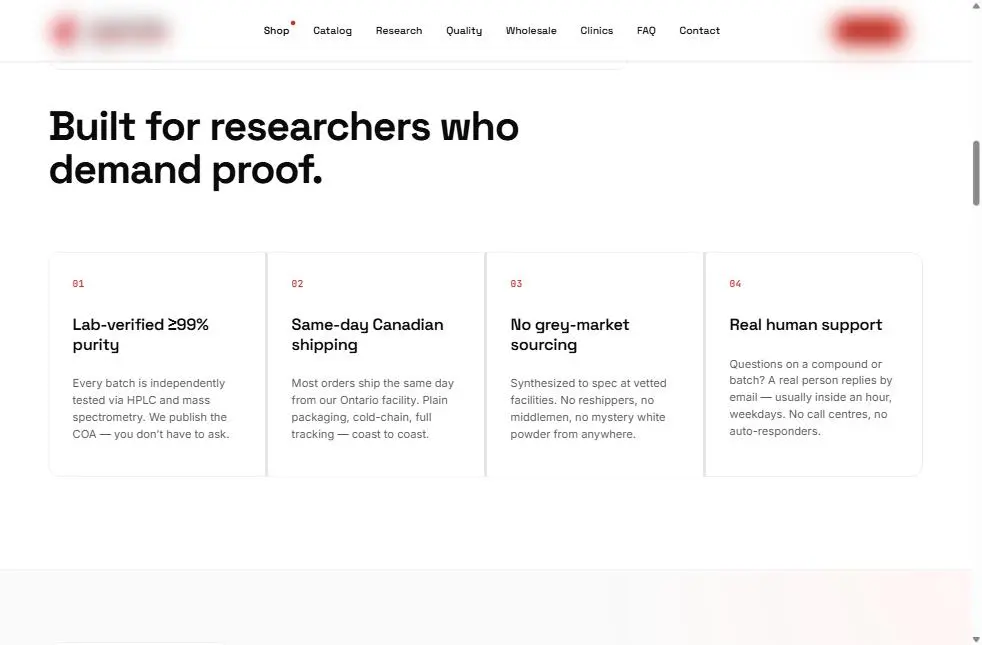
What to notice: the claim set is the same one, reworded — strict quality standards, high purity, responsible sourcing rather than grey-market supply, careful packaging and cold-chain handling, and a real person answering enquiries. The wording changed. The argument did not.
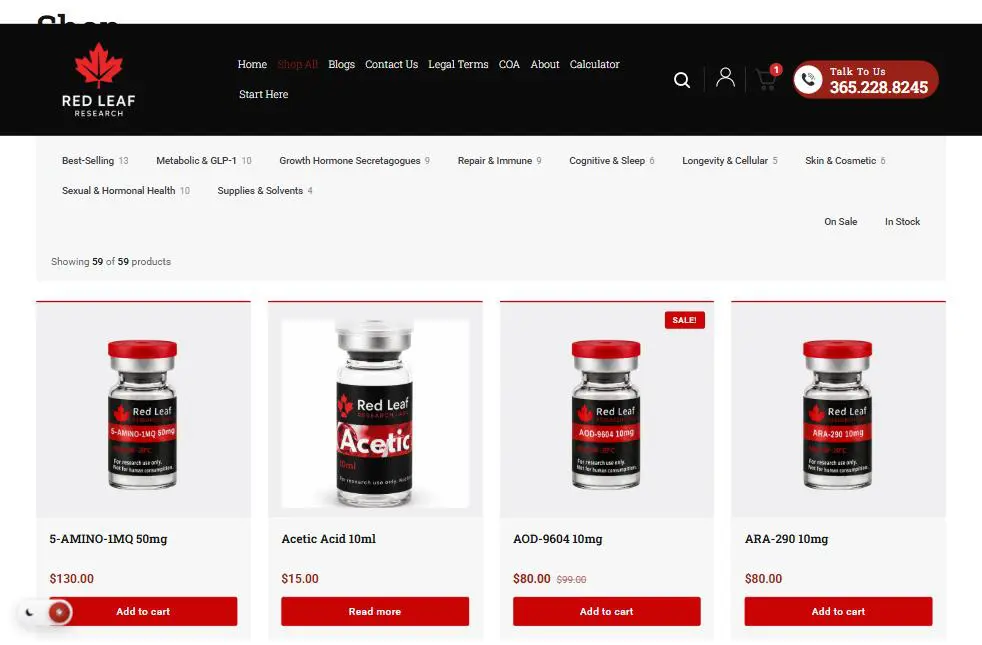
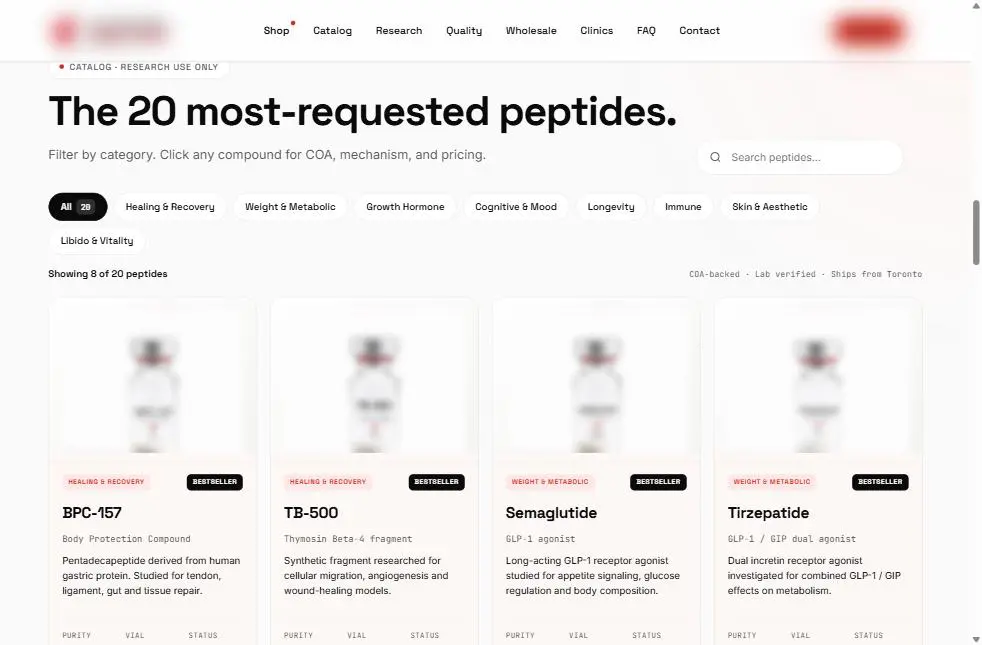
What to notice: a horizontal category filter above the grid, a product count line, then a four-across card grid with a status badge, the compound name and a red action button. The category set maps onto ours almost one for one — see the table below.
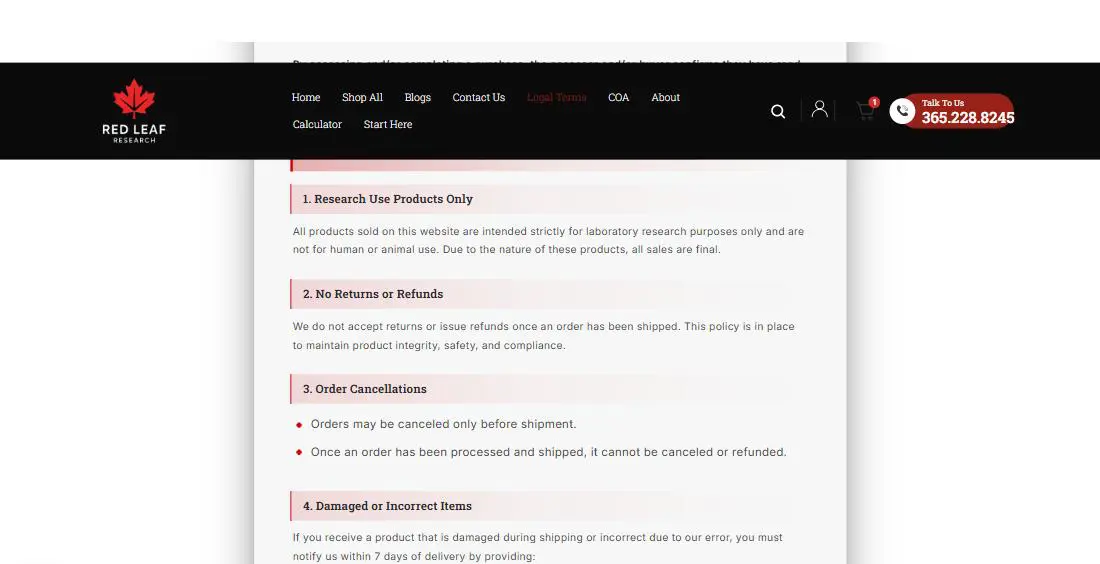
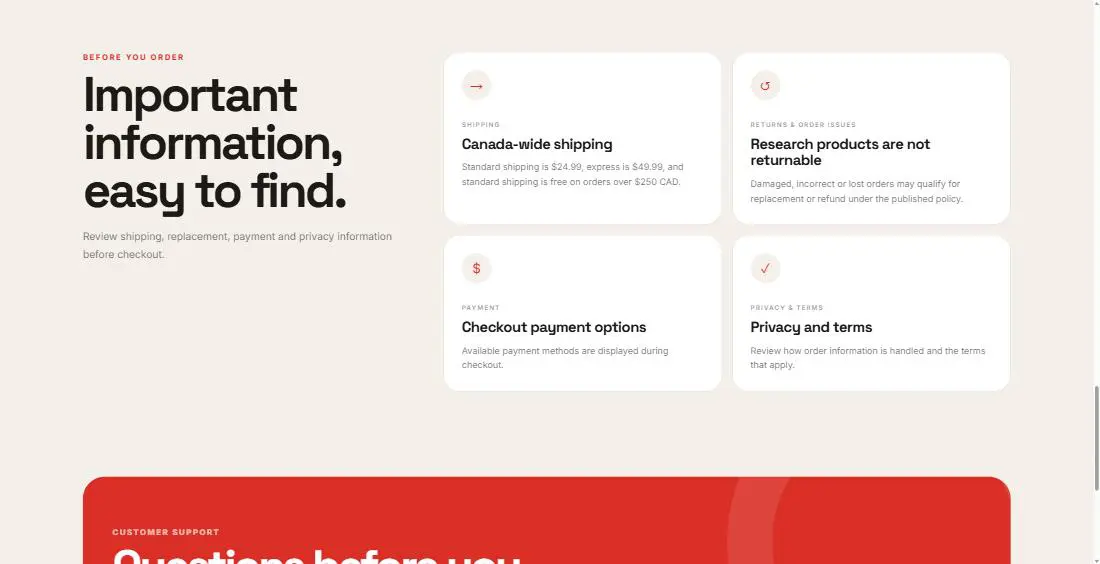
What to notice: four policy topics, same four, same order — Canada-wide shipping with a free-shipping threshold, research products not being returnable, payment at checkout, and privacy and terms. Ours has carried that structure, including the damaged-or-incorrect replacement clause, since long before this storefront existed.
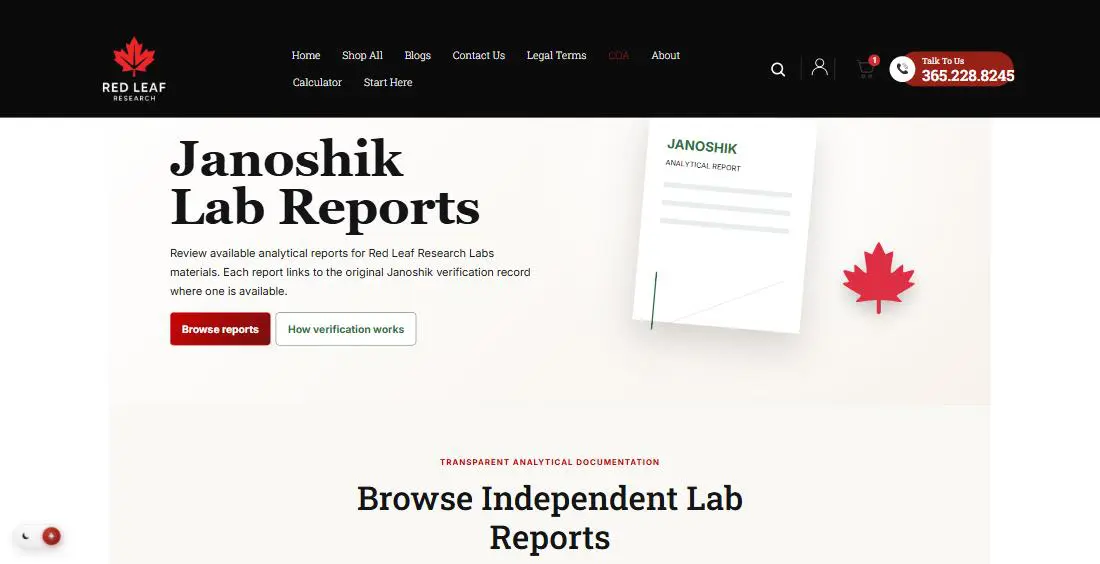
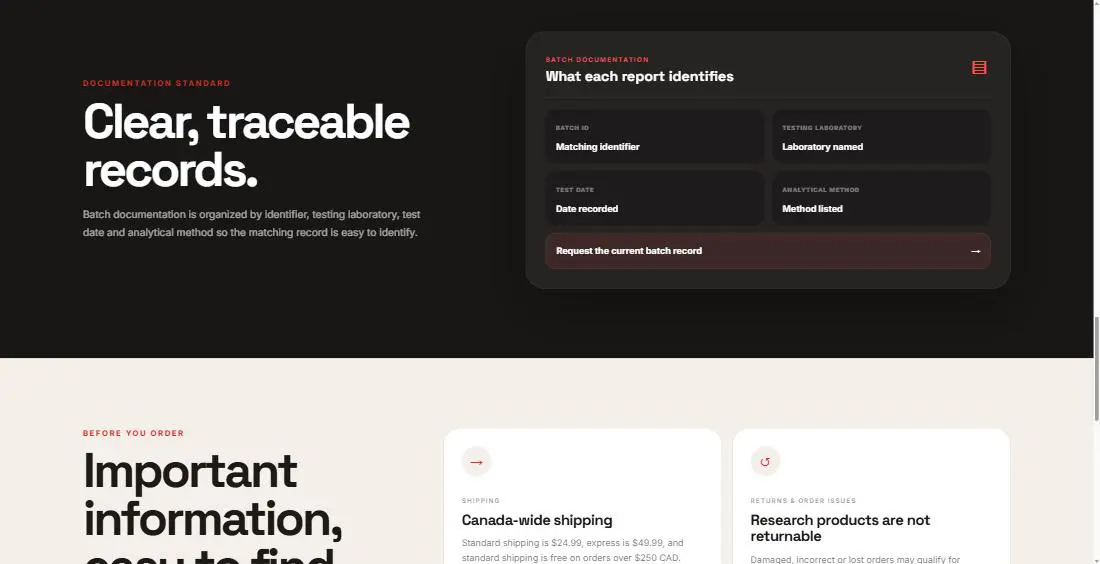
What to notice: theirs lists the four things a report should identify — batch ID, testing laboratory, test date, analytical method — and then fills each one with a placeholder: matching identifier, laboratory named, date recorded, method listed. No laboratory is actually named and no report is actually shown; you are invited to request one. Ours names Janoshik on the page, publishes the reports, and links each to the verification record.
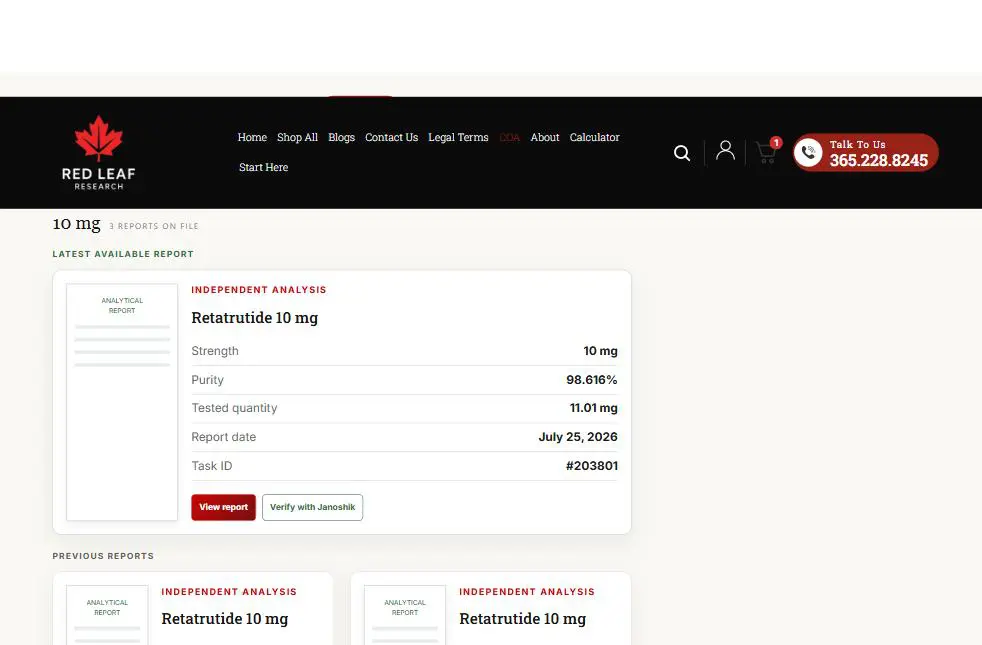
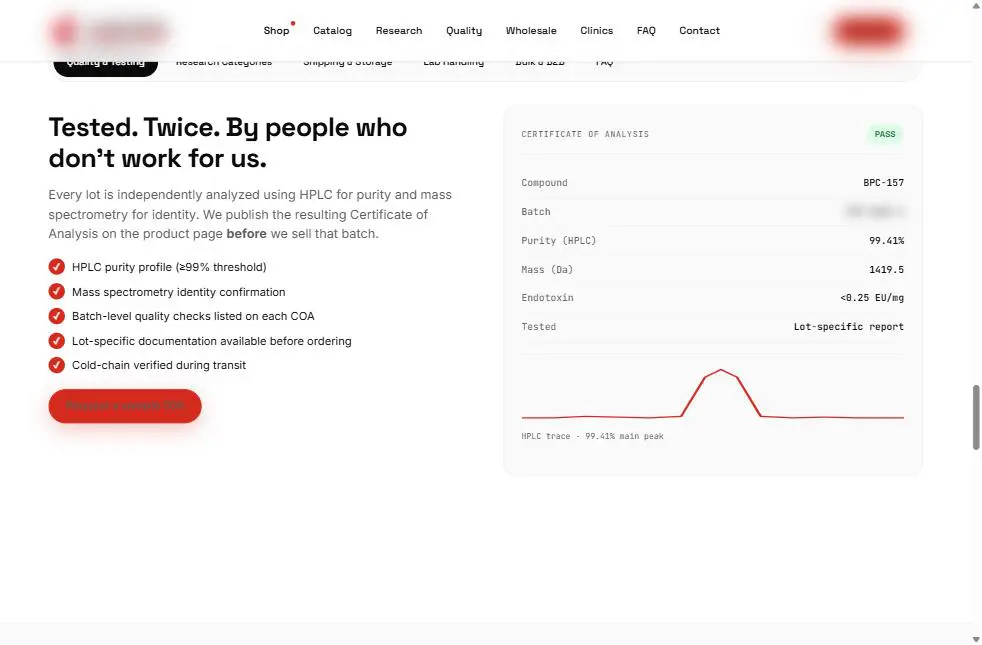
What to notice: this is where the copy stops. Ours lists the testing laboratory by name, the task ID, the report date, and a link that verifies the report on the laboratory’s own site. Theirs is a styled panel with a purity figure and a drawn HPLC trace, no laboratory named and nothing to verify against. A page can be copied in an afternoon. A testing relationship cannot.
| Our category | Their equivalent |
|---|---|
| Metabolic & GLP-1 | Weight & Metabolic |
| Repair & Immune | Healing & Recovery / Immune |
| Growth Hormone Secretagogues | Growth Hormone |
| Cognitive & Sleep | Cognitive & Mood |
| Longevity & Cellular | Longevity |
| Skin & Cosmetic | Skin & Aesthetic |
| Sexual & Hormonal Health | Libido & Vitality |
Seven categories, seven near-matches, in a market where nobody is obliged to group compounds this way at all. On their storefront subdomain the first row is not a near-match — it is Metabolic & GLP-1, character for character.
Deep red for structure, a brighter red for buttons and alerts, near-black for the header, one off-white for the page. Same four roles, same order, shades within a few percent of ours. Both sites also set body copy in Inter.
Why this matters if you are the one buying
A storefront is the cheap part of a peptide supplier. The expensive parts are a sourcing relationship you can describe, independent batch testing you pay for whether the result is good or not, cold-chain handling, a returns policy you honour, and a named human being who answers when something goes wrong. None of that is visible in a screenshot, which is exactly why a copied site can look identical to an established one while sharing none of it.
How to check a supplier for this
- Compare the structure against the established suppliers in the same market. Matching category names, matching badge wording, matching claim sets, matching policy cards and a matching page order tell you more than any statement on an About page.
- Check the age of the domain. A WHOIS lookup and the first capture in the Wayback Machine will show whether a mature-looking catalogue is sitting on a domain registered weeks ago.
- Follow the COA to its source. A credible report names the testing laboratory, carries a batch or task identifier, and can be verified on the laboratory’s own site. A purity number printed on a nicely designed panel is a graphic, not evidence — and a page that only describes what a report would contain is not documentation at all.
- Look for an identifiable operator. A real name, a registered business, a location, a phone number that is answered. Copied storefronts are almost always anonymous.
- Watch the product photography. Generic white-background vials with a lightly edited label are a template, not photographs of stock the seller is holding.
- Ask a question only an operator can answer. Who tested this batch, on what date, and will you send me the raw report. A supplier holding the inventory answers in a sentence.
What should a credible lab report include?
A credible lab report should give you enough information to connect the claim, the product, and the tested sample. It should not be a decorative badge placed beside a product page. The more vague the documentation, the less useful it is for verification.
Look for these details when reviewing peptide supplier reviews, product pages, or COA libraries:
- Independent lab name: The report should identify the third-party laboratory that performed the analysis.
- Product or compound name: The tested material should match the product being sold.
- Batch, lot, task, or sample identifier: There should be a way to connect the report to the batch or sample.
- Report date: Recent documentation is generally more useful than old paperwork reused across multiple listings.
- Purity and quantity data: The report should show what was tested, not just display a pass/fail claim.
- Verification key, QR code, or direct lab link: You should be able to confirm the report through the lab’s own system.
- Clear limitations: A report proves only what was tested in that sample; it does not automatically prove every future batch.
The last point is important. Even a legitimate report is not a permanent guarantee. Batches change, storage conditions differ, and suppliers may switch sources. Responsible peptide suppliers Canada-based or otherwise tend to understand this and keep documentation current instead of leaning on one impressive-looking certificate forever.
Verify Janoshik reports directly, not just on supplier pages
A supplier-hosted report is a starting point, not the finish line. If a vendor shares a Janoshik report, verify it directly on Janoshik’s official website using the reports verification details, QR code, task information, or unique key where available. This helps confirm that the document has not been altered, cropped, reused from another supplier, or disconnected from the product being advertised.
A practical verification routine looks like this:
- Open the supplier’s report from the relevant product or COA page. Avoid relying on screenshots posted in chats or social media comments.
- Find the verification details. Look for the task number, unique key, QR code, or direct verification link.
- Check the report on Janoshik’s official verification system. Confirm that the details match what the supplier displayed.
- Compare the product details. Make sure the compound, amount, date, and client or sample information are consistent.
- Watch for missing or hidden fields. Blurred keys, cropped report bottoms, or broken QR codes reduce confidence.
- Save a copy for your records. If the product page changes later, you will still know what documentation you reviewed.
Some suppliers make this process easier than others. For example, Red Leaf publicly shares Janoshik reports and includes direct Janoshik verification links where available, allowing readers to move from the supplier’s COA page to the original verification record rather than relying only on a static document. That kind of direct verification path is a stronger transparency signal than a vague “tested” badge. (redleafpeptides.com)
This does not mean any single supplier should be trusted blindly. It means the process is easier to audit when reports are public, batch-specific, and directly verifiable. Verification should be normal, not treated as a special favour.
Sourcing claims should be specific, not mysterious
Testing is only one part of responsible supplier evaluation. Sourcing also matters because it affects consistency, accountability, and traceability. If a supplier refuses to say anything meaningful about how products are sourced, handled, or documented, you are left with an incomplete picture.
A responsible supplier does not need to disclose every private commercial detail. However, it should explain its quality-control approach in plain language. For example, does it test incoming material? Are products batch tracked? Are certificates tied to current inventory? Are items sold for research use only and labelled appropriately?
Be cautious when a supplier leans too heavily on vague phrases such as “pharmaceutical grade,” “premium source,” “factory direct,” or “highest purity available” without evidence. These phrases may sound reassuring, but they are not substitutes for verifiable documentation. Strong sourcing communication is practical, not theatrical.
Common sourcing red flags include:
- No batch or lot references anywhere on product pages.
- The same COA reused across different strengths, dates, or product formats.
- Claims of exclusive manufacturing with no supporting documentation.
- A refusal to explain whether current inventory matches posted reports.
- Overconfident language that suggests testing is unnecessary because the supplier knows the source.
- Products presented with consumer wellness claims instead of clear research-use positioning.
The issue is not that every supplier must reveal its entire supply chain. The issue is whether the supplier gives researchers enough information to connect the product being sold with the evidence being shown.
Grey-market overseas buying: cheap is not the same as safe
Another practical risk comes from buying peptides overseas through grey markets on the promise of dramatic discounts. Price compression is not, by itself, evidence of fraud, but it can be used as a lure when documentation is weak or unverifiable. In the worst cases, the advertised peptide may be heavily cut with excipients or replaced entirely with inexpensive fillers. Buyers sometimes describe receiving material that appears to be primarily mannitol or sucrose rather than the advertised compound.
The takeaway is not that all overseas suppliers are inherently unreliable. The takeaway is that cheaper is not a substitute for identity confirmation. If the purchasing channel is opaque and independent testing is missing or cannot be verified, lower price should increase caution, not confidence.
Why some new peptide companies disappear quickly
One reason the market can feel crowded and unstable is that some new peptide sellers build their inventory through short-lived broker relationships rather than controlled, repeatable manufacturing and quality systems. When a company relies on brokers (including overseas sourcing networks) and does not independently test incoming material, it can end up cycling through sources, facing inconsistent supply, or discovering that upstream claims were unreliable. In practice, that kind of setup can contribute to short business lifespans: the seller runs out of reliable brokers, runs into counterfeit or misrepresented material, or cannot maintain consistency once a source changes.
In contrast, suppliers that operate with stronger manufacturing control and traceability tend to have more stable quality narratives over time. If a supplier states that it owns or directly controls manufacturing capacity (including facilities in multiple regions), that claim should still be evaluated through what you can verify: batch tracking, consistent third-party testing, and documentation that remains current. The key is not the marketing claim itself, but whether the supplier can repeatedly prove product identity and quality with verifiable records.
As an example of how established businesses may present transparency, Red Leaf presents itself as an established Canadian business and describes owning manufacturing facilities around the world. Treat any supplier’s manufacturing narrative as a starting point, then confirm that the testing, traceability, and documentation practices match the claim.
Cold chain handling and temperature control are part of credibility
Responsible supplier evaluation should include basic logistics and handling, not just paperwork. Many raw peptides are sensitive to temperature, light, moisture, and time in transit. While stability depends on the specific compound and formulation, international shipping often requires a cold chain approach for temperature control and integrity management.
For domestic delivery, credible sellers commonly use insulated, food-grade cool packaging and appropriate cooling elements to reduce temperature swings during parcel transport. A supplier that treats shipping as an afterthought may still be able to create attractive COA pages, but it may struggle to demonstrate consistent handling practices that align with product sensitivity.
Practical questions to ask include:
- Does the supplier explain how it packages temperature-sensitive materials for international transit?
- Is domestic shipping insulated and cool-packed using food-grade materials?
- Do they provide clear storage guidance on arrival?
- Do they document shipping timelines and replacement policies for compromised deliveries?
These details do not replace third-party testing, but they do help you judge whether the supplier appears to understand product integrity beyond marketing.
SEO, PBNs and link farming can distort supplier reputation
Search visibility is not credibility. A supplier can rank on page one and appear in every “best of” list with no verifiable testing behind a single vial.
Rankings can be bought. Private blog networks (PBNs), link farms and paid placements make a seller look recommended. None of it proves what is in the box.
AWhat manipulation looks like
- Links from relevant sites, communities and publications
- Gradual, uneven link growth over years
- Mostly brand-name and URL anchor text
- Traffic that matches the site’s authority
- Near-identical posts across many thin sites
- Hundreds of links appearing in weeks
- “Buy peptides Canada” anchor text, repeated
- Links from casino, spam or hacked-looking pages
BWant to know what a peptide company is really doing?
Don’t take anyone’s word for it, including ours. Two of the most widely used SEO platforms let anyone look behind a site’s rankings. Both offer free checks.
 Ahrefs
See a domain’s backlinks, referring domains, anchor text and Domain Rating.
 Semrush
See a domain’s backlink profile, link growth and organic traffic trends.
CHow to run the check
- Enter the root domain. Use the homepage, not a product page.
- Open referring domains. Would a real researcher or publication link here?
- Check the anchor text. Healthy profiles are mostly brand names and URLs.
- Compare authority to traffic. Big authority with little traffic deserves a closer look.
- Weigh the pattern. One odd link proves nothing. A pattern plus thin testing is a real warning.
DReading the results
EWhat’s at risk: your money and your data
Heavily promoted storefronts can take payments, ship late, ship something unverifiable or ship nothing, then relaunch under a new name.
- Rankings are bought faster than testing relationships are built
- Short-lived operations rarely honour refunds
- Anonymous owners leave no one accountable
- Link farms run on hacked sites injected with casino and pharma spam
- Doorways, cloaking and sneaky redirects can lead to malware or ransomware
- Pirated themes and plugins are a known source of backdoors
- Names, addresses, order histories and devices are exposed
FSigns a site may be compromised
Good SEO helps people find useful information. Bad SEO replaces evidence with repetition. If a supplier’s presence is loud but its testing page is thin, trust the testing page.
Fake reviews and fake sales signals are easier to miss than fake claims
Fake or manipulated reviews can be persuasive because they feel personal. A glowing testimonial may mention fast shipping, friendly service, or great results, but those comments do not verify product identity or purity. Peptide supplier reviews are useful only when they are read alongside testing documentation and business transparency.
Look for patterns rather than individual comments. A few positive reviews are not enough to establish credibility, and a few negative reviews are not always proof of irresponsibility. The question is whether the overall review profile looks natural, specific, and consistent across time.
Review red flags include:
- Many reviews posted in a short period with similar wording.
- Generic praise such as “best quality ever” without product or order detail.
- Reviews that make personal-use or outcome claims instead of discussing service and documentation.
- No critical or neutral feedback at all, especially for a supplier claiming high order volume.
- Review profiles that appear only on websites controlled by the supplier.
- Aggressive responses to reasonable questions about testing or sourcing.
Another common inconsistency is a high volume sales narrative that does not match observable signals. If a website claims massive order throughput, constant sell-outs, or extraordinary shipment counts, but shows virtually no independent reviews, no meaningful discussion in legitimate communities, and no inventory or batch documentation cadence that aligns with that volume, the story may be manufactured. Similarly, if a product page claims something like “3,000 sold in the last month” and “only 2 left” yet has zero reviews (and no credible third-party footprint that matches that volume), treat it as a strong prompt to verify rather than a reason to rush.
Legitimate review footprints can be harder to build in the research-peptide space
Not every sparse review profile is proof of manipulation. Research peptide companies can have a difficult time sourcing third-party review platforms willing to host them, especially as policies and regulations evolve. That reality can create a confusing environment: legitimate businesses may have fewer mainstream reviews than their order volume would otherwise suggest, while irresponsible sellers may attempt to compensate with fabricated testimonials.
Red Leaf, for example, states that it previously had over 140 reviews on Trustpilot, but that the page was later taken down as review-platform policies changed for research-peptide-related businesses. Red Leaf also states it retained copies of those website reviews. As with any review narrative, treat this as context rather than proof: the practical question remains whether a supplier’s testing documentation is current, batch-specific, and independently verifiable.
Communication reveals how seriously a supplier treats accountability
How a supplier responds to questions can tell you a lot. Responsible suppliers answer reasonable verification questions calmly. They do not shame customers for asking about COAs, refuse to explain batch details, or pressure people to order before reviewing documentation.
Before choosing a supplier, consider asking simple questions:
- Is this report tied to the current batch being sold?
- Can I verify the lab report directly with the third-party lab?
- Where can I find the task number, unique key, or QR code?
- Do you update reports when a new batch arrives?
- What does this test prove, and what does it not prove?
- How are temperature-sensitive items packaged for international cold chain transport and for domestic delivery?
The tone of the answer matters. Clear, direct answers build confidence. Evasive answers, sudden discounts, or claims that “everyone trusts us” should do the opposite.
A practical checklist before trusting a supplier
Use this quick checklist when evaluating peptide suppliers in Canada:
- The supplier publishes third-party testing, not only internal COAs.
- Reports are tied to specific products, batches, or samples.
- Janoshik reports or other third-party reports can be verified through the lab’s own website.
- Product pages do not rely on exaggerated wellness or outcome claims.
- Sourcing and batch-control language is specific enough to be useful.
- The supplier explains handling and shipping practices (including cold chain expectations where relevant).
- Reviews appear natural, varied, and not overly promotional.
- Search results are supported by substance, not just SEO volume, PBNs, or link farming.
- Customer support answers documentation questions without pressure.
- The supplier is clear about research-use context and limitations.
- You can walk away if verification is incomplete.
This checklist will not eliminate every risk, but it helps you slow down and evaluate evidence instead of reacting to marketing.
Final verification step: do manual and AI-assisted research
Before you trust any supplier’s claims (positive or negative), do your own verification using manual searches and reputable AI-assisted search tools. The goal is not to outsource judgment to a search engine, but to surface inconsistencies that marketing pages and link networks may hide.
Useful questions to write down and answer with citations include:
- Who owns this company? Can you identify the legal entity, directors, or corporate registration details?
- Is this peptide company legit? Can you verify the company’s history, address, and business footprint outside its own website?
- Is the reputation real? Do independent references exist that are not clearly affiliate-driven, PBN-driven, or link-farm-driven?
- Does the company participate in Janoshik testing? Are reports posted, batch-specific, and verifiable directly through Janoshik’s system?
- Can you verify the testing source? If a company cites a different testing facility, can that facility’s report be independently verified and tied to a specific batch, sample, and date?
- Does this peptide company participate in PBNs, link farms, or other link schemes that violate Google’s spam policies, including links placed on hacked or compromised websites? If so, what is the evidence (specific networks, domains, or patterns) and does it align with what you see in independent SEO or backlink data?
Many labs can perform legitimate analytical testing, but the most important credibility line is independent, directly verifiable, batch-linked documentation. Janoshik is widely used in this niche in part because its verification workflow is straightforward for the public to audit. If a supplier’s testing cannot be independently verified (regardless of the lab name), treat that as a red flag.
Final takeaway
Irresponsible peptide suppliers usually reveal themselves through what they make difficult: independent verification, batch matching, clear sourcing, appropriate handling, and honest review signals. Lack of third-party testing is the clearest warning sign, especially when a supplier relies on vague purity claims or unverified COAs. Janoshik reports can be useful verification tools, but only when you confirm them directly through Janoshik’s official website and compare the details carefully.
The best approach is simple: do not reward opacity. Choose suppliers that make documentation public, verification direct, and communication straightforward. In a market where polished marketing can be cheap, transparent evidence is what deserves your attention.
Frequently asked questions about irresponsible peptide suppliers in Canada
What is the biggest red flag when choosing a peptide supplier in Canada?
The biggest red flag is the absence of third-party testing. When a company tests its own products, controls the paperwork, and offers customers no outside verification path, purity and identity claims rest entirely on the seller’s word.
Are internal COAs good enough?
No. Supplier-created documents can look official, but they are not the same as independent analytical reports. Treat an internal COA as a starting point and ask for third-party testing you can confirm yourself.
What should a credible peptide lab report include?
A credible report gives you enough information to connect the claim, the product, and the tested sample: the product identity, the batch or sample reference, the testing lab, the date, and the analytical method. The vaguer the document, the less useful it is for verification.
How do I verify a Janoshik report?
Do not stop at the copy hosted on the supplier’s page. Check the report directly on Janoshik’s official website using its verification details, QR code, task information, or unique key, which confirms the document is genuine and belongs to the product in question.
Why are cheap overseas peptides risky?
Price compression alone is not evidence of fraud, but dramatic discounts are often used as a lure when documentation is weak or unverifiable. Grey-market overseas purchases also remove your recourse if a batch turns out to be wrong.
Does cold chain shipping matter for research peptides?
Yes. Many raw peptides are sensitive to temperature, light, moisture, and time in transit. Stability depends on the specific compound and formulation, but international shipping frequently calls for cold-chain handling, so a supplier’s logistics practices form part of their credibility.
Can a supplier’s search ranking or backlinks tell me they are trustworthy?
No. A company can rank well or appear widely recommended by investing in SEO tactics such as private blog networks and link farming. Visibility measures marketing spend, not product verification.
Are few reviews a sign that a peptide supplier is fake?
Not necessarily. Research peptide companies often struggle to find third-party review platforms willing to host them as policies evolve, so legitimate businesses can show sparse review footprints. Read review volume alongside documentation rather than on its own.
What should I ask a supplier before ordering?
Ask for batch-specific third-party testing, how to verify it at the lab, how the product is sourced and handled, and what the shipping conditions are. How calmly a supplier answers those questions is itself a signal. For wider context, see our guides on whether peptides are steroids, BPC-157 vs TB-500, and harm reduction for peptide users in Canada.