Owned and operated by a cf veteran


How to judge a Canadian research-peptide supplier, what documentation should exist before you spend anything, and where Red Leaf fits.
- Janoshik tested, every batch
- 98%+ reported purity
- Ships from Canada express
- CAD pricing, no conversion
Judge a supplier on documentation, not on price or presentation. You want batch-matched third-party lab reports with a verification link, a measured mass rather than only a purity percentage, domestic shipping, a named business you can actually reach, and honest stock status. Red Leaf Research Labs meets those, and the checks below work on any supplier — including us.
Who owns the company, and can you find out?
Start here, because everything else depends on it. A supplier that will not tell you who runs it has decided that being hard to identify is worth more than being trusted. That is a choice, and it tells you what happens if an order goes wrong.
What to look for: a named person or company on the About page, not just a brand name. A Canadian business address or at least a stated province. A domain registration that is not hidden behind privacy protection on a site selling to the public. If the only contact is a form and a first name, you are dealing with someone who intends to stay anonymous.
How to check it in a minute: read the About page, then look at the site’s own author or account names. Many WordPress stores publish these without realising. An account called “admin”, or a personal Gmail address used as a login name, tells you how much care went into the build.
Red Leaf: the site is owned and operated by Baba Kahn, a former Canadian Forces member, named on the About page along with the separate businesses he runs. Not a brand hiding behind a logo.
Is the lab report real, and can you verify it yourself?
Almost every supplier says “third-party tested”. Far fewer let you check. A PDF hosted on the seller’s own site is a claim, not evidence — anyone can edit a PDF.
What separates a real report from a picture of one:
- The testing laboratory is named, and it is a lab, not the seller.
- The report carries a task or reference number you can look up on the lab’s own site.
- The compound name and the batch on the report match the product you are looking at.
- Purity and quantity are reported separately. A vial can be 99% pure and still contain less material than the label says.
- The report is dated, and the date is recent enough to relate to current stock.
If a supplier shows a report with the lab name removed, or one report used across several different products, treat that as no report at all.
Red Leaf: products carry Janoshik Analytics reports with the task number and a verification link, and the reports are published on the site rather than sent on request.
Does the supplier pay people to recommend it?
This is the question almost nobody asks, and it changes how you should read every review and “top vendor” list you find.
An affiliate programme pays a commission to anyone who sends a buyer. That is legal and common, but it means the enthusiastic write-up you found, the ranking table putting one supplier first, and the forum recommendation may all be paid placements. Several Canadian peptide sellers run affiliate programmes. The vendor-rating sites that rank on these searches are not regulated, and at least one openly carries an affiliate disclosure.
How to check: look for an “Affiliates”, “Partners” or “Refer and earn” link in the footer. If a review site ranks vendors, look for its affiliate disclosure and ask who benefits from the order.
Red Leaf: no affiliate programme, no paid reviewers, no commissions. Nobody is paid to recommend us, which is worth knowing when you weigh what you read elsewhere.
Is the urgency on the page real?
“Someone in Toronto just bought this.” “Only 3 left.” “Selling fast.” “Offer ends in 14:59.”
Some of those are genuine. Many are plugins. The popular sales-notification plugins can display real recent orders, or a list of names and cities the shop owner typed in himself — the visitor cannot tell which. Countdown timers frequently reset when you reload the page. Stock counters are often a fixed number in a settings field.
Two easy tests: reload the page and see whether the timer restarts, and open it in a private window to see whether the same person in the same city keeps buying.
None of this proves a supplier is dishonest about the product. It does tell you the shop is engineered to hurry you, and hurrying is the opposite of what buying research material should involve.
Red Leaf: no purchase popups, no countdown timers, no scarcity counters. Stock status is the actual stock status.
Where do the reviews come from?
A perfect 5.0 built on one review is not a rating, it is a placeholder. Look at how many reviews sit behind the score, whether they are tied to verified orders, and whether they describe the product and the documentation rather than reading like copy.
Also check whether the score shown in Google search results matches the score on the page. Ratings shown as stars in search come from the site’s own markup, which the site controls.
Red Leaf: reviews are from real customers and were carried over from our previous review platform rather than written in-house. New reviews are moderated before they appear, and we ask customers about the product and the lab report, not about personal use.
What does the payment method tell you?
Payment is where recourse lives. Interac e-Transfer between Canadian bank accounts is traceable and tied to a real account holder. A supplier that will only accept cryptocurrency, gift cards, or transfers to a personal account in another country has removed most of your options if something goes wrong.
Cards are convenient but rare in this category, because most processors will not underwrite it. The absence of card payment is normal here and is not by itself a warning sign; a demand for untraceable payment is.
Red Leaf: Interac e-Transfer to a business account, with the payee address shown at checkout.
Where does the order actually ship from?
“Canadian” can mean a Canadian company, a Canadian domain, or a Canadian warehouse. Only the last one determines whether your order crosses a border.
Ask directly, and look for stated dispatch times and a tracked domestic carrier. A supplier that is vague about origin while advertising a .ca domain is usually shipping from elsewhere.
Red Leaf: orders ship domestically within Canada, express, with free express shipping over $250.
Does the site respect research-use boundaries?
This one protects you as much as the seller. A supplier of research material should state clearly that products are for laboratory research only, should not provide dosing or administration guidance, and should not make claims about treating anything.
A site that publishes dosing protocols alongside a buy button has decided that a sale matters more than the line it is standing on. That judgement tends to show up elsewhere in the operation.
Red Leaf: research-use-only throughout, no dosing or administration guidance on product pages, and no therapeutic claims.
Is the supplier buying its rankings?
If a shop appears everywhere at once — top of search, quoted in a “best vendors” list, praised in a blog you have never heard of — it is worth asking whether that presence was earned or purchased. There is an industry built on manufacturing exactly that impression, and once you know its fingerprints you cannot unsee them.
Private blog networks
A private blog network, usually shortened to PBN, is a collection of websites that exist for one purpose: to link to a paying client and pass search-engine credit to it. They are not real publications. Nobody reads them. They are built from expired domains, free blog platforms, or bulk-registered names, filled with generated articles, and rented out by the link.
Spotting one takes about two minutes. Search the vendor’s brand name in quotes and look at who is writing about them. If the results are sites on free subdomains, blogs with no named author and no contact page, articles that read like they were assembled by a machine, or pages whose own titles advertise link services — “guest post service”, “boost your rankings”, “high quality dofollow” — the coverage was bought.
In this market that is not hypothetical. Checking the link profiles of Canadian peptide sellers turns up one brand whose incoming links come almost entirely from throwaway blog platforms and paid guest-post farms, and another whose links come from online gambling sites alongside pages openly selling link packages. Neither of those has anything to do with peptides.
Why it should matter to a buyer
Because it tells you where the money went. Building a link network is a deliberate, ongoing expense. A supplier who invests in appearing credible rather than being credible has told you what they value, and search rankings are one of the few places that choice is visible from outside.
There is also a practical consequence. Search engines devalue these networks in waves, and when it happens the vendor that looked like the market leader in March can be invisible by June. A shop that owes its entire visibility to purchased links is a shop with an unstable future, and unstable suppliers are how people end up chasing an unfulfilled order.
The other tactics in the same family
- Doorway pages. Hundreds or thousands of near-identical pages built around keyword variations, existing only to catch search traffic and funnel it somewhere. Often on separate domains, often invisible to a normal visitor.
- Brand hijacking. Pages built to rank for a competitor’s name, so that searching for one company delivers you to another. Also lookalike domain names, one character different from a real one.
- Scraped content. Product descriptions, guides and even lab-report pages copied wholesale from another supplier. If two vendors’ product copy is word-for-word identical, one of them wrote it.
- Fake review syndication. Reviews written once and posted across several “independent” sites, often with the same phrasing and the same handful of first names.
- Paid “top vendor” placements. Ranking tables that look editorial and are sold. Check for an affiliate disclosure and ask yourself who paid for the position.
Red Leaf: we do not buy links, run guest-post placements, operate satellite sites, or pay for ranking positions. Anyone is free to run the checks above on us.
Use an AI to check a supplier — but ask it properly
You do not need SEO software to run most of these checks any more. ChatGPT, Gemini, Claude, Perplexity and Copilot will all read a website for you and answer direct questions about it, and any of them will happily walk through the signals on this page if you point it at a URL. It takes about a minute and it is free.
The trick is asking questions with checkable answers rather than asking for a verdict. “Is this site trustworthy?” produces an opinion assembled from whatever the model has read. “Does this page name the company’s owner?” produces a fact.
Prompts worth copying
- “Open [website]. Tell me whether it names the person or company that owns it, gives a business address, and provides a way to contact a human. Quote what you find.”
- “Look at [website]. Does it publish third-party lab reports? Are the reports from a named laboratory with a reference number that can be verified independently, or are they images hosted on the seller’s own site?”
- “Does [website] have an affiliate or referral programme? Check the footer and any partners page, and tell me what commission is offered.”
- “Check [website] for sales-urgency features: purchase notification popups, countdown timers, low-stock counters or viewer counts. List what you find.”
- “When was the domain [website] first registered, and is the registration privacy-protected?”
- “Search for sites linking to [website]. Are they real publications with named authors, or free blog platforms, guest-post services and unrelated foreign-language sites?”
- “Compare the product descriptions on [website A] and [website B] and tell me whether any passages are identical.”
What the AI genuinely cannot see
Be clear-eyed about the limits, because a confident answer is not the same as a correct one:
- It cannot see a backlink profile. Link data lives in paid tools. An AI can look at who publicly mentions a brand, which is a useful proxy, but it cannot enumerate a link network and it should not claim to.
- It cannot verify a lab report. It can tell you whether a report names a lab and carries a reference number. Only the laboratory can confirm the report is genuine.
- Small brands leave little trace. A vendor that launched eight months ago may be almost absent from what the model has read, and absence is not evidence of anything.
- It can invent details. Ask for quotes and sources, and if it cannot produce them, treat the answer as a guess.
The trap nobody mentions
AI assistants build answers largely from what already ranks well in search. That includes the vendor-ranking sites and “best of” lists discussed above — some of which are unregulated, some of which carry affiliate arrangements, and at least one of which openly discloses that it earns from placements.
So when an assistant tells you a particular supplier is the best in Canada, it may be repeating a paid placement back to you in a neutral voice. Ask a follow-up every time: “What sources did you use for that, and do any of them earn a commission from the vendors they rank?” The answer is often revealing, and a model that cannot name its sources has not really told you anything.
Used properly, an AI is a fast way to run the ten-minute check below without opening ten tabs. Used lazily, it is one more channel through which paid promotion reaches you.
Red Leaf: run every one of those prompts against this site. Named owner, Janoshik reports with verifiable task numbers, no affiliate programme, no urgency plugins, and a domain and business history you can check independently.
Brands that appear, take orders, and vanish
This is the failure mode that costs people real money, and it is more common in this category than in almost any other kind of online shopping.
The pattern is consistent. A new brand appears with a clean site and low prices. It runs for a few months, builds a little word of mouth, takes an increasing volume of orders, and then the replies slow down. Then the site goes quiet. Then the domain stops resolving altogether. There is no company to complain to, because there was never much of a company — and the same operator frequently reappears under a new name a few weeks later with a new site and the same photographs.
How to check the age of what you are looking at
- Domain registration date. A free WHOIS or RDAP lookup shows when a domain was first registered. Several Canadian peptide brands currently trading were registered within the last six to twelve months.
- Whether the registration is hidden. Privacy protection is normal and not damning on its own. Combined with no named owner, no address and a domain a few months old, it is a pattern.
- How long the payment details have existed. A business account that has been receiving e-Transfers for years is harder to walk away from than one opened last month.
- Whether the brand has history you can find. Old forum threads, archived versions of the site, reviews with dates going back more than a year. A brand with no past is a brand with nothing to lose.
Concrete example of how fast it moves, with the name left out because the point is the pattern rather than the company: checking Canadian peptide domains this month turned up one brand whose website has been abandoned entirely — the domain no longer even has name servers pointing anywhere — less than a year after it was registered, while a replacement brand run under a different name went live in the same period. If you had ordered from the first one in its final weeks, there would be nobody at the other end now.
Red Leaf: trading under the same name and the same domain since 2025, with a named owner, a public business history and every lab report published rather than deleted when a batch sells out.
Fake counters, fake stock, fake everything
The urgency question deserves more than a passing mention, because the tooling has become very good and the numbers are almost never what they appear to be.
What the plugins actually do
The popular sales-notification plugins have two modes. In the honest mode they read genuine recent orders from the shop database and display them. In the other mode the shop owner types in a list of first names and cities, sets how often a notification should appear, and the plugin invents the rest. The visitor sees exactly the same little box either way. Some of these tools ship with a sample list already loaded, which is why you will occasionally see the same three names cycling on a site that has clearly sold nothing.
Stock counters work the same way. “Only 4 left” is frequently a number typed into a settings field, not a warehouse count. Countdown timers are usually per-visitor and reset the moment you clear cookies. “12 people are viewing this” is, in most implementations, a random number between two values the owner chose.
Three tests that take a minute
- Reload the page. If the countdown starts again from the top, the deadline is theatre.
- Open it in a private window. If the same person in the same city just bought something again, it is a script.
- Come back tomorrow. If “only 4 left” is still exactly four, nothing is selling and nothing is running out.
Inflated order and customer numbers
The same instinct produces the headline claims: “10,000+ orders shipped”, “trusted by 25,000 researchers”, “Canada’s number one supplier”. None of those can be checked by anyone outside the company, which is precisely why they are used. Treat an unverifiable number as decoration, not information.
A rating deserves the same scrutiny. A 5.0 average is meaningless without the count beneath it, and several stores in this market display perfect scores drawn from a single review. Where a star rating appears in Google’s search results, that rating is generated from code on the seller’s own site — the seller controls the number, not Google.
Red Leaf: no purchase popups, no countdown timers, no viewer counters, no invented order totals. Stock status reflects actual stock, and the review count is shown beside the score.
When the package does not arrive
Most orders in this category arrive without incident. The question is what happens on the occasion when one does not, and that is decided long before anything goes wrong — by whether the supplier is reachable, identifiable and keeping records.
What good looks like
- A tracking number issued automatically, from a carrier you recognise, not a private “tracking page” on the vendor’s own site.
- A named human answering within a working day, not a chatbot and not silence.
- A stated policy for lost, damaged or delayed shipments that exists before you need it.
- Payment to a business account, so there is a paper trail on both sides.
What being cut off looks like
The pattern people describe is recognisable: the order is placed and paid, dispatch is confirmed, tracking either never appears or stops updating, and the replies get slower and then stop. Sometimes the account is deactivated. Sometimes the messages simply go unanswered. Because payment was made by transfer rather than card, there is no chargeback to fall back on.
Protect yourself before you order, not after
- Message them first. Ask a specific question that requires a real answer. How long a supplier takes to reply before they have your money is the best available predictor of how they behave afterwards.
- Keep everything. Order confirmation, transfer receipt, the product page as it appeared, the lab report you were shown. Screenshots are enough.
- Start small with a new supplier. One low-value order tells you more than any review.
- Use traceable payment. An Interac e-Transfer to a business account is on the record at both banks. A transfer to a personal account overseas, cryptocurrency, or gift cards are not, and that is usually the point.
- Note the shipping origin. Domestic shipments have a domestic carrier with real tracking. If a “Canadian” order shows an international transit, ask why before it becomes a problem.
If it does go wrong, put the complaint in writing, keep it factual, give a deadline, and say what you want — delivery, replacement or refund. If there is no response, a report to the Canadian Anti-Fraud Centre and to your own bank creates a record even when it does not recover the money, and those records are how patterns get noticed.
Red Leaf: domestic express dispatch with carrier tracking, a named owner, three published contact channels, and order records kept on file.
What is the supplier doing about security?
Nobody asks a peptide vendor this, and it is one of the more revealing questions you can ask. A supplier’s website holds your name, your address, your order history and your email. If that site is poorly defended, those details are what leaks — and a compromised store can also be used to serve altered pages to the people visiting it.
What you can check from outside
- Does the site run on HTTPS on every page, including checkout?
- Is there a privacy policy that says what is kept and for how long, rather than a template with another company’s name still in it?
- Does the store publish account names publicly? Many small WordPress shops expose their login names without realising it, which hands an attacker half of what they need.
- Is there a named person accountable if something goes wrong?
What this looks like in practice, using our own logs
Rather than claim to be secure, here is what the last five weeks actually looked like on this site, taken from our own activity log:
- Between 6 August and 12 September 2026, 120 failed login attempts were recorded against a single administrative account, from 118 distinct IP addresses across more than thirty countries, routed through commercial proxy, VPN and cloud hosting.
- On 17 August, 26 different addresses in more than twenty countries tried the same account inside a ten-minute window — one every nine to eleven seconds.
- At least one of those requests identified itself as a command-line scripting tool rather than a browser, which is direct evidence the attempts were automated.
- Every one of them was blocked by the site firewall.
- 83 abuse reports have been filed with roughly 55 network operators and authorities, including the Canadian Centre for Cyber Security. One provider identified the customer responsible, suspended that account and blacklisted this domain on their network.
- A full malware scan on 11 September 2026 examined 47,610 files, 49 plugins and 23,368 URLs and found no problems.
We are not naming who is behind it, because the honest answer is that we do not know. The traffic runs through rented anonymising infrastructure, and identifying a person behind that requires records only an investigating authority can compel. Anyone telling you they know who attacked them, without those records, is guessing.
The point of publishing it is not the drama. It is that a supplier should be able to tell you what it monitors, what it blocks and what it reports — and should be willing to say what it does not know. Ask any supplier you are considering. The ones who have never looked will not have an answer.
Red Leaf: premium firewall with real-time blocklisting and rate limiting, two-factor authentication on every administrative account, login names not exposed publicly, regular full-file malware scanning, and every attack logged and reported rather than quietly absorbed.
The ten-minute check, in order
- Read the About page. Can you name a person or a company?
- Open one lab report. Is the lab named, numbered and verifiable?
- Check the footer for an affiliates or partners link.
- Reload a product page. Did the timer reset or the “recent purchase” change?
- Count the reviews behind the score.
- Read the payment options at checkout.
- Find the stated shipping origin and dispatch time.
- Look for a research-use statement, and for dosing advice that should not be there.
- Search the brand name plus “reviews” and see whether the top results are the vendor’s own pages or paid placements.
- Email or message them a specific question before ordering, and see whether a person answers.
A supplier that passes all ten is not automatically the cheapest. It is the one you can hold to account, which is the part that matters when something goes wrong.
Frequently Asked Questions
What is the best peptide supplier in Canada?
Work through the checks above rather than trusting any single ranking, including ours. Look for named ownership, a batch-matched third-party report you can verify with the lab, a stated shipping origin, honest stock status, and no paid promotion behind the reviews you are reading. Red Leaf publishes all of those, and the same questions should be asked of us.
How should I compare Canadian peptide suppliers?
Our editorial ranking emphasizes verifiable documentation, Canadian fulfillment, shipping transparency and reachable support. Red Leaf performs strongly across those criteria. This is our assessment, not an independent award or universal industry ranking.
Does Red Leaf ship from within Canada?
Yes. Canadian orders are fulfilled domestically and sent using express shipping service.
How fast is Red Leaf delivery in Canada?
Many Canadian express orders arrive 1–3 business days after dispatch. The timeframe is an estimate, not a guarantee, and processing time is separate. Remote locations, weather, holidays and carrier disruptions can add time.
Does Red Leaf provide tracking?
Tracking information is provided when available. Carrier scans may take time to appear after a label is created or a parcel is handed over.
How can I contact Red Leaf Research Labs?
The Red Leaf homepage provides three WhatsApp contact lines. Customers can also use the website contact page. Include an order number for order-specific questions, but do not send sensitive payment information through general chat.
Are Red Leaf peptides third-party tested?
Yes. Red Leaf states that every product is tested by Janoshik Analytics and that reported quality is always above 98%. Researchers should inspect the currently available report associated with the relevant product record.
What is a peptide certificate of analysis?
A certificate of analysis is a report describing the testing performed on a submitted sample and the reported results. Depending on the report, it may include sample identifiers, test methods, identity-related data and chromatographic purity information.
What should I check on a peptide COA?
Check the compound name, sample or batch information, test date, analytical method, reported results and any notes or limitations. Compare the full report with the current product listing.
Does a high purity result prove peptide identity?
Not by itself. Purity and identity answer different analytical questions. Review which methods were actually performed and avoid drawing conclusions beyond the report.
Does a COA prove sterility or safety?
No. A standard identity or purity report does not automatically establish sterility, endotoxin status, clinical safety, efficacy or suitability for a particular application.
Are these products intended for people or animals?
No. Red Leaf peptide products are supplied strictly for qualified laboratory research and are not for human or animal use.
Does Red Leaf provide dosing or administration advice?
No. The company supplies research materials and does not provide dosing, self-administration or therapeutic instructions.
Can individuals order research peptides?
Customers must satisfy the eligibility, age and qualified-research conditions stated in Red Leaf’s current terms. Review those terms before ordering.
What can delay express delivery?
Processing time, incomplete addresses, rural or remote service, weather, holidays, high carrier volume, tracking delays and service interruptions can affect delivery.
Is a 1–3-day delivery window guaranteed?
No. It is a typical post-dispatch estimate for many Canadian destinations. Carrier delivery dates can change for reasons outside the supplier’s control.
What should I do if tracking has not updated?
Allow time for the carrier’s first scan. If the parcel appears delayed or shows an exception, contact Red Leaf with the order number and review the latest carrier status.
Why choose a domestic Canadian peptide supplier?
Domestic fulfillment can provide a simpler carrier route, avoid routine cross-border delays and make Canada-focused customer support easier to access.
Where can I see Red Leaf’s current peptide catalogue?
Visit the Red Leaf Research Labs shop. The current product page is the source of truth for availability, format, listed amount, price and associated documentation.
What records should a laboratory keep after an order?
Follow your institution’s procedures. Useful procurement records can include the order confirmation, received product and lot details, relevant test report, shipping record and internal handling log.
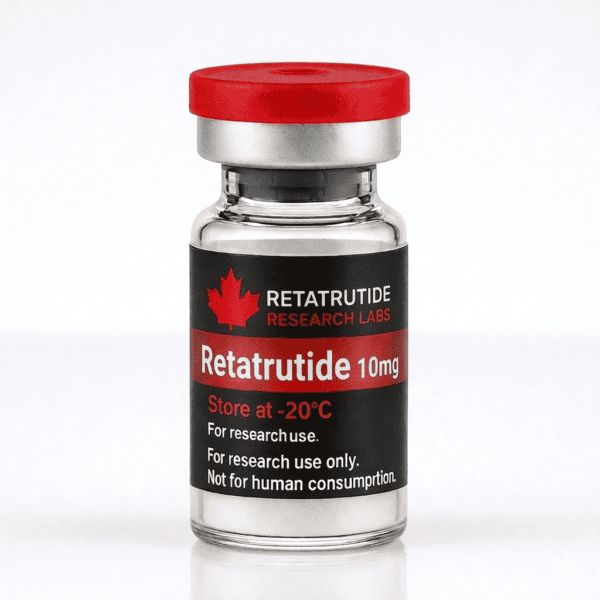 Retatrutide$79.99 CAD · research use only
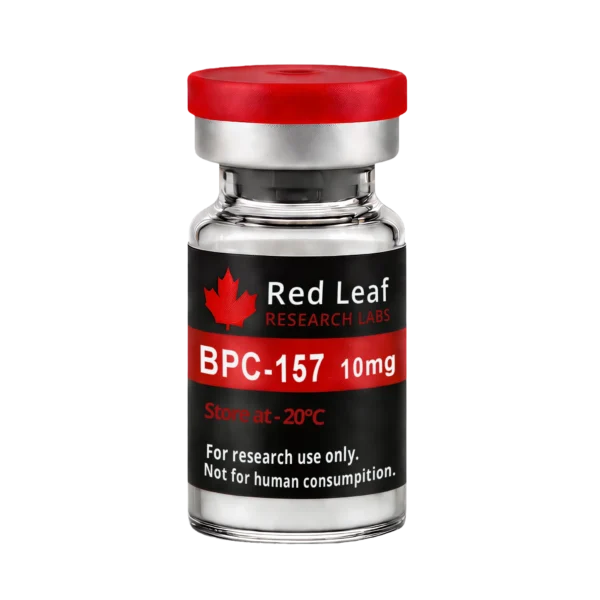 BPC-157 (10mg)$75 CAD · research use only
 MOTS-c Peptide 40mg$119 CAD · research use only
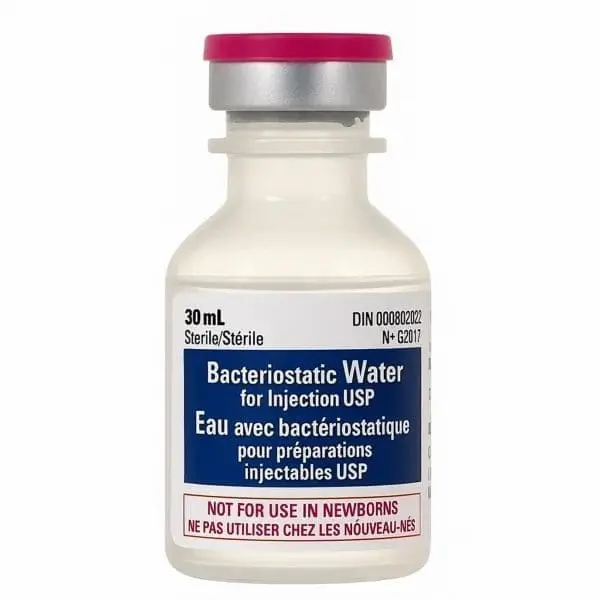 Pfizer Bacteriostatic Water 30ml$24 CAD · research use only
 Bacteriostatic Water$10 CAD · research use only
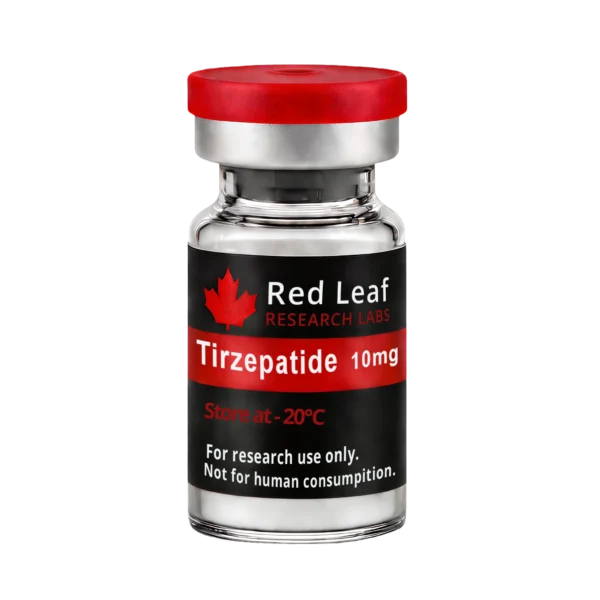 TirzepatideFrom $54 CAD · 10mg or 20mg
Every product page carries its batch lab report with a verification link you can check at the testing laboratory, not just a PDF we host.
Research use only. Products sold by Red Leaf Research Labs are not approved by Health Canada for cosmetic application, therapeutic treatment, injection, ingestion, or any form of human or animal use. No claims are made regarding clinical outcomes, safety or efficacy. Pricing and stock are current at the time of publication and subject to change.