SNAP-8 research: quick summary
SNAP-8 (acetyl octapeptide-3) is a cosmetic-science research peptide studied as a modulator of SNARE-complex assembly. It is a topical cosmetic ingredient by design, not an injectable research peptide. This Canadian product listing concerns laboratory and formulation research material only. It is not an authorized medicine, does not provide dosing or administration instructions, and is not intended for human or veterinary use.
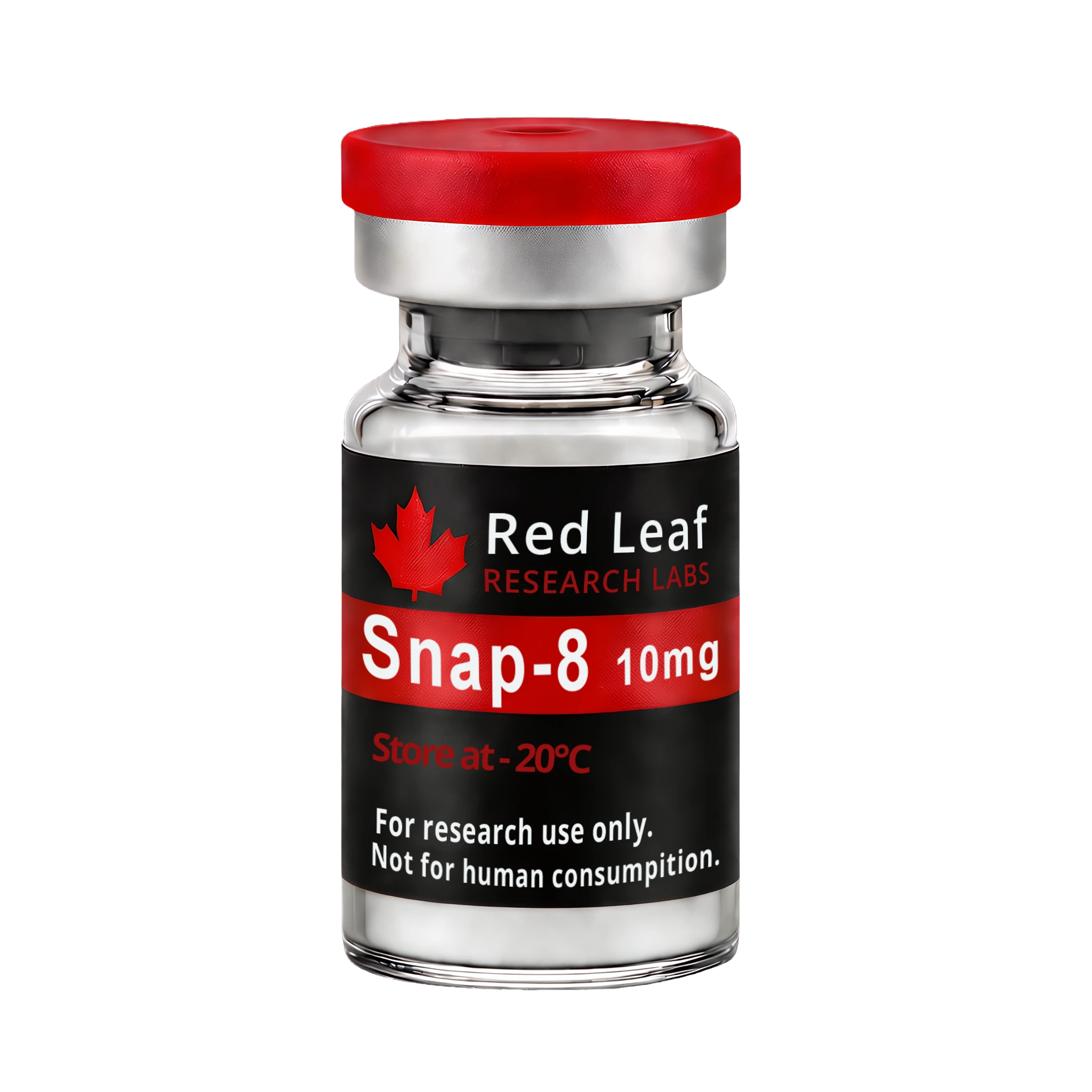
SNAP-8 Canada: SNAP-8 10mg Research Product
SNAP-8 Canada researchers, formulators and research estheticians can order a 10mg vial directly from Red Leaf Research Labs, with published analytical information, Canadian-dollar pricing and domestic express fulfilment.
For searches such as buy SNAP-8 Canada, acetyl octapeptide-3 or SNAP-8 peptide formulation, this page sets out what the molecule is, how it differs from the hexapeptide it was derived from, and why it belongs in a different category from the rest of a research-peptide catalogue.
Red Leaf Research Labs supplies research material to qualified purchasers in Canada. Nothing on this page describes a therapy, a treatment or a permitted personal use.
SNAP-8 Is a Topical Cosmetic Ingredient, Not an Injectable
This is the most important thing on the page, and it separates SNAP-8 from almost everything else Red Leaf lists.
SNAP-8 was developed as a cosmetic active for topical formulation. Its entire published context is skincare science: serums, creams and emulsions applied to the skin surface, evaluated with formulation endpoints. It is catalogued under an INCI name — acetyl octapeptide-3 — which is a cosmetic-ingredient designation, not a pharmaceutical one.
It appears on peptide catalogues alongside injectable research compounds largely as an accident of supply chain, and that adjacency invites a category error. A lyophilized vial of SNAP-8 is raw cosmetic material for formulation work. Nothing about the published literature supports any other route, and Red Leaf provides no information supporting one.
SNAP-8 Research Specifications
- Compound name: SNAP-8
- INCI name: Acetyl octapeptide-3 (also catalogued as acetyl glutamyl heptapeptide-1)
- Class: Synthetic octapeptide cosmetic active
- Structure: N-terminally acetylated, C-terminally amidated — both modifications are part of the defined molecule
- CAS number: 868844-74-0
- Approximate molecular weight: 1.1 kDa
- Research target: SNARE complex assembly, with SNAP-25 the component of interest
- Derivation: An elongated analogue of the hexapeptide acetyl hexapeptide-8 (Argireline)
- Physical format: Lyophilized powder
- Available research quantity: 10mg
- Intended use: Qualified laboratory and formulation research only
SNAP-8 and Acetyl Hexapeptide-8: What the Two Extra Residues Do
SNAP-8 is frequently marketed as “Argireline 2.0”, which is a slogan rather than a description. The actual relationship is worth stating properly.
Acetyl hexapeptide-8 (Argireline) is a six-residue peptide modelled on the N-terminal region of SNAP-25, a component of the SNARE protein complex that mediates vesicle fusion. SNAP-8 extends that sequence to eight residues, giving a longer stretch of the SNAP-25 mimetic region.
The proposed rationale is that a longer mimetic competes more effectively for a position in the SNARE complex, interfering with its assembly. Whether that translates into a proportionally larger formulation effect is a question for controlled comparison rather than for marketing copy — and comparative studies between the two peptides are less abundant than the confidence of the claim suggests. A formulator evaluating a switch should treat it as a hypothesis to test in their own system.
What the SNARE Mechanism Does and Does Not Establish
SNARE-complex proteins mediate vesicle fusion, including at the neuromuscular junction, and that is the mechanistic premise behind the whole class of peptides SNAP-8 belongs to.
The mechanistic story is coherent. What it does not establish on its own is a topical outcome: a peptide that interferes with SNARE assembly in a biochemical system still has to reach a relevant site through the stratum corneum in a real formulation at a realistic concentration, and skin penetration for a molecule of this size and charge is a genuine formulation problem rather than an assumed property. That is the useful research question with SNAP-8, and it is a formulation question.
Why Buy SNAP-8 10mg in Canada from a Domestic Research Supplier?
SNAP-8 is a stable short peptide and travels well, so the domestic argument here is about documentation and turnaround rather than degradation.
For formulation work specifically, batch consistency matters more than for a one-off assay: a formulator comparing prototypes needs to know that variation between trials comes from the formulation and not from the raw material. A supplier who publishes a checkable third-party report per lot, and who can be reached about it, is what makes that possible.
How This SNAP-8 Canada Page Improves on Typical Competitor Listings
- The route is stated. SNAP-8 is a topical cosmetic ingredient, and this page says so plainly rather than letting catalogue adjacency imply otherwise.
- The INCI designation is given, which is how this material is actually regulated and traded.
- The Argireline comparison is explained instead of being reduced to a version number.
- The penetration problem is named — the real open question in this category.
- No outcome claims. This listing does not describe experiences, results or benefits.
How to Evaluate a SNAP-8 Certificate of Analysis
Both terminal modifications are part of the molecule, which makes mass the check that resolves identity.
- Named molecule: SNAP-8 or acetyl octapeptide-3, with CAS 868844-74-0.
- Terminal modifications: N-acetylation and C-amidation both confirmed. An unmodified octapeptide is a different substance.
- Mass confirmation: approximately 1.1 kDa, consistent with both modifications present.
- Lot reference and date: cross-check both against the vial.
- Method: note which technique produced the purity number.
- Reported quantity: should reconcile with the 10mg format.
- Independent check: a verification reference you can put to the issuing laboratory.
Red Leaf publishes Janoshik reports with a verification key. For formulation work, keep the report with the batch record — it is the only way to attribute a result to the material rather than the recipe.
SNAP-8 10mg Handling and Formulation Notes
The 10mg vial arrives as a lyophilized powder. Lyophilization describes the drying process and implies nothing about identity or purity.
SNAP-8 is water-soluble and generally stable, but formulation context matters more than storage does: pH, the presence of oxidising or reducing agents, and interactions with other actives can all affect it in a finished emulsion in ways they would not in a simple buffer. Formulators should establish compatibility in their own base rather than assuming it, and should document the batch against its analytical report. Keep the powder dry, sealed and out of direct light, and follow validated institutional procedures.
How to Buy SNAP-8 in Canada for Qualified Research
- Establish eligibility. Confirm the purchaser and institution are authorized to hold research and formulation material.
- Confirm the intended route. SNAP-8 is a topical cosmetic active; work should be scoped accordingly.
- Read the report, checking that both terminal modifications are confirmed.
- Plan compatibility testing in your own formulation base before committing to a prototype run.
- Log it in. Lot reference, arrival condition, storage location, against the batch record.
Fulfilment is to qualified Canadian purchasers by domestic express. Red Leaf supplies material and documentation; it does not advise on formulation or study design and provides nothing that supports use in humans or animals.
SNAP-8 Availability in Canada: Research vs. Consumer Searches
SNAP-8 is a cosmetic ingredient rather than a medicine, and raw ingredient supply is not the same thing as a finished cosmetic product. Finished cosmetics sold in Canada are subject to their own regulatory requirements covering safety substantiation, ingredient disclosure and notification, and a vial of raw peptide meets none of them by itself.
A researcher or formulator buying this material is buying an input. Turning it into a product people put on their skin is a separate undertaking with separate obligations.
SNAP-8 10mg Canada Procurement Checklist
| Check | What to confirm |
|---|
| Purpose | Laboratory or formulation research with a defined scope |
| Route | Understood as a topical cosmetic active |
| Identity | Acetyl octapeptide-3, CAS 868844-74-0, both terminal modifications confirmed |
| Mass | Near 1.1 kDa, consistent with the modified peptide |
| Compatibility | Tested in the intended formulation base, not assumed |
| Records | Analytical report kept with the batch record |
| Regulatory | Finished-cosmetic obligations understood as separate from ingredient supply |
Explore SNAP-8 Research Information
For related work on peptides studied in skincare contexts, see skincare, anti-ageing and copper peptides. For supplier-selection criteria in the Canadian market, review how to evaluate a Canadian research peptide supplier.
SNAP-8 research FAQ
Is SNAP-8 an injectable peptide?
No. It is a topical cosmetic active developed for formulation into skincare products, catalogued under the INCI name acetyl octapeptide-3.
How does it differ from Argireline?
Argireline is acetyl hexapeptide-8, a six-residue SNAP-25 mimetic. SNAP-8 extends that to eight residues. The proposed advantage is more effective competition in SNARE-complex assembly; comparative evidence is thinner than the marketing suggests.
What is the SNARE complex?
A protein complex that mediates vesicle fusion. SNAP-25 is one of its components, and this peptide class is designed to mimic part of it.
Why do the terminal modifications matter?
N-acetylation and C-amidation are both part of the defined molecule. An unmodified octapeptide has a different mass and is a different substance.
Does Red Leaf Research Labs provide formulation guidance?
No. Red Leaf Research Labs supplies research material and analytical documentation only.
Research use only. SNAP-8 supplied by Red Leaf Research Labs is intended for qualified laboratory and formulation research. It is not a medicine, not for human or veterinary use, and not for diagnostic or therapeutic application.


 Owned and operated by Baba Kahn, a CF veteran