Owned and operated by a cf veteran

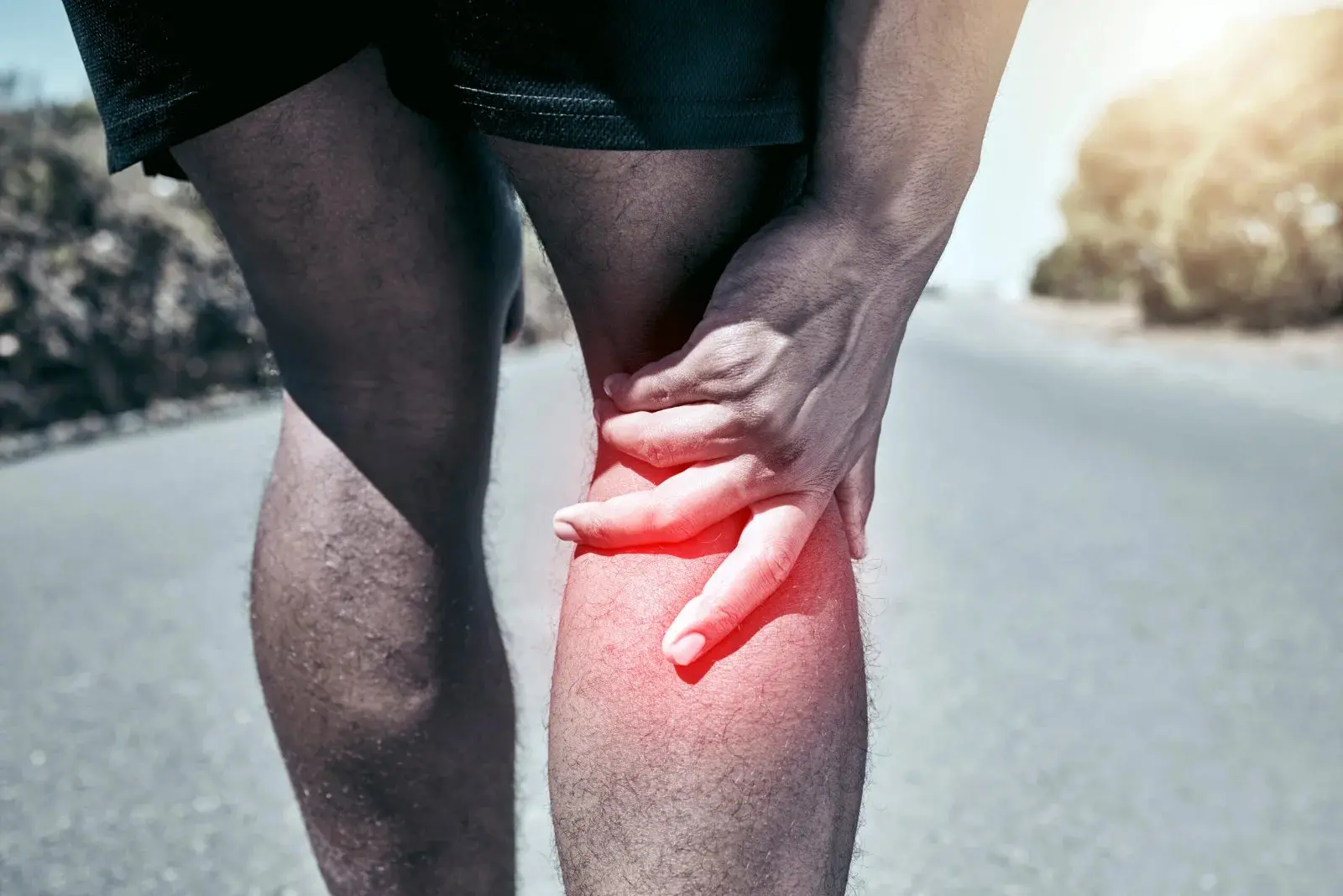
Knee pain, body weight and peptides. What the trials measured, what is still only animal data, and why researchers look at retatrutide and BPC-157 as two different levers.
- 4 lb less knee load per 1 lb lost
- 28.7% weight loss in a knee arthritis trial
- 0 human trials for BPC-157
- Lot-tested with outside lab reports
Knees hurt more when they carry more weight. Every pound you lose takes about four pounds off each knee with every step. That is measured, not guessed. Retatrutide is a weight-loss compound in late-stage trials. One of those trials tested it in people with knee arthritis. It reported in December 2025. Knee pain scores fell far more than placebo. A different drug in the same family had already shown the same thing. BPC-157 is a separate story. It is studied for soft tissue repair. But every one of those studies is in animals. There are no human trials showing it works for anything. Researchers look at the two together because they act on different problems. One lowers the load. One is studied for the tissue. Both are lab material here, not treatments.
- Why weight and knees are linked
- What retatrutide is
- The trial that proved the idea
- What BPC-157 research shows
- The evidence gap, side by side
- Why the two get paired
- Where do you inject it for a knee?
- Where TB-500 fits
- What goes wrong in this area
- What to check before you buy
- Common questions
- Bottom line
- Other guides on this site
Why weight and knees are linked
Your knee is a hinge. It carries your whole upper body every time your foot hits the ground.
Walking is not gentle on it. The force through a knee with each step is far more than your body weight. When you walk, your leg swings. Your foot lands. Your muscles pull hard to stop the knee folding. All of that stacks up.
So the maths is not one for one. It is much bigger than that.
A study at Wake Forest University followed 142 older adults who were overweight and had knee osteoarthritis. It ran for 18 months. The lead researcher was Stephen Messier. The team measured the real load going through the knee while people walked. They measured it before and after weight loss.
The finding: every single pound of body weight lost took about four pounds off the knee, per step.
That ratio is why weight matters so much for knees. Real numbers make it easier to picture.
| Weight lost | Load taken off each knee, per step | Over one mile of walking |
|---|---|---|
| 5 lb | About 20 lb | Roughly 24,000 lb less |
| 10 lb | About 40 lb | Roughly 48,000 lb less |
| 20 lb | About 80 lb | Roughly 96,000 lb less |
| 50 lb | About 200 lb | Roughly 240,000 lb less |
The mile figure comes straight from the research team. Losing ten pounds means each knee handles about 48,000 pounds less over a mile walked.
That is the number worth sitting with. No peptide fixes a knee. But this is why weight-loss compounds keep showing up in joint research.
What retatrutide is
Retatrutide is a peptide built to act on three receptors at once. Most weight-loss peptides hit one or two. This one targets GLP-1, GIP and glucagon together.
That is why people call it a triple agonist. Agonist just means it switches a receptor on.
Its phase 2 trial was published in the New England Journal of Medicine by Jastreboff and co-workers. Here is what that trial did.
338 people
Adults with obesity or overweight. Each was put on a dose or on placebo at random.
Four dose levels
1 mg, 4 mg, 8 mg and 12 mg, given once a week under the skin.
48 weeks
The main result was read at 24 weeks. A second one at 48 weeks.
The results, at the highest dose:
- 17.5% mean body weight reduction at 24 weeks. That is about 41.2 lb, or 18.7 kg.
- 24.2% mean body weight reduction at 48 weeks. That is about 57.8 lb, or 26.2 kg.
One detail from that trial matters more than the headline number. The group had not stopped losing weight when the study ended. The curve was still going down. So 24.2% is where the clock ran out. Not where the effect ran out.
Now put that next to the four-to-one knee number from the section above. A 57 lb loss would take roughly 228 lb of load off each knee, per step.
That is not a claim that retatrutide treats knees. It is just maths on two published findings.
The trial that tested it on knees
Retatrutide’s phase 3 programme is called TRIUMPH. One of those trials was built around this exact question.
TRIUMPH-4 enrolled 445 adults who had both obesity and knee arthritis. It ran 68 weeks. People got 9mg, 12mg or placebo. It reported in December 2025.
| What | 9mg | 12mg | Placebo |
|---|---|---|---|
| Body weight lost | 26.4% | 28.7% | 2.1% |
| Knee pain score drop | 4.5 points | 4.4 points | 2.4 points |
| Pain-free at 68 weeks | 14.1% | 12% | 4.2% |
Starting weight was about 113 kg. The 12mg group lost roughly 32 kg.
Look at the last row. About one in eight said their knee pain was gone. On placebo it was one in twenty-four.
One caveat, and it matters. These are topline numbers released by the trial sponsor. The full paper has not been published yet. So treat them as reported, not yet peer-reviewed.
The trial that proved the idea
Here is the strongest proof that losing weight this way changes knee pain. It is not from retatrutide. It is from semaglutide, an older drug in the same family.
The trial was called STEP 9. It was published in the New England Journal of Medicine.
| What | Detail |
|---|---|
| People | 407 adults with obesity and moderate knee osteoarthritis |
| Treatment | Semaglutide 2.4 mg once a week, or placebo |
| Length | 68 weeks |
| Weight change | −13.7% on treatment vs −3.2% on placebo |
| Knee pain score change | −41.7 on treatment vs −27.5 on placebo |
| Result | Both gaps were real, not chance. P<0.001 |
The pain score is called WOMAC. Higher means worse. It started at about 70.9 for the group.
Read the two pain numbers again. The placebo group improved too, by 27.5 points. That happens in pain trials. People get better on their own. And knowing you are in a study changes how you report pain.
But the treated group improved by 41.7 points. The gap between the two is the real effect.
That is the cleanest proof in this whole area. Take weight off with a drug in this family, and knee pain scores move. It does not prove retatrutide does the same. It does show the idea is not made up.
What BPC-157 research shows
BPC-157 is where this topic gets loud online. It is also where it needs the most care.
It is a chain of 15 amino acids. The order of them comes from a protein found in stomach fluid. Animal studies have looked at it for tendon, ligament, muscle and gut injury.
Those animal studies are genuinely interesting. Published work has reported effects on tendon cell growth, cell survival and cell movement. This was in lab dishes and in rats. That is why it gets attention.
Now the part that most pages selling it will not put in bold. So we will.
So when you read about BPC-157 for knee pain or BPC-157 for arthritis online, what sits behind it is animal data and personal stories. Both are very different from a trial. It is worth knowing which one you are looking at.
We sell BPC-157 as research material. We will not pretend the proof is better than it is. A lab buying it should know where the science really stands. That is what makes it useful for research.
What the animal work actually looked at
- Tendon models. Rat studies have reported faster healing markers in cut or damaged tendon tissue.
- Cell behaviour. Lab work has reported effects on tendon cell outgrowth, survival and movement.
- Ligament and muscle models. Similar animal work exists, with the same limits.
- Route. Animal studies have used several ways of giving it. What works in a rat is not a plan for anything else.
Cartilage deserves its own note. BPC-157 cartilage repair is a phrase that gets thrown around a lot. Cartilage is slow. It has almost no blood supply. It is very hard to regrow. No human study shows any peptide regrows it. Doubt anything that says it does.
The evidence gap, side by side
These two compounds are at completely different stages. One table makes that obvious.
| Retatrutide | BPC-157 | |
|---|---|---|
| What it targets | Body weight, through three receptors | Soft tissue repair, in animals |
| Human trials | Phase 2 published, phase 3 running | None showing it works |
| Published in | New England Journal of Medicine | Animal and lab journals |
| Knee link | TRIUMPH-4 reported knee pain results | Animal soft-tissue models only |
| Same-family proof | STEP 9 showed knee pain scores move | Nothing like it |
| Approval status | Still in trials, not approved | Not approved anywhere |
| Anti-doping status | Banned | Banned, S0 group |
One column has human results. The other does not. That is the honest summary. It should shape how any study is built around either one.
Why the two get paired
Researchers look at these two together because they act on different problems.
Think of a sore knee as having two separate issues.
Problem one: the load
Too much force through the joint. Every step, all day. This one has a measured answer. Less body weight means less load, at about four pounds per pound.
Problem two: the tissue
Damage to the tendon, ligament or cartilage itself. This is the harder problem. It has far weaker proof behind any peptide.
Retatrutide research sits on the first problem. BPC-157 research sits on the second.
That is the whole idea behind the pairing. One does not make the other stronger. They are aimed at different things.
Worth saying clearly: no published study has tested these two compounds together. The pairing is a research idea, not a proven plan. Anyone selling you a knee stack protocol is selling a guess.
The weight-loss catch nobody mentions
Here is something that cuts against the simple story. It belongs in an honest guide.
Fast weight loss does not only take off fat. It can take muscle too. The muscle around a knee helps protect it. Your thigh muscles act like a brake and a shock absorber for that joint.
So you can lose weight, lower the load, and still end up with a weaker knee if muscle goes with it. Researchers in this area track lean mass for that reason. It is one of the bigger open questions here.
Where do you inject it for a knee?
This is one of the most searched questions about BPC-157. It deserves a straight answer, not a dodge.
We do not give injection sites, routes or doses for anything we sell. Not for knees. Not for anything else.
That is not us being unhelpful. There are three real reasons.
- There is no human plan to give. No human trial has set a dose, a route or a site for BPC-157 for anything. Any number you find online was made up, copied from a rat study, or both.
- Injecting near a joint is not a small thing. A knee joint is a closed space. Putting anything into it or near it carries a real risk of infection. That risk does not care how clean your kitchen table is.
- It is sold as research material. That is the honest basis for selling it. Telling you how to give it would go against that.
If you are reading this because your knee hurts, the most useful thing on this page is not a product. It is the four-to-one number, and a talk with your doctor about it.
Where TB-500 fits
TB-500 comes up constantly alongside BPC-157. Here is the short version.
TB-500 is related to thymosin beta-4. That is a protein involved in cell movement and tissue repair. Like BPC-157, it has been studied in animals. Like BPC-157, it has no human trials showing it works for joints.
The two are often sold as one blend because their animal research overlaps. A blend is handy for a lab running a single study arm. It is not proof that the mix does anything.
| Compound | Studied in animals for | Human joint evidence |
|---|---|---|
| BPC-157 | Tendon, ligament, muscle, gut | None |
| TB-500 | Cell movement, tissue repair | None |
| BPC-157 / TB-500 blend | Sold for combined study arms | None |
What goes wrong in this area
This corner of the peptide market fails in the same few ways. Here are the ones worth knowing.
- Animal data quoted as human proof. A rat tendon study turns into proven for knees in about three hops online. Always check what animal the study used.
- Before-and-after stories used as evidence. A knee that felt better after eight weeks may have felt better anyway. That is why placebo groups exist. It is why STEP 9 is worth more than a thousand stories.
- Cartilage claims. Regrowing cartilage is one of the hardest problems in medicine. No peptide has been shown to do it in people.
- Dosing charts made up from nothing. A detailed dose chart for something with zero human trials is, by definition, invented.
- No lab report. If a seller cannot show you an outside lab test for the actual lot you are buying, you do not know what is in the vial.
- Athletes not checking the rules. Both BPC-157 and this class of weight-loss drug are banned in tested sport. Anyone competing needs to know that first.
What to check before you buy
If you are buying research material, the checks are the same for every compound.
- A lab report for your exact lot. Not a general one. Not a photo of a report for some other batch. The lot you are getting.
- A report you can check yourself. You should be able to go to the testing lab’s own site and confirm the result is real. A PDF anyone could edit proves nothing.
- Both purity and identity. Purity says how clean it is. Identity says it is the right molecule. You want both tested.
- Clear storage details. Peptides are fragile. How it was shipped and how it is stored changes what you actually get.
- Honest wording on the site. A seller making treatment claims about an unapproved compound is telling you how they operate.
Every Red Leaf lot is tested by an outside lab. The reports link straight to that lab’s own page, so you can check them yourself instead of taking our word for it.
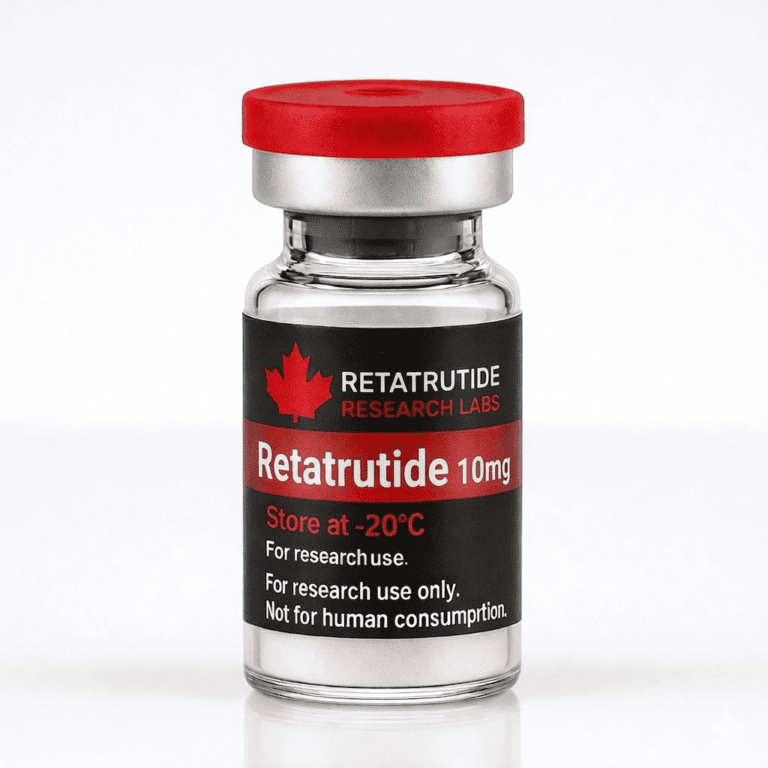 Retatrutide$79.99 CAD
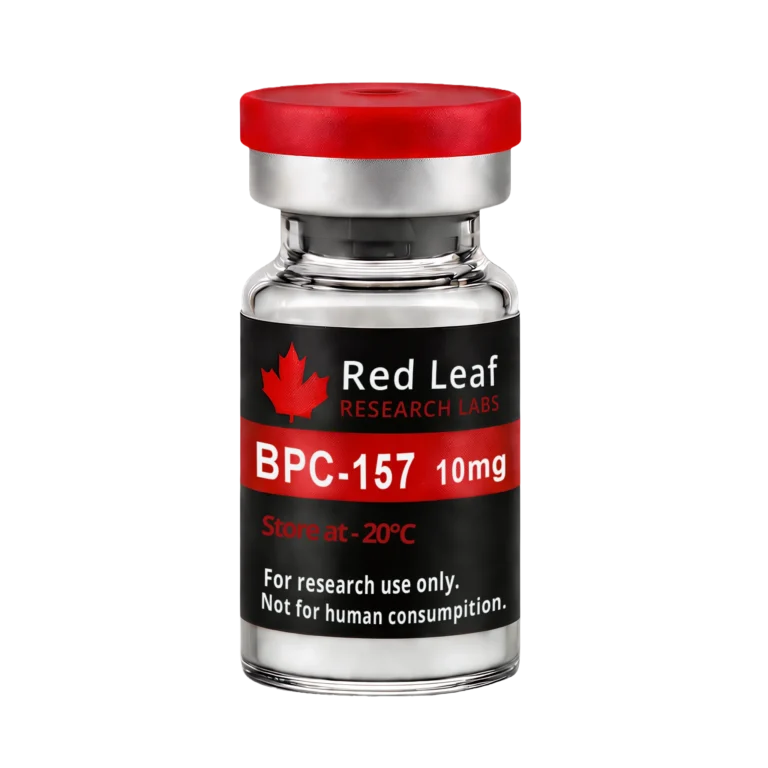 BPC-157 (10mg)$75 CAD
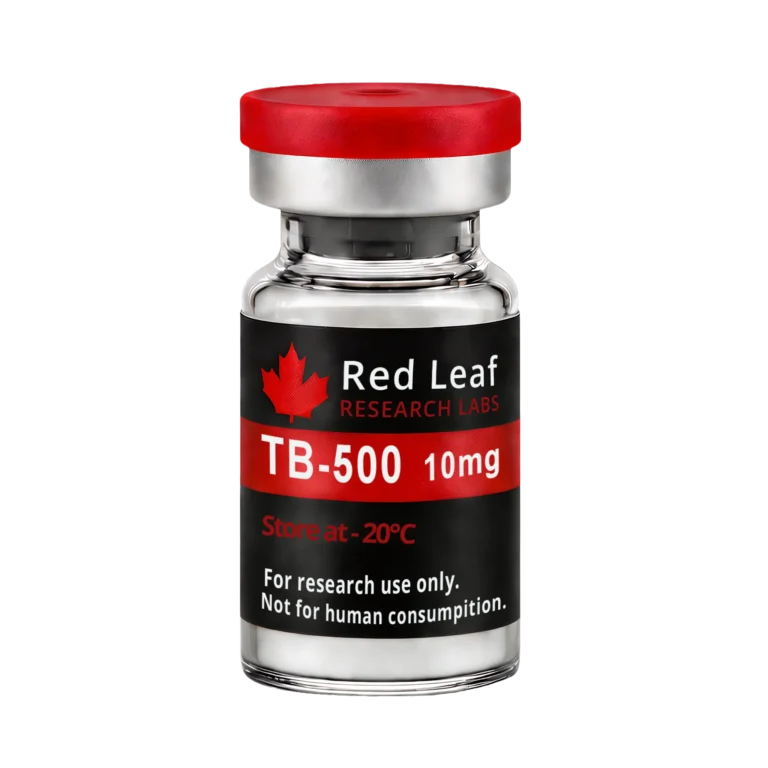 TB-500 (10mg)$84.99 CAD
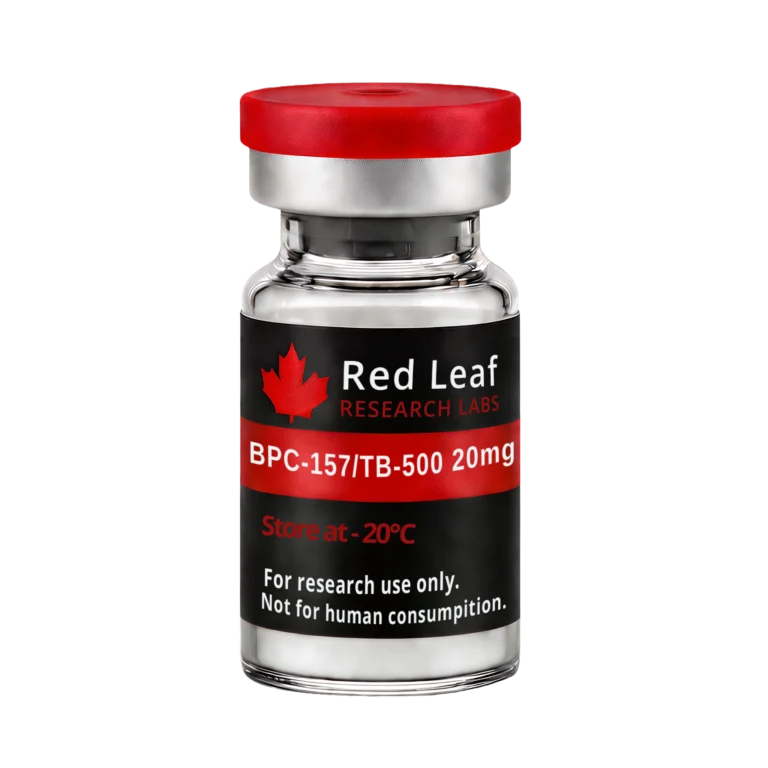 BPC-157 / TB-500 20mg$110 CAD
 Bacteriostatic Water$10 CAD
 Research Pen Add-On$99 CAD
Common questions
Is BPC-157 good for arthritis?
No human trial shows BPC-157 helps arthritis. Animal studies have looked at soft tissue repair. Some results are interesting. But animal results are not human results. Anyone who says it works for arthritis is going past the proof.
Does BPC-157 repair cartilage?
No human study has shown that. Cartilage has almost no blood supply. It is very slow to change. Claims that peptides regrow it in people are not backed by trials.
Where do you inject BPC-157 for a knee?
We do not give injection sites, routes or doses for any product. No human trial has set one. Injecting near a joint carries a real risk of infection. This material is sold for lab research only.
Can retatrutide help knee pain?
A trial has now tested that. TRIUMPH-4 ran on 445 adults with obesity and knee arthritis, for 68 weeks. Knee pain scores fell 4.5 points on 9mg and 4.4 on 12mg. Placebo fell 2.4. About one in eight were pain-free at the end, against one in twenty-four on placebo. Those are topline figures, not a published paper yet.
How much weight does retatrutide cause in trials?
In the published phase 2 trial of 338 adults, the highest dose gave a mean 17.5% weight loss at 24 weeks and 24.2% at 48 weeks. Weight was still falling when the trial ended.
How much load does losing weight take off a knee?
About four pounds per step for every pound of body weight lost. That comes from work at Wake Forest University in 142 adults with knee osteoarthritis. Losing ten pounds is roughly 48,000 pounds less load per knee over a mile walked.
Is BPC-157 banned in sport?
Yes. It is on the World Anti-Doping Agency banned list under S0. That group is for substances no health body has approved. Weight-loss drugs in this class are banned too. Tested athletes should treat both as off limits.
Should BPC-157 and retatrutide be used together?
No published study has tested them together. The idea comes from them aiming at different things. One at the load on the joint, one at the tissue. That is a research reason, not a proven mix.
Can losing weight too fast be bad for knees?
It is a fair question. Fast weight loss can take muscle as well as fat. The muscle around the knee helps support and protect it. Researchers in this area track lean mass for that reason.
Is any of this approved for human use?
No. Retatrutide is still in trials. BPC-157 and TB-500 are not approved by any health body. Everything sold here is lab research material only.
Bottom line
- The load link is real and measured. One pound off your body is about four pounds off each knee, per step.
- Retatrutide has real human data for weight. 28.7% mean loss at 68 weeks in the knee arthritis trial.
- TRIUMPH-4 tested it on knees and reported. 445 people, 68 weeks, pain scores down 4.5 points against 2.4 on placebo.
- A related compound already moved knee pain scores. STEP 9, 407 people, 68 weeks, a clear gap over placebo.
- BPC-157 has no human trials. Animal work only. Doubt every confident claim about it.
- Nobody has tested the pair together. The pairing is a reason, not a plan.
The most useful things on this page are a ratio from 2005 and two trials, one from 2024 and one from 2025. BPC-157 is the part still being worked out.
Other guides on this site
BPC-157 in Canada
The long guide: rules, claims and what the studies do say.
BPC-157 vs TB-500
Two compounds, two literatures, and why stacking them is a guess.
TB-500 in Canada
What thymosin beta-4 research covers, and the anti-doping problem.
What retatrutide does
Three receptors, appetite, fat and the numbers from the trials.
Retatrutide side effects
What the trials reported, without turning it into advice.
Retatrutide cost
Price per mg and per vial, with the math shown.
Research material with outside lab reports linked to the testing lab’s own page, so you can check the result yourself. Free express shipping over $250.
Research use only. Retatrutide, BPC-157 and TB-500 from Red Leaf Research Labs are not approved for cosmetic, treatment, injection, ingestion or any human or animal use. No claims are made about clinical outcomes, safety or effect. Trial figures are reproduced from published research for reference only and are not guidance of any kind. References: Jastreboff AM, et al. Triple-Hormone-Receptor Agonist Retatrutide for Obesity, A Phase 2 Trial. N Engl J Med, 2023. Bliddal H, et al. Once-Weekly Semaglutide in Persons with Obesity and Knee Osteoarthritis. N Engl J Med, 2024. Messier SP, et al. Weight loss reduces knee-joint loads in overweight and obese older adults with knee osteoarthritis. Arthritis Rheum, 2005. United States Anti-Doping Agency, BPC-157 advisory.