Owned and operated by Baba Kahn, a CF veteran


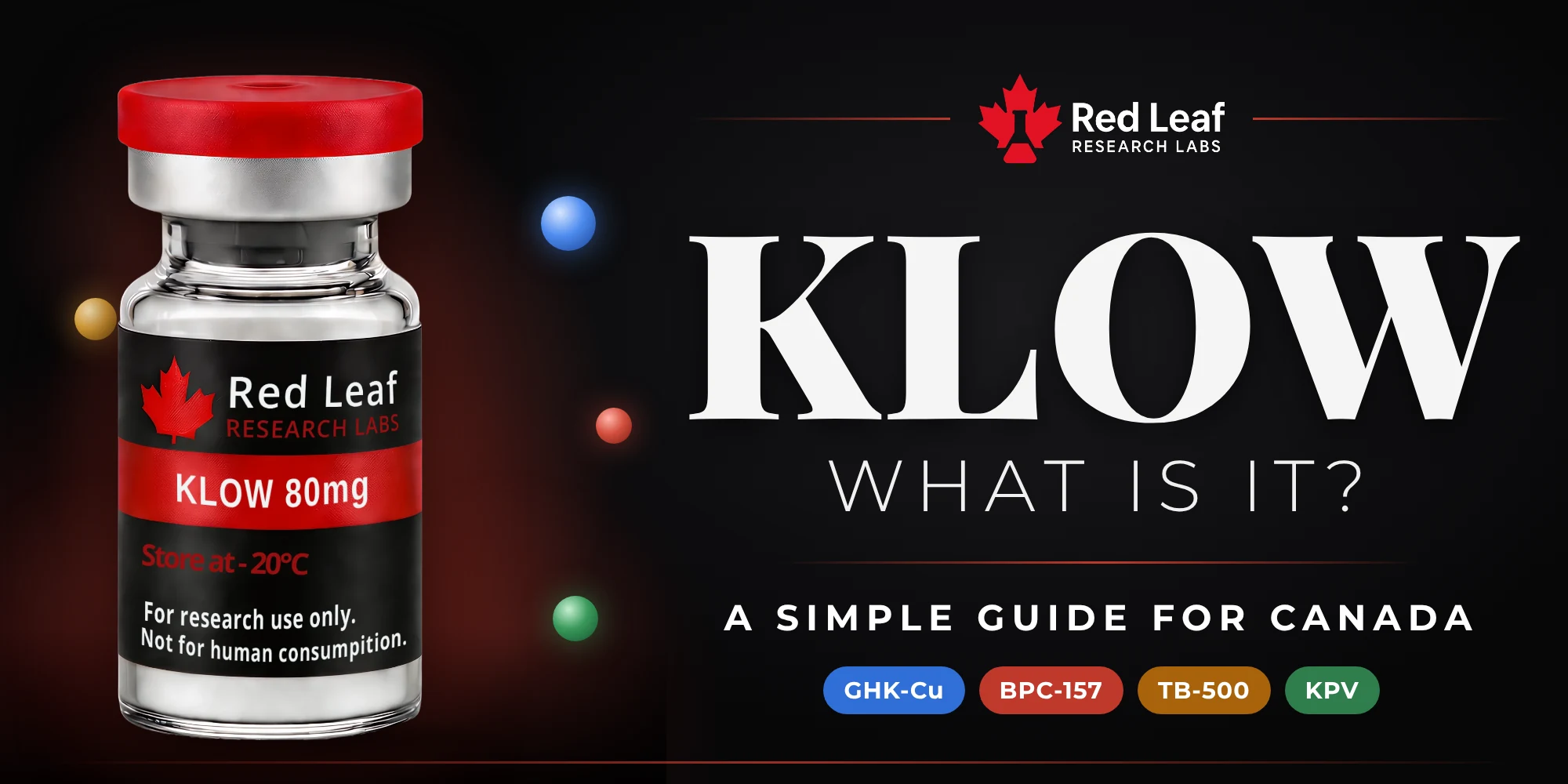
What is KLOW? The KLOW peptide is really four research peptides packed into one vial: GHK-Cu, BPC-157, TB-500 and KPV. This KLOW peptide Canada guide shows what is inside, what labs study each part for, what the rules say and how to check a vial. Plain words and lots of pictures, from a peptides Canada supplier.
- 4 peptides in one vial
- 80 mg in our vial
- 50 mg of it is GHK-Cu
- 0 studies on the blend itself
KLOW is a peptide blend, so it mixes more than one peptide in the same vial. A peptide is a short chain of small parts called amino acids.
A KLOW vial holds four peptides: GHK-Cu, BPC-157, TB-500 and KPV. In our 80 mg vial, 50 mg is GHK-Cu, while the other three have 10 mg each.
So far, each of the four has been studied on its own, mostly in cells and animals. However, the KLOW mix itself has never been studied. It is also not an approved medicine in Canada.
In Canada, Red Leaf sells KLOW 80mg as a freeze-dried powder, for lab research only. Also, an outside lab measured all four parts in our current batch.
What is the KLOW peptide?
First, think of a peptide like a short bracelet of beads. Each bead is an amino acid. In other words, amino acids are the small parts that build every protein in your body.
Most research vials hold one kind of peptide. A KLOW vial, however, holds four. So the KLOW peptide is not really one peptide. Instead, it is a team of four, mixed together by the maker. People still say “the KLOW peptide” because it is easier.
A simple drawing of our freeze-dried powder. The amounts are from our 80 mg vial label, but other sellers may use a different mix.
Also, the four parts come from four different corners of science. In fact, they were found years apart, by different labs. Then, in the last few years, sellers began putting them in one vial and calling it the KLOW peptide.
Where does the KLOW peptide name come from?
Surprisingly, there is no official story. Instead, KLOW is a nickname that sellers use, not a science name. So you will not find it in a chemistry book.
Still, here is an easy way to remember it. First came a mix of two peptides, BPC-157 and TB-500, which many sellers call the Wolverine stack. Then GHK-Cu was added, and the three-peptide mix got the nickname GLOW. Finally, add a fourth peptide, KPV, swap the G for a K, and you get KLOW.
The dotted outline marks the new peptide in each step. Also, Wolverine, GLOW and KLOW are seller nicknames, rather than science names.
What is inside a KLOW peptide vial?
Here are the four parts of the KLOW peptide blend, one by one.
GHK-Cu
3 beads plus 1 copper atom. Dr. Loren Pickart found GHK in human blood in 1973. The copper makes it blue. Face creams also use it, where it is called copper tripeptide-1. So labs often study it for skin and collagen. See GHK-Cu 100mg.
BPC-157
15 beads. A team in Zagreb, Croatia, first wrote about it in 1993. It is based on a protein found in stomach juice. Since then, most of the research has been in rats, on the gut, tendons and muscles. See BPC-157 10mg.
TB-500
7 beads. A short, lab-made copy of one small part of a bigger protein called thymosin beta-4. In fact, almost every cell in your body makes thymosin beta-4. Labs study TB-500 for wound repair and also for how cells move. See TB-500 10mg.
KPV
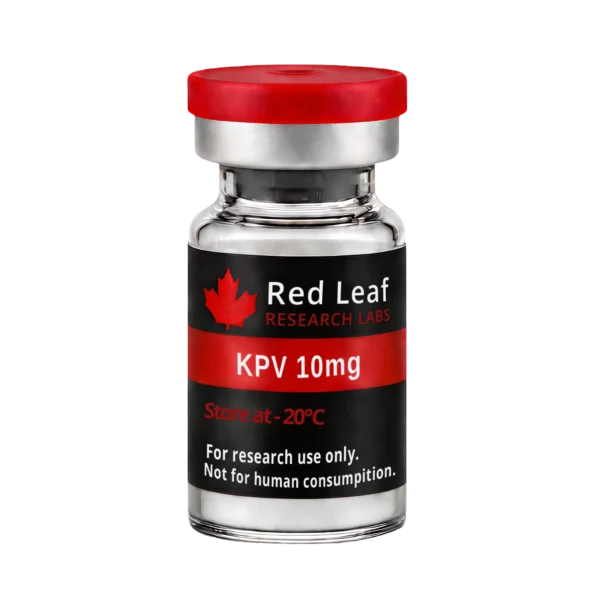
3 beads. The last three beads of a natural hormone called alpha-MSH. Alpha-MSH is best known for skin colour. However, in lab tests KPV seems to calm swelling signals without the skin colour part. So far, labs study it mostly for gut swelling in mice. See KPV 10mg.
Each bead is one amino acid, shown by its one-letter code. TB-500 also has a tiny cap at the start (an acetyl group), not shown.
So the four parts are very different in size. KPV and GHK are tiny, with just three beads each, while BPC-157 is five times longer.
How much of each peptide is in KLOW?
Most KLOW peptide vials sold today hold 80 mg of powder in total. That total is then split between the four parts. For example, our vial is split like this:
Amounts from our KLOW 80 mg label. Also, the lab results for our current batch are further down this page.
So GHK-Cu makes up more than half of the vial, while the other three parts get 10 mg each. However, other sellers may use a different split. That is why you should always compare the label with the lab report.
What do labs study each peptide in KLOW for?
Each part of the KLOW peptide has its own research. Some of the research areas also overlap, and that overlap is one reason people put the four together.
Each peptide was studied on its own, mostly in cells and animals. However, none of these studies used the KLOW mix.
- GHK-Cu: in lab dishes, it helped skin cells make more collagen than usual. Collagen is like the springs in a mattress, because it keeps skin firm.
- BPC-157: studied in rats for the gut, tendons, muscles and wounds. Still, only about 30 people have been in published reports.
- TB-500: studied in cells and animals for wound repair, and also for how cells crawl into a wound to fix it.
- KPV: studied in mice with gut swelling, especially colitis. It gets into gut cells through a doorway called PepT1.
Has the KLOW peptide blend been studied?
No. We could not find one published study on the four-peptide KLOW mix. Not in cells, not in animals and not in people.
Each part does have its own studies, though. But results for one part do not tell you what happens when all four share one vial. So far, nobody has checked that.
Still, the closest thing is a 2026 rat study from Türkiye. In it, scientists tested BPC-157, TB-500 and both together on a cut heel tendon. However, using both did not add extra help. Also, that study covers only two of the four parts, and only in rats.
Each tag shows the highest step that part has reached. A medicine must climb every step before it can be approved.
Why put four peptides in one KLOW vial?
A blend is handy. But it also has trade-offs. So here are both sides.
A simple drawing. Both ways hold the same four peptides, but the blend mixes them for you.
What a blend makes easier
- One vial to buy, store and track instead of four.
- Also, one batch number and one lab report for the whole vial.
- It often costs less than four separate vials.
What to watch for
- You cannot change the mix, because the amounts are fixed.
- The lab report must also measure all four parts, not just one.
- In a study, it is hard to tell which part did what when all four are mixed.
KLOW vs GLOW vs Wolverine peptide blends
These three peptide names often get mixed up, because they share most of their parts. So here is the simple way to tell KLOW apart from the others.
| Wolverine | GLOW | KLOW | |
|---|---|---|---|
| Peptides inside | 2 | 3 | 4 |
| BPC-157 | Yes | Yes | Yes |
| TB-500 | Yes | Yes | Yes |
| GHK-Cu | No | Yes | Yes |
| KPV | No | No | Yes |
| Research areas | Repair | Repair and skin | Repair, skin and gut swelling |
Want to know more about the parts? Read BPC-157 vs TB-500 and our simple guide to GHK-Cu.
Is the KLOW peptide legal in Canada?
Above all, here is the big thing to know. The KLOW peptide is not an approved medicine in Canada. Also, none of its four parts is an approved medicine. So if you are looking at KLOW Canada sellers, it helps to know the rules for peptides in Canada, because they got a lot of attention in 2026. Here is what changed.
Health Canada has not approved KLOW or its parts as medicines. Then, in April 2026, it warned Canadians not to inject peptides bought online. It also said a “research use only” label does not make a product OK for people.
In June 2026, a court in Québec ordered an online seller to stop selling unapproved peptides for injection. Later, Health Canada shared the news in July 2026 and said it will keep watching.
Peptides can still be sold for real lab research. But Health Canada looks at the whole picture: the website, the claims and who is buying. Not just the label.
Finally, the World Anti-Doping Agency (WADA) bans BPC-157 and TB-500 at all times. So every KLOW vial holds two banned substances.
Meanwhile, in the US, the rules for BPC-157 moved a lot in 2026. Our BPC-157 2026 update explains what changed and what did not.
How to check a KLOW peptide vial
A blend is harder to test than a single peptide, because the lab has to find and measure all four parts, not just one. Sadly, some sellers still skip that step.
For example, Finnrick is a group that buys peptides from sellers and sends them to labs. Since May 2026, it has posted 26 KLOW tests from 10 sellers. Here is how they came out.
Counts from Finnrick’s public KLOW page, tests dated May 7 to November 13, 2026. Each dot is one test of one seller’s vial.
In other words, about 1 in 4 KLOW tests failed. So for a blend, the lab report matters even more. Use this checklist:
- Ask for the lab report. It is often called a COA. Also, its batch number should match the one on your vial.
- Look for all four names. A report that only says “KLOW” or gives one total weight is not enough, because a blend has four parts.
- Look at the powder. KLOW should be a dry, freeze-dried powder. Because most of it is GHK-Cu, it usually has a blue tint.
- Check each amount. Then compare each part on the report with the label.
- Check who tested it. The lab should be independent, rather than the seller.
- Make sure you can verify it. Good reports also have a code or link you can check yourself.
Our KLOW peptide lab test
First of all, we sent a sample of our KLOW 80 mg to Janoshik, an independent testing lab. We also asked the lab to measure each of the four parts on its own, rather than one total.
Janoshik report, task 243491. Sample received October 26, 2026, results October 29, 2026. The report lists amounts only, rather than a purity number.
All four parts were there, and each one came in close to its label. For example, GHK-Cu and TB-500 came in a little low, while BPC-157 came in a little high. You can read the full KLOW report, and every other one, on our testing and COA page.
How to store KLOW peptide powder
Freeze-dried peptide powder is a bit like ice cream, because it lasts longest when it stays cold. That is why our KLOW label says to store it at −20 °C, which is about as cold as a home freezer.
- Keep the vial cold, dark and dry until you need it.
- Keep the cap closed tight, so moisture stays out.
- Let a cold vial warm up to room temperature before you open it. This stops water drops from forming inside.
- Also, try not to warm it up and freeze it again and again.
- Keep the batch number, so you can match the vial to its lab report.
- Ordering in summer? Read how we ship peptides in Canadian heat.
Buying the KLOW peptide in Canada
When you search for KLOW Canada, you will find sellers in Canada, the US and overseas. However, for a Canadian lab, buying peptides in Canada has some clear upsides. Here are four simple steps.
Buy in Canada
No border delays, customs holds or surprise fees. Also, prices are in Canadian dollars.
Read the report
Before you buy, find a lab report that names and measures all four parts.
Match the batch
When the vial arrives, its batch number should match the report.
Keep it cold
Put the vial in the freezer when it arrives.
Red Leaf ships peptides Canada-wide by express from Ontario. Also, our KLOW peptide has a lab report for the current batch. Thinking of changing where you buy? Read how to switch peptide suppliers in Canada safely and how to spot bad peptide sellers.
More guides on the KLOW peptides
Each of these guides covers one part of KLOW, or a blend like it.
The GLOW stack
KLOW without the KPV. Read the GLOW guide.
GHK-Cu in Canada
Why it is blue and what labs study it for. Read the GHK-Cu guide.
BPC-157 vs TB-500
Two of the four parts, side by side. Read the comparison.
TB-500 in Canada
Where TB-500 comes from and what it is. Read the TB-500 guide.
BPC-157 in 2026
New studies, new rules and prices. Read the 2026 update.
KPV and the gut
What KPV and other peptides do in gut research. Read the gut guide.
Peptides Canada: 2026
Five research advances to watch this year. Read the roundup.
New to peptides?
The basics, in a few minutes. Read the beginner guide.
KLOW peptide in our shop
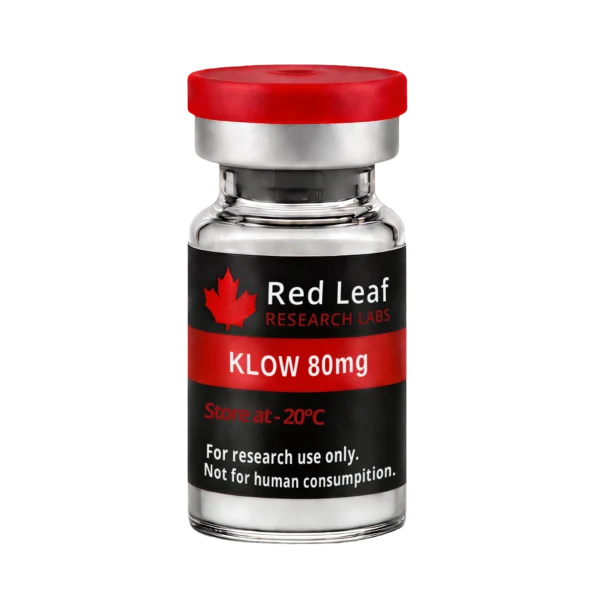
Looking for a KLOW peptide Canada seller you can check? If so, our KLOW comes as 80 mg of freeze-dried powder in a 3 mL vial, with a lab report for the batch. Want to study one part at a time? Then each part is also sold on its own.

Questions people ask
What is KLOW peptide?
KLOW is a blend of four research peptides in one vial: GHK-Cu, BPC-157, TB-500 and KPV. So it is not one single peptide. People call it the KLOW peptide because that is easier to say. Also, it is sold for lab research only.
What does KLOW stand for?
There is no official meaning, because KLOW is just a nickname that sellers use. Still, an easy way to remember it: take the GLOW blend (GHK-Cu, BPC-157 and TB-500) and add a K for KPV.
What is the difference between KLOW and GLOW?
GLOW has three peptides: GHK-Cu, BPC-157 and TB-500. KLOW, however, has the same three plus a fourth one, KPV.
How much of each peptide is in KLOW?
Our 80 mg vial is labelled 50 mg GHK-Cu and 10 mg each of BPC-157, TB-500 and KPV. Other sellers may use a different split, so always check the lab report for the batch.
Has KLOW been tested in people?
No. So far, we could not find any published study of the four-peptide KLOW blend, in people or in animals. However, each part has been studied on its own, mostly in cells and animals.
Is KLOW approved in Canada?
No. Health Canada has not approved KLOW or any of its four parts as a medicine. Then, in April 2026, Health Canada warned Canadians not to inject peptides bought online. It also said a “research use only” label does not make a product OK for people.
Can you buy KLOW in Canada?
Yes, as a research material for lab use. So for KLOW Canada buyers, Red Leaf sells KLOW 80mg to researchers in Canada, with an outside lab report for the batch. However, it is not sold for use in people or animals.
Is the KLOW peptide a powder or a liquid?
Our KLOW is a lyophilized (freeze-dried) powder in a sealed 3 mL vial, rather than a liquid. Lyophilized means the water was taken out, so the peptides stay stable for longer. Also, because most of the vial is GHK-Cu, the powder usually has a blue tint.
How should KLOW be stored?
Our KLOW label says to store the powder at −20 °C. Until you need it, keep the vial cold, dark, dry and closed tight. Also, let a cold vial warm up to room temperature before you open it, so no water drops form inside.
Is KLOW banned in sports?
Two of its parts are. In fact, the World Anti-Doping Agency (WADA) bans BPC-157 and TB-500 at all times. So athletes who get tested should stay away from KLOW.
KLOW is four peptides in one vial: GHK-Cu, BPC-157, TB-500 and KPV. Each part has its own early research, mostly in cells and animals, so the proof in people is thin. However, the blend itself has never been studied, and it is not an approved medicine in Canada. So if you buy the KLOW peptide for lab research, make sure the lab report names and measures all four parts.
KLOW (80mg)See our test sheetsSources
The four peptides
- Pickart L, Thaler MM. Tripeptide in human serum which prolongs survival of normal liver cells and stimulates growth in neoplastic liver. Nature New Biology, 1973; 243: 85–87.
- Pickart L, Margolina A. Regenerative and protective actions of the GHK-Cu peptide in the light of the new gene data. International Journal of Molecular Sciences, 2018; 19(7): 1987. Read the review
- Sikirić P, Petek M, Ručman R, et al. A new gastric juice peptide, BPC. An overview of the stomach-stress-organoprotection hypothesis and beneficial effects of BPC. Journal of Physiology (Paris), 1993; 87: 313–327.
- Vasireddi N, Hahamyan H, Salata MJ, et al. Emerging use of BPC-157 in orthopaedic sports medicine: a systematic review. HSS Journal, 2025; 21(4): 485–495. View on PubMed Central
- Goldstein AL, Hannappel E, Sosne G, Kleinman HK. Thymosin β4: a multi-functional regenerative peptide. Basic properties and clinical applications. Expert Opinion on Biological Therapy, 2012; 12(1): 37–51.
- Dalmasso G, Charrier-Hisamuddin L, Nguyen HTT, et al. PepT1-mediated tripeptide KPV uptake reduces intestinal inflammation. Gastroenterology, 2008; 134(1): 166–178. View on PubMed Central
- Kannengiesser K, Maaser C, Heidemann J, et al. Melanocortin-derived tripeptide KPV has anti-inflammatory potential in murine models of inflammatory bowel disease. Inflammatory Bowel Diseases, 2008; 14(3): 324–331.
Studies with more than one part
- Biçer O, Adanir O, Güleryüz Y, et al. Effects of BPC-157 and TB-500 on Achilles tendon healing in rats: a histopathological and biomechanical study. Joint Diseases and Related Surgery, 2026; 37(3): 822–837. Read the study
Rules and news
- Health Canada. Think twice before injecting peptides bought online: unauthorized products can seriously harm your health. Public advisory RA-81874, April 9, 2026. Read the advisory
- Jospé D, Ellbogen E, Letellier J. Life sciences: Health Canada takes action against unauthorized peptide sales. Fasken, August 2026. Read the bulletin
- Powers J-P. Peptides in Canada: regulatory reality is catching up with the hype. Gowling WLG, September 9, 2026. Read the article
- World Anti-Doping Agency. 2026 Prohibited List (S0 non-approved substances; S2 peptide hormones, growth factors and related substances). View the list
Testing
- Finnrick. KLOW: independent test results by seller. Checked November 18, 2026. View the results
- Janoshik Analytical. KLOW 80 mg, task 243491, for Red Leaf Research Labs. October 29, 2026. View our report
Research use only. KLOW, GHK-Cu, BPC-157, TB-500, KPV and every other compound named here are sold by Red Leaf Research Labs as laboratory materials for in-vitro research. They are not approved for cosmetic, treatment, injection, ingestion or any human or animal use. Nothing on this page is medical advice, a dose, or a protocol. Study findings are described from published research so readers can see what was measured. Rules and test counts are current to November 18, 2026. Full wording on our legal terms page.