Owned and operated by Baba Kahn, a CF veteran

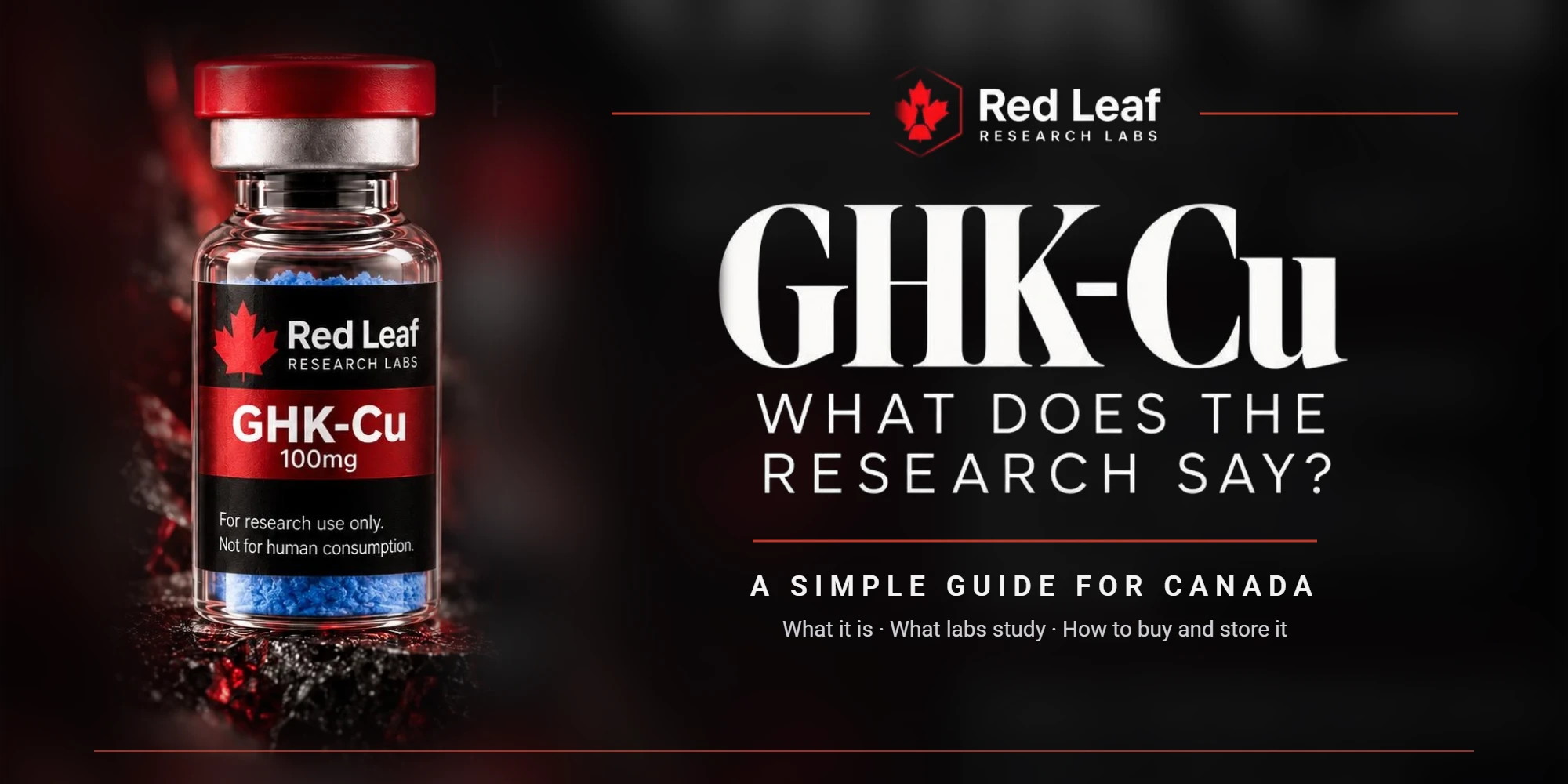
What is GHK-Cu? It is a tiny copper peptide that our bodies make. Scientists have studied it since 1973. This GHK-Cu peptide Canada guide shows what it is, why it is blue, what labs study it for, and how to buy and store it. Plain words, lots of pictures.
- 1973 the year it was found
- 3 building blocks
- 1 copper atom
- 8 easy pictures
GHK-Cu is a peptide. A peptide is a short chain of small parts called amino acids. GHK-Cu has just three of them. They hold on to one copper atom.
Your body makes GHK. It is in your blood, your spit and your pee. A scientist named Dr. Loren Pickart found it in human blood in 1973.
Labs study GHK-Cu to learn about skin, healing and aging. Skincare brands also put it in face creams. On those labels it is called copper peptide.
In Canada, Red Leaf sells GHK-Cu 100mg as a dry powder for lab research. An outside lab tests every batch.
What is GHK-Cu?
Think of a peptide like a short bracelet of beads. Each bead is an amino acid. Amino acids are the small parts that build every protein in your body.
GHK-Cu has three beads. G stands for glycine. H stands for histidine. K stands for lysine. Scientists give each amino acid one letter. That is where the name GHK comes from.
The Cu part means copper. Cu is the science sign for copper. The three beads hold on to one copper atom, a bit like a hand holding a coin.
A simple drawing, not to scale. Real atoms are far too small to see.
On skincare labels, GHK-Cu often goes by another name: copper tripeptide-1. “Tri” means three, for the three beads.
Why is GHK-Cu blue?
Most peptide powders are white. GHK-Cu is not. It is blue.
The blue comes from the copper. When copper joins the three beads, the powder turns a deep blue. When a lab mixes it with water, the water turns blue too.
A simple drawing. The exact shade of blue can change a little from batch to batch.
So if a vial sold as GHK-Cu holds plain white powder, ask the seller why. The copper is what makes it GHK-Cu.
Where did GHK-Cu come from?
In 1973, Dr. Loren Pickart was studying blood from young and older people. He saw that blood from young people helped old liver cells in a lab dish act more like young cells. He tracked this down to a tiny piece in the blood. That piece was GHK.
Dates from the published papers listed under Sources at the end of this guide.
Want the longer story? Read GHK-Cu, Cleopatra and the history of copper in skin care.
GHK and age
Researchers report that people have less GHK in their blood as they get older. At age 20 there is about 200 nanograms in each millilitre of blood. By age 60 it drops to about 80. A nanogram is a very, very tiny amount.
Blood levels as reported by Pickart and co-workers (BioMed Research International, 2015). Rounded.
This drop is one reason scientists study GHK-Cu in research on aging skin.
What do labs study GHK-Cu for?
Most GHK-Cu research has been done on cells in lab dishes and on animals. A few small studies have tested face creams. Here are the main areas.
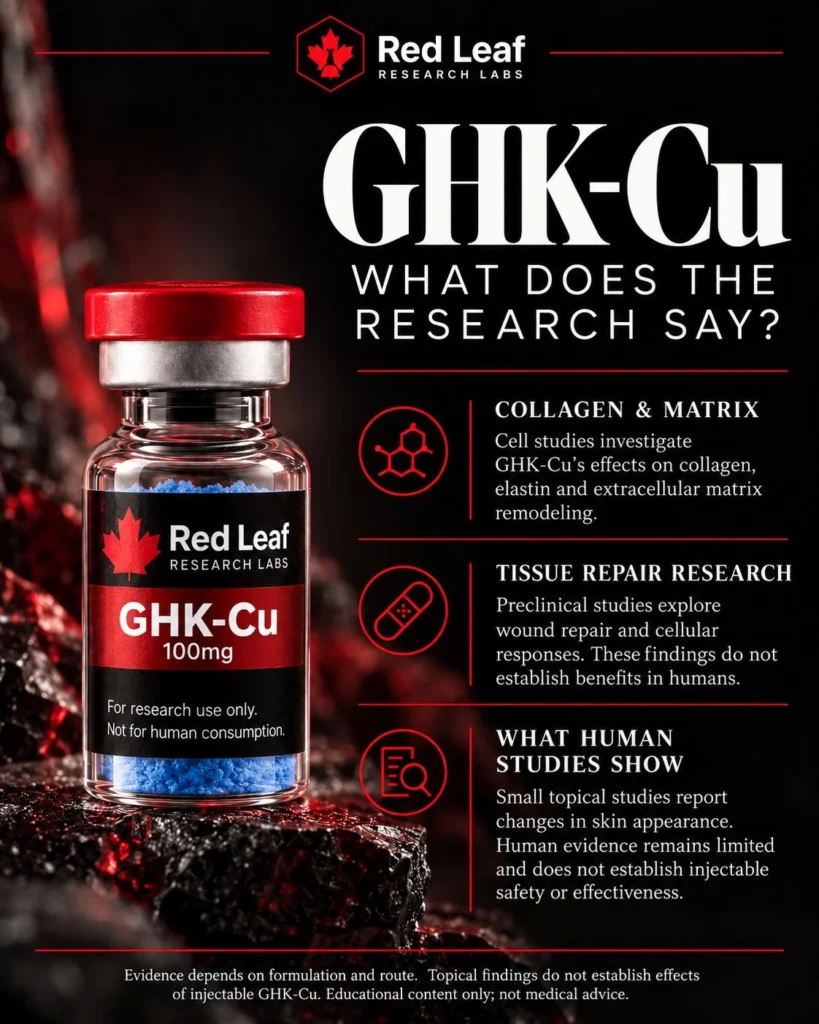
Lab and animal studies look at collagen and wound repair. Studies in people are small. They only tested creams on skin.
Skin and collagen
Collagen is like the springs in a mattress. It helps keep skin firm. In lab dishes, GHK-Cu helped skin cells make more collagen.
Wound healing
In a 1993 study, rat wounds that got GHK-Cu built up much more collagen than wounds that did not.
Face creams
Small studies tested creams with GHK-Cu on aging skin. The groups were small and the tests were short.
Hair
Copper peptides show up in many hair products. Lab work has looked at hair roots, but big studies in people are missing.
Calming signals
Lab tests suggest GHK-Cu can turn down some swelling signals in cells. Swelling is your body’s alarm system.
Genes
Some lab data suggest GHK can turn many genes up or down. This is early science, and it is still being checked.
A simple picture of the published research, not exact counts.
None of this makes GHK-Cu a medicine. It is not approved to treat any illness. That is why research vials are sold for lab use only. Curious about skin topics? See GHK-Cu and acne and copper peptides in skincare.
Face cream or research vial?
In Canadian stores you can find creams and serums that list copper peptides. A research vial is something different. Here is how they compare.
Left: a simple drawing of a typical serum bottle. Right: our GHK-Cu 100mg vial.
| Face serum | Research vial | |
|---|---|---|
| What it is | A cream or liquid for skin | Dry blue powder in a sealed glass vial |
| How much GHK-Cu | A small amount, often not listed | 100mg, checked by a lab |
| Who it is for | Shoppers | Labs and researchers |
| Testing | Depends on the brand | An outside lab report for each batch |
| Use | On skin | Lab research only |
How to check GHK-Cu quality
Not every vial is what it says. Use these four checks before you buy.
- Look for a lab report. A good seller shows a test report from an outside lab. It is often called a COA. Red Leaf posts one for every batch. See how our testing works.
- Check the colour. GHK-Cu powder should be blue.
- Check the amount. The label and the lab report should show the same amount, like 100mg.
- Buy in Canada. A Canadian seller means no border delays and no surprise fees. Red Leaf ships express from Ontario.
A simple drawing. Real reports list more details, such as the test method and date.
Thinking of changing where you buy? Read how to switch peptide suppliers in Canada safely.
How to store GHK-Cu
Peptide powder is a bit like ice cream. It lasts longest when it stays cold. Our GHK-Cu label says to store it at −20 °C.
General storage tips for dry peptide powder. Always follow the label on your vial.
- Keep the vial cold, dark and dry.
- Keep the cap closed tight.
- Let a cold vial warm up to room temperature before you open it. This stops water drops from forming inside.
- Ordering in summer? Read how we ship peptides in Canadian heat.
More GHK-Cu guides
Want to dig deeper? These guides each cover one topic.
The history of copper in skincare
From Cleopatra to the lab. Read the history guide.
GHK-Cu and acne
What the research does and does not show about pimples. Read the acne guide.
GHK-Cu and hair
How copper peptides fit with other hair-loss research. Read the hair guide.
Copper peptides and skincare
Creams, serums and what studies looked at. Read the skincare guide.
GHK-Cu in our shop
Looking for a GHK-Cu peptide Canada seller you can check? Ours comes as a 100mg dry powder. You can pick a 3 mL or a 10 mL vial. Every batch has an outside lab report on the product page.

Questions people ask
What is GHK-Cu?
GHK-Cu is a small peptide made of three amino acids (glycine, histidine and lysine) that hold one copper atom. The body makes it, and it was first found in human blood in 1973.
What does GHK-Cu do?
In lab dishes, GHK-Cu helped skin cells make more collagen. In animal studies, wounds treated with it built more collagen. Small face-cream studies have also been done. It is not an approved medicine.
Is GHK-Cu the same as copper peptide?
Mostly, yes. “Copper peptide” is the everyday name, and GHK-Cu is the best-known one. On skincare labels it is often called copper tripeptide-1.
Why is GHK-Cu blue?
The copper makes it blue. Most peptide powders are white, but GHK-Cu powder is a deep blue.
Can you buy GHK-Cu in Canada?
Yes. Red Leaf Research Labs sells GHK-Cu 100mg for lab research, shipped express from Ontario, with an outside lab report for every batch.
How should GHK-Cu powder be stored?
Keep it cold, dark and dry. A freezer at −20 °C is best for a long time, and a fridge is fine for a short time. Let a cold vial warm up before opening it.
Is GHK-Cu safe?
Face creams with GHK-Cu were well tolerated in small studies on aging skin. Research vials are different: they are sold for lab research only and are not for people or animals.
Every Red Leaf vial carries an independent lab report with a verify link, right on the product page. Free express shipping on Canadian orders over $250.
GHK-Cu (100mg)Browse the full catalogueSources
- Pickart L, Thaler MM. Tripeptide in human serum which prolongs survival of normal liver cells and stimulates growth in neoplastic liver. Nature New Biology, 1973; 243: 85–87.
- Schlesinger DH, Pickart L, Thaler MM. Growth-modulating serum tripeptide is glycyl-histidyl-lysine. Experientia, 1977; 33: 324–325. View on PubMed
- Maquart FX, Pickart L, Laurent M, Gillery P, Monboisse JC, Borel JP. Stimulation of collagen synthesis in fibroblast cultures by the tripeptide-copper complex glycyl-L-histidyl-L-lysine-Cu2+. FEBS Letters, 1988; 238: 343–346. View the paper
- Maquart FX, Bellon G, Chaqour B, et al. In vivo stimulation of connective tissue accumulation by the tripeptide-copper complex glycyl-L-histidyl-L-lysine-Cu2+ in rat experimental wounds. Journal of Clinical Investigation, 1993; 92(5): 2368–2376. View the paper
- Gorouhi F, Maibach HI. Role of topical peptides in preventing or treating aged skin. International Journal of Cosmetic Science, 2009; 31(5): 327–345. View the paper
- Pickart L, Vasquez-Soltero JM, Margolina A. GHK peptide as a natural modulator of multiple cellular pathways in skin regeneration. BioMed Research International, 2015: 648108. View on PubMed
- Pickart L, Margolina A. Regenerative and protective actions of the GHK-Cu peptide in the light of the new gene data. International Journal of Molecular Sciences, 2018; 19(7): 1987. View on PubMed
Research use only. GHK-Cu, SNAP-8, glutathione and every other compound named here are sold by Red Leaf Research Labs as laboratory materials for in-vitro research. They are not approved for cosmetic, treatment, injection, ingestion or any human or animal use. Nothing on this page is medical advice, a dose, or a protocol. Study findings are described from published research so readers can see what was measured. Full wording on our legal terms page.