Owned and operated by a cf veteran

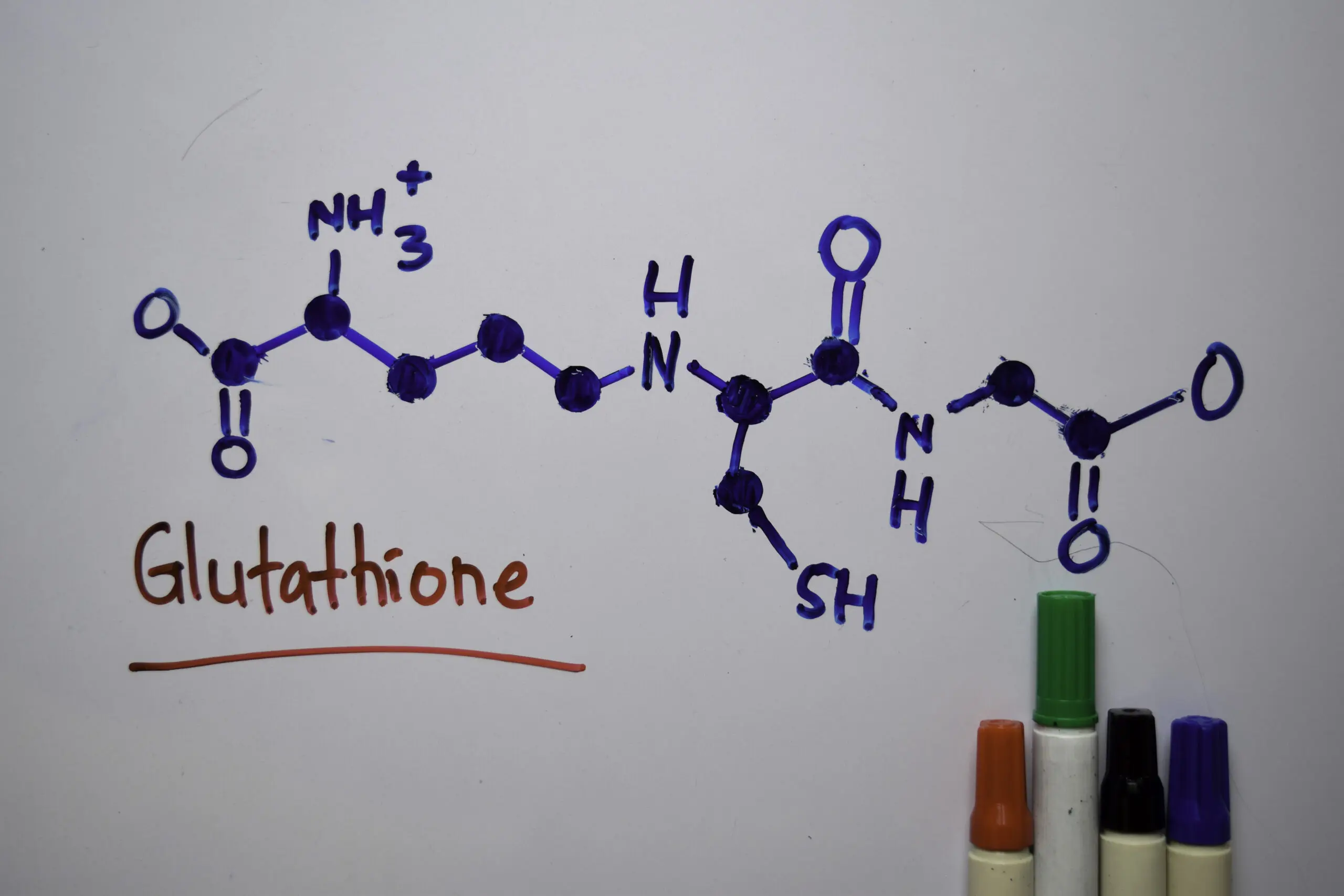
What the glutathione research covers, and where the marketing claims outrun it.
- Endogenous antioxidant
- Delivery is the problem
- Skin claims unproven
- Research use only
Glutathione is the antioxidant your cells already make, and the research question is almost entirely about delivery — getting meaningful amounts into circulation is hard, which is what most of the supplement market quietly ignores.
Glutathione is a naturally occurring tripeptide made from glutamate, cysteine and glycine. In Canadian research settings, it is studied primarily for its role in cellular redox balance, antioxidant defence, detoxification pathways and mitochondrial function. This guide explains the science, Canadian regulatory context and key questions researchers ask about glutathione.
Research-use notice: This article is educational and does not provide medical advice. Research materials sold by Red Leaf Research Labs are not approved by Health Canada for ingestion, injection, therapeutic treatment, cosmetic application, or human or animal use.
What Is Glutathione?
Glutathione, commonly abbreviated GSH, is a small molecule produced in cells throughout the body. It consists of three amino acids: glutamate, cysteine and glycine. The reduced form, GSH, can donate electrons to help neutralize reactive molecules; in the process it becomes oxidized glutathione, or GSSG.
Enzymes can convert GSSG back to GSH. This reversible cycle is one reason glutathione is central to redox biology and is often described as the “master antioxidant.” That phrase is informal, but it reflects glutathione’s broad participation in cellular antioxidant systems.
Why Is Glutathione Studied?
Researchers investigate glutathione because it participates in several connected biological systems:
- Antioxidant defence: GSH helps cells manage reactive oxygen species and oxidative stress.
- Enzyme activity: Glutathione is a substrate for enzymes including glutathione peroxidases and glutathione S-transferases.
- Redox signalling: The balance between GSH and GSSG is used in research as one indicator of cellular redox state.
- Detoxification pathways: Glutathione conjugation helps make certain compounds easier for cells to process and eliminate.
- Mitochondrial research: Scientists study glutathione in relation to mitochondrial protection and cellular energy metabolism.
- Immune-system research: Glutathione status is studied in connection with immune-cell function and inflammatory signalling.
Potential Glutathione Benefits: What the Research Means
Searches for “glutathione benefits” often mix basic science, clinical research and product marketing. These are not interchangeable. Laboratory findings can identify a biological mechanism without proving that a particular product, dose or route produces a health benefit in people.
Antioxidant and cellular protection research
Glutathione helps maintain proteins in an appropriate redox state and supports enzymes that reduce peroxides. This makes it important in studies of oxidative stress and cellular integrity.
Liver and detoxification research
The liver contains substantial glutathione activity. Researchers study glutathione conjugation and related enzymes to understand how cells process endogenous compounds and some foreign chemicals. “Detox” should not be interpreted as evidence that an unapproved product treats poisoning or disease.
Mitochondrial and aging research
Because mitochondria generate reactive species during normal energy production, mitochondrial glutathione is an active research topic. Changes in glutathione status have also been observed with aging and in many disease states, but association alone does not establish a treatment effect.
Glutathione in Canada: Regulatory Context
In Canada, a finished natural health product intended for human use generally requires authorization and a Natural Product Number (NPN) before it can legally be sold with approved health claims. Consumers can verify licensed products in Health Canada’s Licensed Natural Health Products Database.
A laboratory research reagent is different from a licensed natural health product. “Research grade,” a purity percentage or a certificate of analysis does not mean that a material is approved, sterile, clinically effective or suitable for human use. Intended use and regulatory status should always be stated clearly.
What Should Canadian Researchers Look For?
When sourcing glutathione in Canada for legitimate laboratory work, assess the documentation rather than relying on marketing language alone:
- Clearly stated chemical identity and form
- Lot or batch number that matches the container
- Lot-specific certificate of analysis
- Named analytical method and testing laboratory
- Reported purity and any relevant limitations
- Storage, handling and stability information
- Unambiguous research-use-only labelling
- Canadian shipping terms and traceable supplier contact information
A COA is most useful when it identifies the actual lot, test method, date and laboratory. It should not be treated as proof of medical safety or regulatory approval.
Frequently Asked Questions About Glutathione Canada
What is glutathione?
Glutathione is a tripeptide composed of glutamate, cysteine and glycine. Cells use it in antioxidant defence, redox regulation and enzyme-mediated detoxification pathways.
Why is glutathione called the master antioxidant?
The nickname refers to its presence across many cells, its recyclable reduced and oxidized forms, and its interaction with multiple antioxidant enzymes. It is a popular description, not an official medical classification.
Is glutathione approved by Health Canada?
Some finished natural health products containing glutathione may be licensed for specific uses and carry an NPN. That does not make every glutathione material or research reagent approved for human use. Check the individual product in Health Canada’s database.
Is research-grade glutathione intended for people?
No. A material labelled for laboratory research only is not intended for ingestion, injection, therapeutic treatment, cosmetic application, or human or animal use.
Does a certificate of analysis prove a product is safe?
No. A COA reports selected analytical results for a sample or lot. It does not by itself establish sterility, clinical safety, efficacy, regulatory approval or suitability for a particular use.
How should glutathione be stored?
Storage requirements depend on the specific form, formulation and supplier documentation. Researchers should follow the lot documentation and label rather than assuming that all glutathione materials have identical stability requirements.
Key Takeaways
- Glutathione is a naturally occurring tripeptide central to cellular redox biology.
- Its roles in antioxidant defence, enzyme systems, mitochondria and detoxification are active areas of research.
- Mechanistic or laboratory findings do not automatically prove clinical benefit.
- In Canada, licensed human-use products and laboratory research reagents have different regulatory status.
- Researchers should prioritize traceable, lot-specific analytical documentation and clear intended-use labelling.
Scientific and Canadian Sources
- Wu G, Fang YZ, Yang S, Lupton JR, Turner ND. Glutathione metabolism and its implications for health. Journal of Nutrition. 2004;134(3):489–492.
- Forman HJ, Zhang H, Rinna A. Glutathione: overview of its protective roles, measurement, and biosynthesis. Molecular Aspects of Medicine. 2009;30(1–2):1–12.
- Lu SC. Regulation of glutathione synthesis. Molecular Aspects of Medicine. 2009;30(1–2):42–59.
- Health Canada. Licensed Natural Health Products Database.
Last reviewed: August 2026. This page is provided for research education only and does not replace advice from a qualified health professional or regulatory specialist.
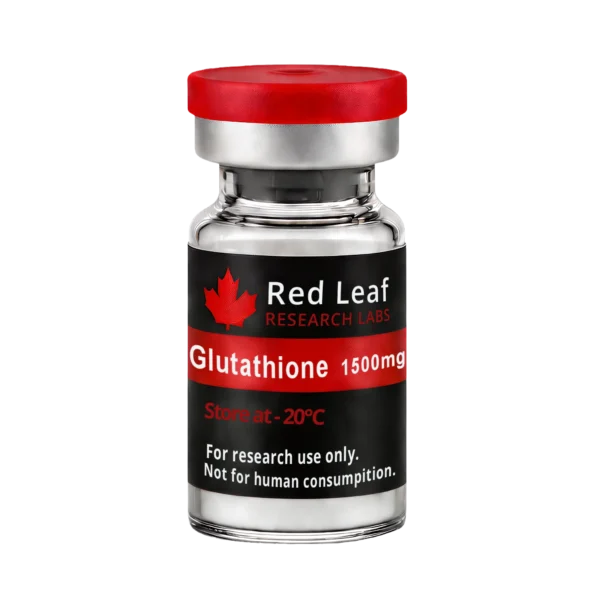 Glutathione 1500mg$59.99 CAD · research use only
 NAD+$120 CAD · research use only
 SS-31 50mg$150 CAD · research use only
 GHK-Cu 100mg – 3ml Vial$64.99 CAD · research use only
 Bacteriostatic Water$10 CAD · research use only
 Peptide Pens Canada – Red Leaf Research Pen Add-On$99 CAD · research use only
Every product page carries its batch lab report with a verification link you can check at the testing laboratory, not just a PDF we host.
Browse the catalogue See the lab test sheetsResearch use only. Products sold by Red Leaf Research Labs are not approved by Health Canada for cosmetic application, therapeutic treatment, injection, ingestion, or any form of human or animal use. No claims are made regarding clinical outcomes, safety or efficacy. Pricing and stock are current at the time of publication and subject to change.