Owned and operated by a cf veteran
DSIP, night shifts and emergency work. What the human trials on this peptide really found. Why so many shift workers sleep badly. And the one test that finds the thing no peptide can fix.
- 31% of first responders screen positive for shift work disorder
- 30% screen positive for sleep apnea
- 4 in 5 with apnea have never been told
- Lot-tested with outside lab reports
DSIP is a small peptide found in rabbit brain blood in 1974. It was named for slow deep sleep because it seemed to bring it on. The human research is thin and old. Small studies in the 1980s looked good. Then one proper placebo test in 1992 found almost nothing. Every one of those trials used a drip into a vein, not a shot under the skin. So the route people use now has never been tested. Meanwhile the reason shift workers land on pages like this is well measured. Across 28 studies and 100,080 first responders, 31% screened positive for shift work disorder and 30% for sleep apnea. And roughly four out of five people with real apnea have never been told they have it. That matters here more than any peptide. Apnea is a blocked airway. No peptide opens an airway. A sleep study finds it. And treating it cut crash risk by about 72% in one pooled look at nine studies.
- What DSIP is
- What the human trials found
- The route no one tested
- Why shift workers end up here
- The apnea problem
- Telling the three apart
- What a sleep study is
- What night work does over years
- What has been measured as working
- DSIP against the tested options
- What goes wrong in this area
- What to check before you buy
- Common questions
- Bottom line
- Other guides on this site
What DSIP is
DSIP stands for delta sleep-inducing peptide. Delta means the slow brain waves of deep sleep.
It is a short chain of nine amino acids. The letters are W-A-G-G-D-A-S-G-E. It weighs about 850 daltons. That is tiny as peptides go.
Where it came from
A Swiss team led by Schoenenberger and Monnier found it in 1974.
Here is how. They put rabbits into a sleep-like state. Then they took blood from the veins leaving the brain. Something in that blood seemed to push other rabbits toward slow wave sleep. They pulled it out and named it after what it seemed to do.
That is the whole origin story. A rabbit study, fifty years ago.
The odd part
Fifty years on, some basic things are still unknown.
No one has found the gene that makes it. No one has found a receptor it binds to. No one has found the larger molecule it gets cut from.
It does turn up in the body. In the hypothalamus, in the limbic system, in the pituitary. Also in blood and other fluids. It has even been found in human breast milk.
But how the body makes it is still an open question. One gene search even matched it to a germ protein. That raised an odd idea. It might not be ours at all.
It also breaks down fast. In lab conditions its half-life is about 15 minutes.
What the human trials found
This is the part that matters, and most pages tell only half of it.
There were a handful of small human studies, mostly in the 1980s. Then the trail goes cold.
The studies that looked good
| Year | People | What it reported |
|---|---|---|
| 1981 | 6 | Faster sleep onset, better sleep efficiency |
| 1984 | 10 | Fewer wake-ups, more slow wave sleep |
| 1986 | 18 | Sleep returned to normal values by the end |
The 1986 one is the biggest of them. Schneider-Helmert gave 18 people with long-standing insomnia six doses over a week. He reported sleep normalising, and holding through a follow-up week.
Read those numbers again though. Six people. Ten people. Eighteen people.
And those studies were not placebo-controlled in the way a modern trial would be. Tell someone you are giving them a sleep compound. Then ask if they slept better. You will often get a yes.
The study that was built right
In 1992 a Dutch team ran the test that should settle it.
Bes and co-workers used a double-blind design with matched pairs. Sixteen people with chronic insomnia. Half got DSIP, half got a glucose solution. Neither the patients nor the staff knew which. Sleep was measured with electrodes, not just asked about.
The results were weak. Sleep efficiency and sleep latency looked slightly better on DSIP. Most other measures showed nothing. And some of the difference could be explained by what the placebo group did.
Their own conclusion: short-term treatment of chronic insomnia with DSIP is not likely to be of major therapeutic benefit.
That is the researchers’ wording, not ours.
So the honest summary is this. The small open studies looked promising. The one study built to rule out wishful thinking largely did not back them up. And no one has run a bigger one since.
The route no one tested
Here is a thing almost no page mentions, and it changes how you read all of the above.
Every one of those human trials put DSIP straight into a vein. A drip, in a sleep lab, measured in nanomoles per kilogram of body weight.
The 1992 trial used 25 nmol/kg by vein. The 1986 one used 30 nmol/kg by vein.
That is not how people handle this material now. The common route today is a shot under the skin, which is a completely different thing. It absorbs slower, reaches different levels, and passes through different tissue on the way.
No published human trial has tested that route.
So even if you take the 1980s results at face value, they do not transfer. They are results for a drip, not for much else.
Why shift workers end up here
People do not search for sleep peptides because they are curious. They search because they are wrecked.
If you work nights, your body clock is being asked to do what it does not want to do. You sleep when it is light and the phone rings. You work when your body wants to shut down.
For emergency services it is worse again. The shifts rotate. The calls do not wait. You go from asleep to running in under a minute, then back again.
How common this is, measured
In 2022 a team pooled 28 studies of first responders. That covered 100,080 people. Police, fire, paramedics and emergency medical staff.
| What they screened for | How many screened positive | Range |
|---|---|---|
| Shift work disorder | 31% | 15% to 53% |
| Sleep apnea | 30% | 18% to 46% |
| Insomnia | 28% | 19% to 39% |
| Bad daytime sleepiness | 28% | 24% to 33% |
| Restless legs | 2% | 1% to 4% |
Those are not small numbers. Close to a third on the top two lines.
The same work linked these to anxiety, depression, heart disease, diabetes, reflux and PTSD.
If you are reading this because your sleep is broken and you work shifts, you are not an outlier. You are in the biggest group in your trade.
The apnea problem
This is the most important section on this page. If you read nothing else, read this.
Sleep apnea means your airway closes while you sleep. Breathing stops. Oxygen drops. Your brain wakes you just enough to open the airway again. Then it happens again. It can happen hundreds of times in a night.
You will not remember any of it. You will just feel like you never slept.
How often it is missed
A 2026 study looked at people who met the criteria for moderate or worse apnea. 81.4% had never been diagnosed.
The wider estimates the authors cite are worse. Somewhere between 80% and 98% of people who meet the criteria in the United States have never been told.
Roughly four in five. Possibly more.
What it costs in this line of work
In 2015 a team screened 6,933 firefighters across 66 US fire departments. It is the biggest study of its kind in emergency services.
37.2% screened positive for a sleep disorder. The biggest single piece of that was apnea, at 28.4%.
Then they looked at what happened to those people.
| Outcome | How much more likely, with a sleep disorder |
|---|---|
| Motor vehicle crash | 2.0 times |
| Near-miss crash | 2.5 times |
| Falling asleep while driving | 2.4 times |
| Heart disease | 2.4 times |
| Diabetes | 1.9 times |
| Depression | 3.1 times |
| Anxiety | 3.8 times |
Twice the crash risk. Three times the depression. Nearly four times the anxiety.
And most of the people carrying it did not know.
Telling the three apart
Insomnia, shift work disorder and apnea all feel the same from the inside. You are tired. But they are not the same problem.
Here is the rough shape of each.
| What it feels like | The tell | |
|---|---|---|
| Insomnia | You lie there awake | Happens even on days off, on a normal schedule |
| Shift work disorder | You cannot sleep when you need to | Tracks your roster. Eases on a long stretch off |
| Sleep apnea | You sleep, and wake up wrecked | Snoring, gasping, waking with a dry mouth or headache |
That last row is the one people miss. With apnea you often do not feel like you have a sleep problem at all. You think you slept eight hours. Your bed partner knows different.
The other clue is that it does not go away on holiday. Two weeks off fixes a roster problem. It does not fix an airway.
None of this is a diagnosis. It is just the shape of the three, so you know what to raise.
What a sleep study is
People put this off because they picture it worse than it is. So here is what it involves.
The lab version
You sleep one night in a clinic. Staff put soft sensors on your scalp, face, chest and a finger. Nothing goes into you. Nothing hurts.
The sensors record brain waves and breathing. Also oxygen, heart rate and leg movement. In the morning you go home. A specialist reads it later.
The proper name for it is polysomnography. It is the full picture, and it catches things a home test can miss.
The home version
A home sleep apnea test is smaller. Usually a band around the chest, a sensor under the nose and a clip on a finger. You sleep in your own bed.
It is aimed squarely at apnea. It will not map your sleep stages the way a lab night does. But it is easier to say yes to. For a lot of people it is the thing that finally gets the question answered.
Why it is worth the night
Because of what happens when apnea gets treated.
A 2010 pooled look covered nine studies of drivers with apnea. It compared crash rates before and after CPAP. CPAP is the mask that holds the airway open with gentle air pressure.
Crash risk fell by about 72%. The risk ratio was 0.278.
The researchers also noted how fast it moved. Daytime sleepiness got better after a single night on treatment. Driving performance in simulators got better within two to seven days.
Put that next to the peptide evidence. One has a 72% drop in crash risk across nine studies. The other has a 16-person trial from 1992 whose authors said it probably would not help much.
That is not a close call, and pretending otherwise would be doing you a disservice.
Whether any of this applies to you is a conversation with a doctor, not a website. But asking the question is free.
What night work does over years
There is a longer-term side to this that is worth knowing plainly.
In 2019 the cancer research arm of the World Health Organization reviewed night shift work. They classified it as probably cancer-causing to humans. That is their Group 2A.
The cancers the evidence pointed at were breast, prostate, colon and rectum.
Now the honest detail, because this gets quoted badly. They graded the human evidence as limited. The strong evidence came from animals. Changing the light and dark schedule clearly caused cancer there. There was lab work in cells too. It showed a weaker immune response, ongoing swelling, and changes in how cells grow.
Their own wording is that it is unknown how far those disruptions lead to cancer.
So it is a real signal, graded honestly, and not a reason to panic. Their working meaning of night shift work is simple. Work during the hours everyone else is asleep.
If you have done twenty years of nights, this is worth raising at a physical. Not worth losing sleep over, which would rather defeat the point.
What has been measured as working
If the peptide evidence is thin, what is not thin?
In 2023 a team pooled 30 studies of sleep help for rotating night shift workers. Twenty-five of those went into the maths, covering 1,972 people across 13 countries.
They sorted the ways into groups and measured each one.
| Approach | Effect on sleep quality | Verdict |
|---|---|---|
| Light therapy | 0.86 | Large. Worked. |
| Sleep habits and thinking work | 0.60 | Worked. |
| Changing the shift rotation | 0.57 | Not significant |
| Drugs, including melatonin | 0.40 | Not significant |
| Aromatherapy and similar | 0.33 | Not significant |
Light came out on top by a distance. Getting bright light at the right time moved sleep quality most. So did blocking it at the right time.
The behaviour and habit work came second, and it held up.
The surprise is the bottom of that table. The drug group, which included melatonin, did not show a clear effect. That is a widely used option that did not clear the bar in this pooled look.
Read that as a caution about what gets sold in a vial too. Melatonin could not show a clear effect here. So do not expect more from a peptide with one small failed trial behind it.
DSIP against the tested options
One table makes the gap clear.
| DSIP | Finding and treating apnea | |
|---|---|---|
| Biggest human study | 18 people | 6,933 firefighters screened |
| Placebo-controlled test | One, 16 people, largely negative | Pooled across nine studies |
| Route tested in humans | Into a vein only | Standard clinical care |
| Effect on crash risk | Never measured | About 72% lower |
| Last major human trial | 1992 | Ongoing |
| Approval status | Not approved anywhere | Standard practice |
That is not an argument that DSIP does nothing. It says no one has done the work to know. The other column has been measured to death.
If your sleep is broken and you work shifts, the order matters. Find out what is wrong first.
What goes wrong in this area
The noise around sleep peptides follows a few patterns.
Quoting the 1980s without the 1990s
Nearly every page lists the small positive studies. Very few mention the 1992 double-blind trial that did not back them up. Leaving out the one well-controlled test is not a summary, it is a sales pitch.
Ignoring the route
Results from a vein drip get quoted as if they apply to a shot under the skin. They do not. That gap has never been tested in people.
Treating tiredness as one problem
Insomnia, shift work disorder and apnea feel similar from the inside. You are tired. But they are different problems with different answers, and only one of them involves your airway closing.
Skipping the test
Buying a vial is easier than booking a sleep study. It is also the reason four out of five people with apnea are still walking around undiagnosed.
Selling deep sleep as a number
You will see claims about how much slow wave sleep a product adds. Slow wave sleep is measured with electrodes in a lab. Not by a wrist tracker. Not by how you felt. Treat any specific percentage with suspicion unless it came with a sleep study attached.
What to check before you buy
This part is about the material itself.
A test sheet you can check
Ask for the lab report for the lot you are getting. Not a sample. Not one with no date. The batch number on the vial should match the sheet.
Better still, it should link to the testing lab’s own page. Then you can check the lab really issued it. A PDF from the seller proves nothing.
Purity, and what else is in there
DSIP is a nine amino acid chain. Short peptides are easy to get slightly wrong and hard to spot by eye. Purity is the headline number. Mass checks matter too, because they confirm the chain is the right one and not a near neighbour.
Storage and shipping
These arrive as freeze-dried powder. Dry, they are stable. Mixed, much less so. Ask how it ships and how it is kept before it ships. A parcel sitting in a hot vehicle in July is a real thing in Canada.
Claims that should stop you
Some sellers tell you what this will do in a person. Or what dose to use. They have stepped past what this stuff is. It is sold for lab research. A seller who forgets that is cutting corners somewhere you cannot see.
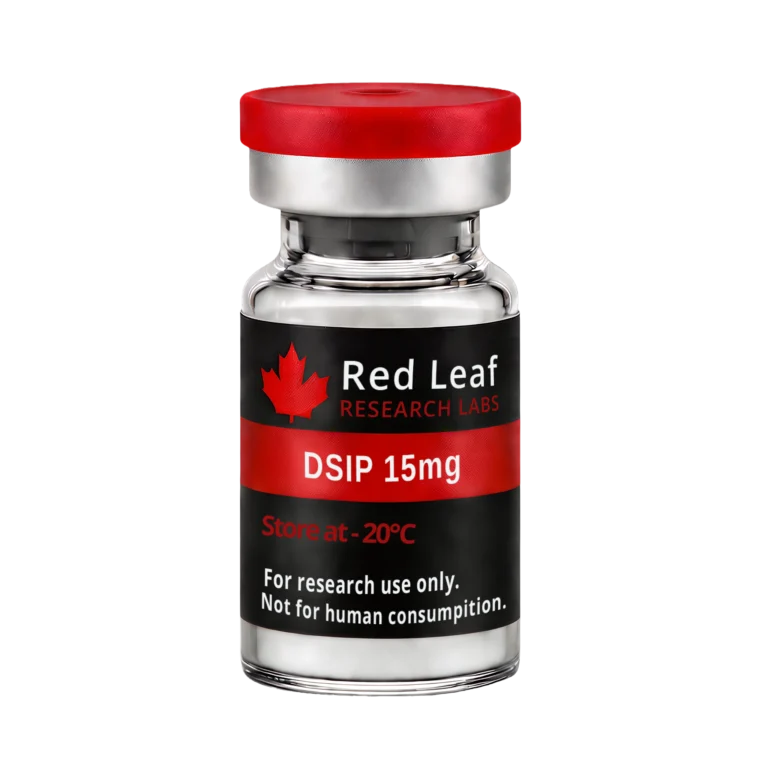 DSIP (15mg)$89.99 CAD
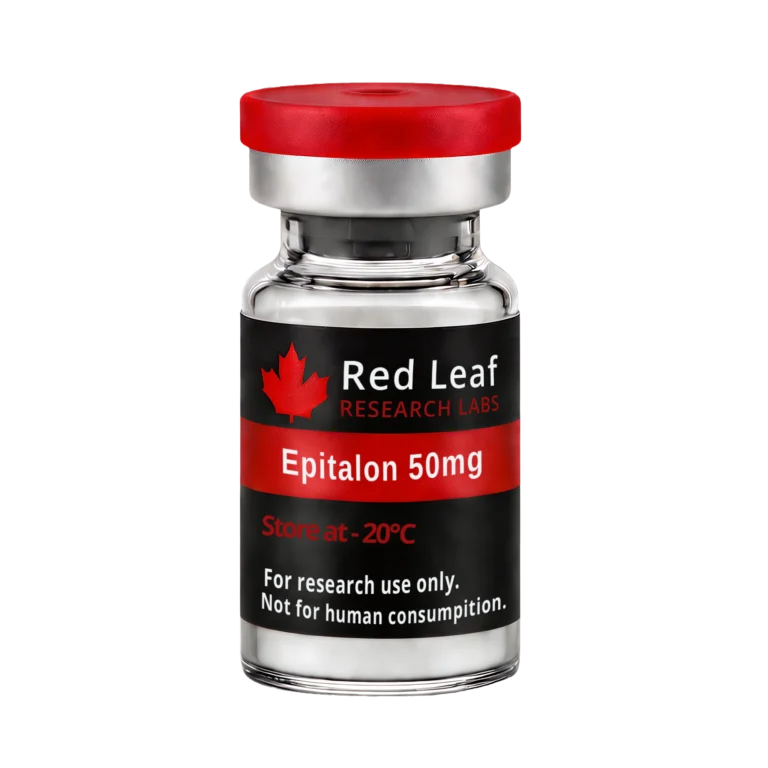 Epitalon (50mg)$90 CAD
 Selank (10mg)$59 CAD
 Pinealon (10mg)$65 CAD
 Bacteriostatic Water$10 CAD
 Research Pen Add-On$99 CAD
Common questions
Does DSIP work for sleep?
The honest answer is that no one has shown it does. Small studies in the 1980s reported better sleep, but they were tiny and not well controlled. Then came the one blind placebo test. Sixteen people, 1992. It found weak effects. The authors said it was not likely to help much. No larger trial has been run since.
What is DSIP?
Delta sleep-inducing peptide. A chain of nine building blocks, about 850 daltons. It was found in 1974, in blood taken from the brains of sleeping rabbits. Fifty years on there is still no known gene for it and no known receptor.
Is DSIP good for shift workers?
No trial has ever tested it in shift workers. Not one, ever. Everything published was in people with insomnia or long-term pain. In the 1980s and early 1990s. Given by vein, in a sleep lab.
How common are sleep problems in emergency services?
Very common. One look pooled 28 studies and 100,080 first responders. 31% screened positive for shift work disorder. 30% for sleep apnea. 28% for insomnia. And 28% for bad daytime sleepiness.
Could my problem be sleep apnea?
It is more likely than most people think. In the firefighter study, 28.4% screened positive. And four in five people who meet the mark have never been told. A sleep study answers the question.
What happens in a sleep study?
In a lab you sleep one night. Soft sensors go on your scalp, face, chest and finger. Nothing goes into you. A home apnea test is smaller. A chest band, a nose sensor and a finger clip. In your own bed. A specialist reads the recording afterwards.
Is it worth getting tested if I feel fine otherwise?
The numbers argue yes. Firefighters who screened positive had twice the crash risk. They had 2.4 times the odds of falling asleep at the wheel. And about three times the odds of low mood. Most of them had no idea.
Does treating apnea change much?
In a pooled look at nine studies of drivers with apnea, crash risk fell about 72% after CPAP. Daytime sleepiness got better after one night, and simulated driving within two to seven days.
Is night shift work really linked to cancer?
The World Health Organization’s cancer arm looked at it in 2019. They called it probably cancer-causing. They pointed at breast, prostate, colon and rectal cancer. But they graded the human evidence as limited. The strong evidence was in animals and in cell mechanisms. It is a real signal, not a settled one.
Is DSIP approved for human use?
No. It is not approved for treatment anywhere. It is sold here as lab research material only, not for injection, ingestion or any human or animal use. Nothing on this page is medical advice.
Bottom line
- DSIP is an old open question. Found in rabbits in 1974. No known gene, no known receptor.
- The one proper trial was negative. Sixteen people, 1992, double-blind. The authors said it probably would not help much.
- The route people use was never tested. Every human trial used a vein drip.
- A third of first responders screen positive for apnea. And four in five people with it have never been told.
- Apnea is mechanical. A closed airway is not something a peptide opens.
- Treating it moved a hard number. Crash risk down about 72% across nine studies.
- Light beat everything else tested. In 1,972 shift workers, light therapy scored highest and drugs did not clear the bar.
Say you work nights and your sleep is wrecked. The cheapest useful thing here is a question for your doctor. Not a vial.
Other guides on this site
Semax explained
The Soviet-era nootropic and what its research really covers.
GHK-Cu guide
The copper peptide, from Cleopatra to the current data.
DSIP in Canada
The sourcing guide, and why the name oversells the research.
Nootropics in Canada
What the brain-peptide category has behind it.
Peptide side effects
What gets reported, across the categories we stock.
Peptides, start here
The plain-English beginner’s guide to the whole category.
Checking a supplier
The ten-point check for any Canadian peptide seller.
Research material with outside lab reports. Each one links to the testing lab’s own page, so you can check it yourself. Free express shipping over $250.
Sources
- Bes F, et al. Effects of delta sleep-inducing peptide on sleep of chronic insomniac patients: a double-blind study. Neuropsychobiology, 1992. 16 patients, 25 nmol/kg by vein.
- Schneider-Helmert D. Efficacy of DSIP to normalize sleep in middle-aged and elderly chronic insomniacs. European Neurology, 1986. 18 patients, 30 nmol/kg by vein.
- Huang G, et al. Prevalence of sleep disorders among first responders for medical emergencies: a meta-analysis. Journal of Global Health, 2022. 28 studies, 100,080 people.
- Barger LK, et al. Common sleep disorders increase risk of motor vehicle crashes and adverse health outcomes in firefighters. Journal of Clinical Sleep Medicine, 2015. 6,933 firefighters, 66 departments.
- Savin KL, et al. Obstructive sleep apnea underdiagnosis: prevalence and correlates. 2026. 81.4% of moderate-to-severe cases undiagnosed.
- Tregear S, Reston J, Schoelles K, Phillips B. Continuous positive airway pressure reduces risk of motor vehicle crash among drivers with obstructive sleep apnea. Sleep, 2010. Nine studies, risk ratio 0.278.
- Jeon BM, Kim SH, Shin SH. Effectiveness of sleep interventions for rotating night shift workers. Frontiers in Public Health, 2023. 30 studies, 1,972 participants.
- IARC Monographs Volume 124: night shift work. International Agency for Research on Cancer, 2019. Group 2A.