Owned and operated by Baba Kahn, a CF veteran

What half-life means, why it varies so much between peptides, and what it changes in practice.
- Minutes to days
- Modifications extend it
- Affects dosing schedules
- Research use only
Half-life is how long it takes for half of a compound to clear. For peptides it ranges from minutes to days, and the difference is usually engineering — a fatty acid chain that grabs onto albumin is what turns a daily compound into a weekly one.
Peptide half-life helps researchers understand how long a peptide remains present, measurable, or active within a defined experimental system. That information can shape sampling schedules, exposure windows, assay design, and comparisons among research compounds.
A reported value only makes sense when the surrounding conditions are clear. The sample type, analytical method, temperature, peptide form, and experimental model can all affect the result. This article discusses controlled laboratory research only and does not provide human or animal dosing guidance.
Why Peptide Half-Life Matters in Laboratory Research
Researchers use half-life to estimate how quickly peptide concentration or activity declines under specified conditions. It is not a fixed value that applies universally across every buffer, biological sample, cell culture, or research model.
Half-life is best considered alongside peptide stability, degradation pathways, exposure data, and, where relevant, pharmacokinetics.
What Peptide Half-Life Means
Peptide half-life is the time required for the measured concentration or amount of a peptide to decrease by 50% under stated conditions. It describes a rate of decline, not the total time the peptide remains detectable.
Half-Life Versus Total Duration
After one half-life, 50% remains. Two half-lives leave 25%, three leave 12.5%, and four leave 6.25%.
A sensitive assay may still detect material after several half-lives. Detectability, however, does not necessarily confirm continued biological or experimental activity.
Peptide Stability and Half-Life
Peptide stability describes how well a peptide maintains its structure, physical integrity, concentration, or measurable activity under defined conditions. A stability study may track degradation over time, while half-life summarizes the observed rate of decline.
Storage, solution, plasma, and cell-based environments may each produce different stability profiles.
Chemical and Enzymatic Degradation
Peptides may decline through oxidation, hydrolysis, deamidation, aggregation, or other chemical processes. Biological samples may also contain proteases or peptidases that cleave peptide bonds.
Different mechanisms can produce distinct fragments and analytical signals, so not every decrease should be interpreted as the same form of degradation.
The Role of Proteases and Peptidases
Proteases and peptidases are enzymes that break peptide bonds. Their abundance and activity vary among blood products, tissues, cell cultures, and other research matrices.
Temperature, preparation time, sample handling, and enzyme inhibitors can alter the observed rate of degradation.
How Amino Acid Sequence Affects Half-Life
A peptide’s sequence can influence its susceptibility to chemical instability and enzymatic cleavage. Terminal residues, cleavage sites, charge, hydrophobicity, and secondary structure may all contribute.
Sequence-based predictions still require experimental confirmation.
Molecular Structure and Peptide Modifications
Researchers may investigate terminal modifications, amino acid substitutions, cyclization, lipidation, or conjugation to study changes in stability, solubility, receptor interaction, or degradation resistance.
Such modifications often affect several molecular properties at once. They should not be interpreted solely as methods of extending half-life.
Environmental Conditions That Influence Half-Life
Temperature, pH, light, oxygen, moisture, agitation, and container materials can influence peptide stability. A compound may therefore degrade at different rates under storage and active experimental conditions.
Documenting these variables supports reproducibility and meaningful comparison.
Solvent and Buffer Effects
Solvent type, buffer composition, ionic strength, and pH can affect peptide solubility and structural stability. Salts, surfaces, and other solution components may also influence recovery.
An apparent loss in concentration could reflect adsorption or precipitation rather than chemical degradation alone.
Half-Life in Different Experimental Systems
A peptide may behave differently in purified buffer, serum, plasma, cell culture, tissue preparations, or whole-organism models. Simpler systems can isolate chemical stability, while biological systems introduce enzymes, binding proteins, distribution, metabolism, and clearance.
Every reported half-life should identify the system in which it was measured.
Measuring Peptide Half-Life
Researchers typically collect samples at several time points and measure the remaining intact peptide or another validated endpoint. Liquid chromatography, mass spectrometry, immunoassays, and functional assays may be used depending on the research question.
Calibration, replicates, controls, and consistent handling influence the reliability of the estimate.
Concentration-Time Curves
A concentration-time curve plots measured peptide concentration against elapsed time. Its slope and overall shape help researchers evaluate the rate and pattern of decline.
The visual appearance of the curve may change depending on whether the data are plotted on linear or logarithmic axes.
First-Order and Nonlinear Decline
In first-order decline, the rate of loss is proportional to the amount of peptide present. Experimental data may depart from this model because of binding, saturation, multiple compartments, complex degradation, or assay limitations.
The model should fit the observed data rather than be assumed in advance.
Half-Life and Pharmacokinetics
Pharmacokinetics examines absorption, distribution, metabolism, and elimination in a biological system. Half-life is one parameter within that broader framework.
Clearance, volume of distribution, and area under the concentration-time curve provide additional information about exposure and disposition. Laboratory findings must not be converted into personal-use recommendations.
Experimental Half-Life Versus Biological Half-Life
Experimental half-life may describe decline in a buffer, sample, or other controlled laboratory condition. Biological half-life generally refers to decline within a living research system, where distribution, binding, metabolism, and elimination add complexity.
Values from in vitro and in vivo studies are not directly interchangeable.
Why Sampling Times Matter
Sampling must be frequent enough to capture early changes and long enough to observe later phases. Widely spaced time points may miss rapid decline and distort the estimate.
Preliminary stability information or pilot studies can help researchers select suitable collection points.
How Half-Life Affects Experimental Exposure
A shorter half-life may create a brief measurable exposure window, while a longer half-life may sustain concentration for more time. Neither is inherently preferable.
Exposure duration can affect which downstream responses are measurable and when they appear, but it is distinct from potency, efficacy, and receptor selectivity.
Interpreting Short and Long Half-Lives
Rapid decline may require closely spaced observations. Slower decline may call for a longer study window.
Interpretation should account for the assay, model, concentration range, endpoint, and purpose of the experiment rather than treating one half-life profile as universally desirable.
Common Sources of Half-Life Measurement Error
Delayed processing, inconsistent temperatures, adsorption, contamination, instrument variability, and degradation during collection can distort results. Too few time points or an unsuitable analytical model may cause further error.
Reports should document sample handling, collection timing, analytical methods, controls, and model assumptions.
How Researchers Use Half-Life in Experimental Design
Half-life information can guide incubation periods, sampling intervals, observation windows, and analytical time points. Preliminary stability studies may also reveal whether the peptide remains measurable for the intended duration of an experiment.
Study design should reflect the research question, model, assay sensitivity, and institutional protocols. A value from one publication should not be transferred to another experiment without comparing the methods and conditions.
How to Evaluate Published Peptide Half-Life Data
Readers should identify the peptide form, matrix, temperature, pH, analytical method, and time-point schedule before comparing numerical values. It is also necessary to determine whether the study measured intact peptide, a degradation fragment, functional activity, or another endpoint.
Differences in controls, replicates, statistical models, and assay sensitivity can explain why publications report different results for the same compound. Headline values provide little context without the methods used to produce them.
Understand Peptide Half-Life Before Interpreting Research
A clear understanding of peptide half-life requires more than locating a single number. Peptide stability, degradation pathways, environmental conditions, assay performance, and pharmacokinetics all influence how researchers plan experiments and interpret concentration changes.
Red Leaf Research Labs provides science-first educational information and research-use-only laboratory products through a compliance-focused approach. Researchers can explore our selection of research peptides while reviewing the documentation relevant to their work.
Reach out to Red Leaf Research Labs today, email us at info@redleafpeptides.com or click here to get in touch online.
Frequently Asked Questions
Is Peptide Half-Life the Same in Every Experiment?
No. Half-life can vary with the sample matrix, peptide form, temperature, pH, analytical method, and experimental model. Every reported value should be interpreted within the conditions under which it was measured.
What Is the Difference Between Peptide Half-Life and Peptide Stability?
Half-life is a calculated period associated with a defined rate of decline. Stability is the broader ability of a peptide to maintain its structure, concentration, physical integrity, or activity under specific conditions. Stability data may support a half-life calculation, but the terms are not interchangeable.
Does a Longer Half-Life Mean a Peptide Is More Effective?
No. Half-life describes persistence rather than potency, efficacy, selectivity, quality, or suitability for an experiment. A shorter or longer value may be more useful depending on the study design and research objective.
How Is Peptide Half-Life Measured in the Laboratory?
Researchers collect samples over time and measure intact peptide or another validated endpoint. Possible methods include chromatography, mass spectrometry, immunoassays, and functional assays. The appropriate method depends on the peptide, sample matrix, and research question.
Why Do Published Half-Life Values Sometimes Differ?
Studies may use different peptide forms, models, sample types, temperatures, pH conditions, time points, and analytical techniques. Statistical models and reporting methods may also affect the final estimate, so methods should be compared before numerical results.
 BPC-157 (10mg)$75 CAD · research use only
 GHK-Cu 100mg – 3ml Vial$64.99 CAD · research use only
 Retatrutide$79.99 CAD · research use only
 TB-500 (10mg)$84.99 CAD · research use only
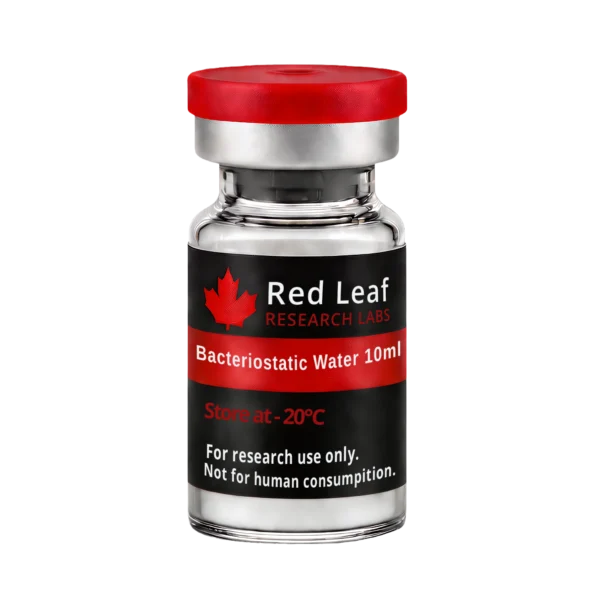 Bacteriostatic Water$10 CAD · research use only
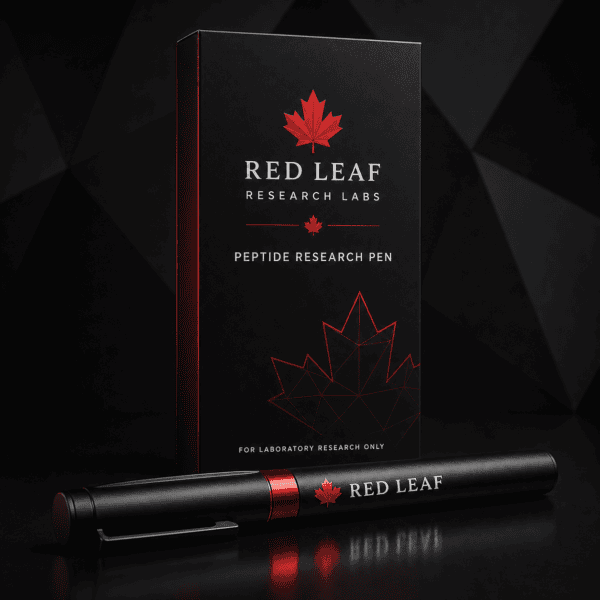 Peptide Pens Canada – Red Leaf Research Pen Add-On$99 CAD · research use only
Every product page carries its batch lab report with a verification link you can check at the testing laboratory, not just a PDF we host.
Research use only. Products sold by Red Leaf Research Labs are not approved by Health Canada for cosmetic application, therapeutic treatment, injection, ingestion, or any form of human or animal use. No claims are made regarding clinical outcomes, safety or efficacy. Pricing and stock are current at the time of publication and subject to change.