AOD-9604 research: quick summary
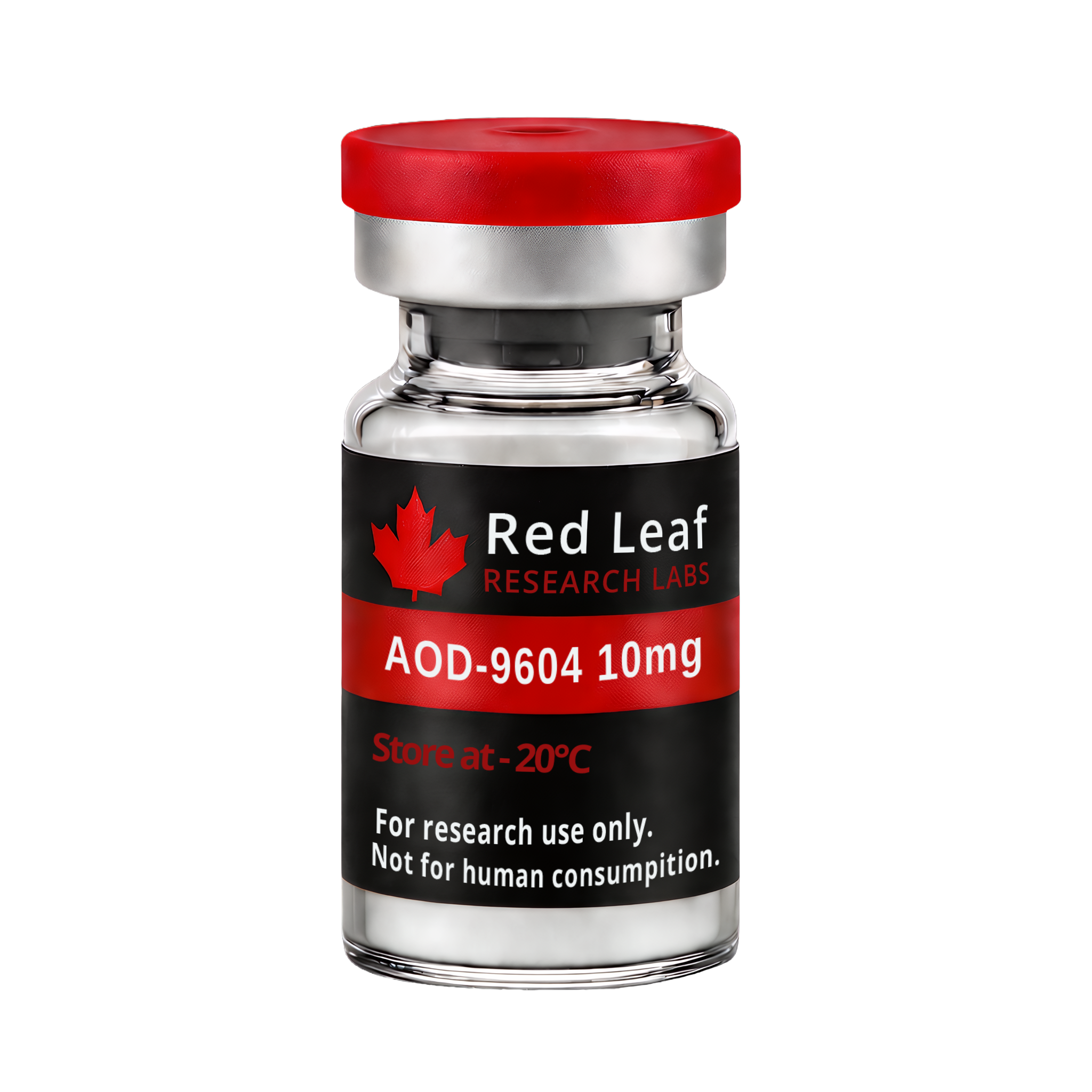
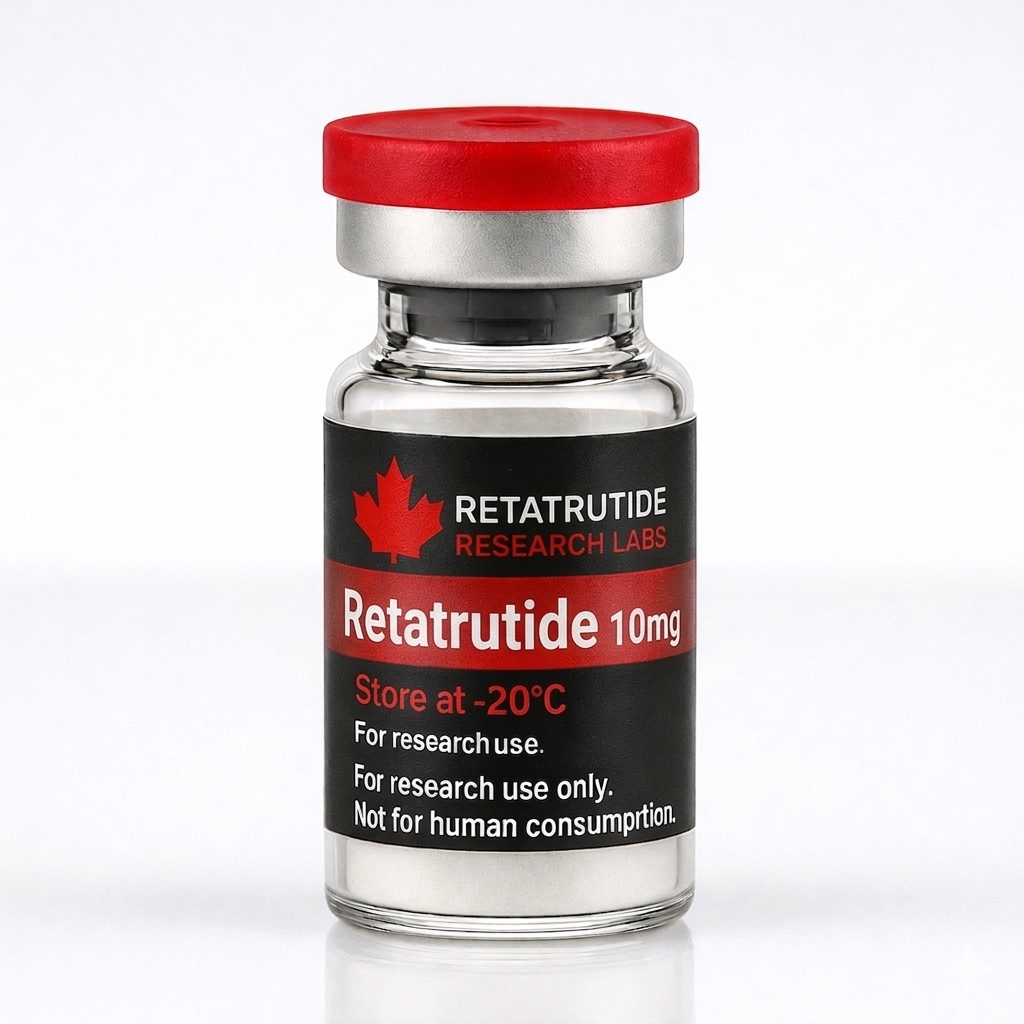
AOD-9604 is a synthetic sixteen-residue peptide corresponding to the C-terminal region of human growth hormone, with a tyrosine at the N-terminus, supplied by Red Leaf Research Labs as a 10 mg lyophilized research material. Published work studies it as an isolated growth hormone fragment in adipose tissue models. It is not an authorized medicine in Canada, is for laboratory research use only, is not for human or veterinary use, and carries no dosing or protocol information.
AOD-9604 Canada: AOD-9604 10mg Research Product
AOD-9604 is stocked in a 10 mg lyophilized fill for qualified purchasers in Canada, described here by material, lot paperwork and dispatch terms.
Visitors arrive on buy AOD-9604 Canada, AOD-9604 peptide Canada and hGH fragment 176-191 Canada. Those strings are recorded as search behaviour, not as purposes this vial is sold for. Personal-health enquiries belong with a clinician.
Red Leaf Research Labs supplies AOD-9604 as a research chemical. The vial is not for administration to a person or an animal, no dosing is issued with it, and no claim is made about its activity.
AOD-9604 10mg Research Format and Options
| Attribute | Detail |
|---|
| Research format | One vial, 10 mg AOD-9604, lyophilized |
| Physical state | Dry cake or powder, glass vial sealed |
| Analytical documentation | Independent report tied to this lot, methods stated |
| Fulfilment | Dispatch to research addresses in Canada |
| Intended use | Laboratory research only; not for human or veterinary use |
The fill is a stock-keeping unit, not a suggestion. No figure is offered for what any experiment ought to consume.
AOD-9604 Research Specifications
- Compound name: AOD-9604
- Alternative name(s): AOD9604, Tyr-hGH(177-191)
- Research shorthand: AOD
- Peptide/compound class: Synthetic growth hormone fragment analogue, cyclised
- Receptor or pathway interest: Adipocyte lipid metabolism; beta-3 adrenergic receptor expression
- Structural origin: hGH residues 177-191 with an N-terminal tyrosine, cyclised through its two cysteines
- CAS: 221231-10-3
- Molecular formula: C78H123N23O23S2
- Molecular weight: approximately 1815.1 g/mol
- Physical format: Solid, freeze-dried
- Available research quantity: 10 mg per vial
- Intended use: Laboratory research use only
- Fulfilment: Domestic dispatch, Canada
What Is AOD-9604?
AOD-9604 reproduces the C-terminal end of the 191-residue human growth hormone chain. Fifteen residues correspond to hGH positions 177 to 191; a tyrosine occupies the position carrying phenylalanine at residue 176 in the parent protein. Two cysteines form an intramolecular disulfide, giving the molecule a small ring and two sulfur atoms. At about 1815 daltons it is a tenth the mass of the intact hormone.
The compound it is most often confused with is hGH fragment 176-191, the unmodified sequence beginning with phenylalanine. The two differ by a single residue and are frequently listed under each other’s names. A larger confusion is with somatropin, recombinant growth hormone, the full 191-residue protein and a different class of substance.
AOD-9604 and Adipose Tissue Research
Published work on this fragment began with Australian investigators studying which part of the growth hormone molecule accounts for its reported activity in fat tissue. Ng and colleagues reported metabolic studies of the synthetic domain in obese rodents in Hormone Research in 2000, recording body-weight change, adipose lipolytic activity and euglycaemic clamp measures. Heffernan and colleagues compared growth hormone and the fragment in obese mice and beta-3 adrenergic receptor knockout mice in Endocrinology in 2001, the knockout line testing whether that receptor was required. Metabolic Pharmaceuticals developed the compound and took it into clinical trials before discontinuing development in 2007.
All of that describes measurements in rodents and cultured tissue by other investigators, and a clinical programme that ended. Activity in an animal model does not establish an effect in a person.
Why Buy AOD-9604 10mg in Canada from a Domestic Research Supplier?
Time in transit is the first point. A disulfide-containing peptide ships dry for a reason, and unrecorded days are days the packaging must compensate for.
The second is that two overlapping names cover materials differing by one residue. Establishing which arrived is a conversation with the seller, easier under one legal system.
Both describe the route, not the powder. Domestic dispatch improves no lot and answers nothing.
How This AOD-9604 Canada Page Improves on Typical Competitor Listings
Listings for this compound routinely conflate it with the fragment it derives from. This page differs in five ways.
- The copy describes the sequence, the substituted N-terminal residue and the disulfide ring, not generic peptide language.
- The analytical basis is stated, not asserted: a report tied to the lot in stock and its methods.
- No effect, advantage or safety property is asserted at any point below.
- The regulatory position is explicit: a research chemical whose clinical development ended, not a medicine.
- Structural relationships are named, separating AOD-9604 from hGH fragment 176-191 and recombinant growth hormone.
How to Evaluate an AOD-9604 Certificate of Analysis
Two structural features set the questions. An intramolecular disulfide closes the molecule, and one N-terminal residue, tyrosine for phenylalanine, separates it from the unmodified fragment by sixteen daltons.
- Compound identity: AOD-9604 or Tyr-hGH(177-191), cited against CAS 221231-10-3.
- Lot reference: the lot printed on the certificate is the lot printed on the vial.
- Analysis date: the date the sample was tested against the date it was made.
- Test methods: the chromatography named, and whether mass work preceded or followed reduction.
- Measured quantity: the mass the certificate accounts for, against the 10 mg on the label.
- Purity result: the number returned, with its method stated.
- Laboratory verification: the laboratory named, and whether it stands apart from the seller.
Sixteen daltons low points to the unmodified fragment. Two daltons high points to a reduced open chain, a doubled mass to a dimer.
AOD-9604 10mg Lyophilized Research Format
The contents are freeze-dried: frozen, then held under vacuum until the ice sublimes, so the solid never passed through a warm aqueous state.
The disulfide adds its own chemistry. Thiol-disulfide exchange is described as accelerated by traces of reducing agent, by alkali and by dissolved metal ions, and its products, a reduced monomer or a scrambled dimer, are invisible in a nominal mass. Humidity, temperature cycling, light and freeze-thaw apply on top. A supplier note requires advanced reconstitution technique, meaning a validated institutional procedure.
Working out concentration for this vial? Our peptide reconstitution calculator converts vial size and bacteriostatic water volume into mg per mL and U-100 syringe units.
How to Buy AOD-9604 in Canada for Qualified Research
- Confirm eligibility. Confirm your organization may receive research chemicals for the work intended.
- Review documentation. Read the lot report and check which of the two fragments it names.
- Select quantity. Take the number of 10 mg vials from the written plan.
- Check shipping route. Match route and transit window to the hours goods can be received.
- Record receipt. Log lot number, arrival date and the state of vial and cake.
These steps are purchasing and records, containing no dosing or study-design guidance.
AOD-9604 Availability in Canada: Research vs. Consumer Searches
Search traffic here divides sharply. One part is laboratory purchasing for work on growth hormone fragments. The other comes from consumer weight-management discussion, where the compound is written about in terms this listing will not use.
AOD-9604 is not an authorized medicine in Canada. Development ended without a marketing authorisation anywhere, so there is no approved formulation, labelling or prescribing framework. It is also a prohibited substance in sport and is tested for in competition, a separate regulatory fact for purchasers in sports-adjacent settings.
A personal-health interest in AOD-9604 belongs with a licensed clinician. A research chemical listing cannot serve that purpose.
AOD-9604 10mg Canada Procurement Checklist
| Check | What to confirm |
|---|
| Purpose | Laboratory research in an organization eligible to receive it |
| Identity | CAS 221231-10-3 on the label and repeated on the lot report |
| Distinctness | The tyrosine-extended analogue, not hGH fragment 176-191 |
| Quantity | Number of 10 mg vials taken from the written plan |
| Documentation | Lot report stating the redox state at which mass was measured |
| Verification | Whether disulfide connectivity is confirmed independently |
| Handling | A validated reconstitution procedure agreed before opening |
Explore AOD-9604 Research Information
Background reading: how peptides work, research peptide terminology, and buying peptides in Canada.
AOD-9604 research FAQ
Does Red Leaf Research Labs provide dosing information?
No. No dosing, reconstitution volume, concentration, route or protocol is provided for this or any product.
Is AOD-9604 the same as hGH fragment 176-191?
No. AOD-9604 carries a tyrosine where the unmodified fragment carries phenylalanine, a difference of one residue and sixteen daltons.
Is AOD-9604 a form of human growth hormone?
No. It is a sixteen-residue fragment analogue of about 1815 daltons; recombinant growth hormone is the intact 191-residue protein.
Is AOD-9604 an approved medicine?
No. Clinical development ended in 2007 without a marketing authorisation; it is supplied as a research chemical.
What documentation comes with the 10mg vial?
The current lot carries an independent report identified by lot number, with methods stated on the document.
Research use only. AOD-9604 10 mg is supplied strictly for laboratory research. It is not an authorized medicine in Canada, is not for human or veterinary use, and carries no dosing or protocol information. Anyone with a personal-health question should consult a licensed clinician.


 Owned and operated by a cf veteran