Owned and operated by Baba Kahn, a CF veteran


Can a peptide help bring down high red blood cells? For rusfertide, clinical research supports an important role in controlling excess red blood cell production in people with polycythemia vera, or PV. Here is what the research shows, what changed in 2026, and what it does not prove.
- 293 adults in VERIFY
- 77% vs 33% met the main goal
- Aug 28, 2026 FDA approval (U.S.)
- Not listed in Health Canada’s database
Rusfertide is a peptide that mimics hepcidin, the hormone that controls how much iron the body can use. In the phase 3 VERIFY trial of 293 adults with polycythemia vera, 77% on rusfertide met the main goal compared with 33% on placebo. The U.S. FDA approved it as Mimrylo on August 28, 2026, for adults with PV. It has not been shown to treat high hematocrit caused by testosterone (TRT), sleep apnea or smoking, and as of November 14, 2026, it is not listed in Health Canada’s Drug Product Database.
However, high red blood cells can have several causes. Results in PV do not automatically establish rusfertide as a treatment for elevated hematocrit caused by testosterone replacement therapy, sleep apnea, or smoking.
For people searching for peptides in Canada, understanding that distinction helps put an emerging treatment into perspective. A promising clinical result applies to the patients, condition, and treatment studied—not every situation involving an abnormal blood count.
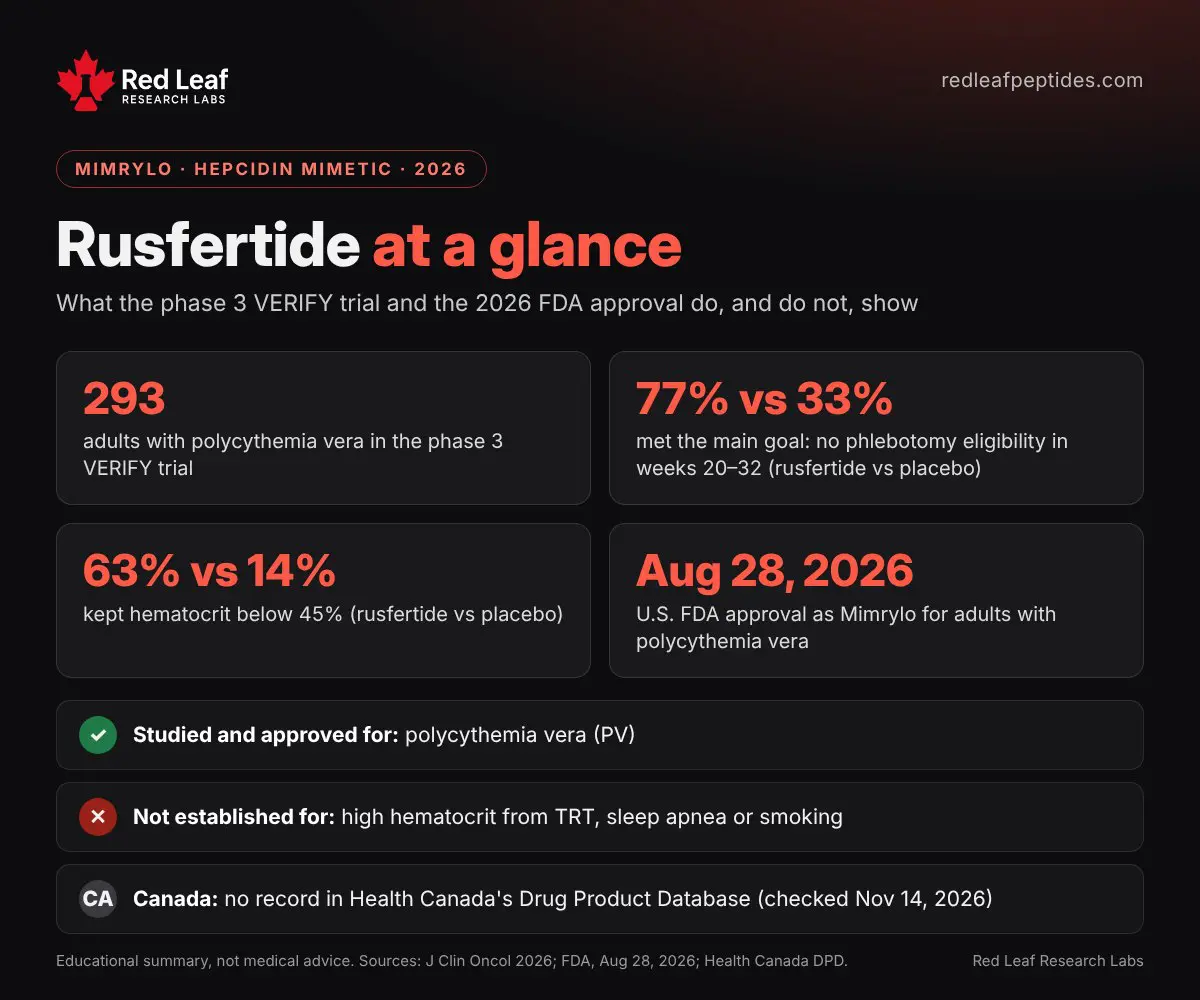
The key numbers from the VERIFY trial, the 2026 FDA approval, and where rusfertide stands in Canada.
What Is Rusfertide?
Rusfertide is a peptide that mimics hepcidin, a naturally occurring hormone that regulates how much iron is available in the body.
Bone marrow needs iron to produce red blood cells. By limiting the iron available for that process, rusfertide can slow red blood cell production and help control hematocrit.
Rusfertide works upstream, on the iron supply for new cells. Phlebotomy works downstream, by taking out blood.
Hematocrit measures the percentage of blood volume occupied by red blood cells. Rusfertide acts on the production of new cells rather than immediately removing cells already circulating. Its mechanism differs from therapeutic phlebotomy, which lowers red blood cell volume by removing blood. [1,2]
What Did the Rusfertide Clinical Trial Show?
The phase 3 VERIFY trial studied 293 adults with polycythemia vera who needed frequent phlebotomy despite receiving standard care. The full results were published in the Journal of Clinical Oncology in October 2026.
The main goal meant not becoming eligible for phlebotomy between weeks 20 and 32.
During the trial:
- 77% vs 33%. 77% receiving rusfertide met the primary response endpoint, compared with 33% receiving placebo. This endpoint meant avoiding eligibility for phlebotomy during weeks 20–32.
- 63% vs 14%. 63% maintained hematocrit below 45%, compared with 14% receiving placebo.
- Fewer phlebotomies. Rusfertide reduced the need for blood removal and improved patient-reported fatigue and symptom scores.
Common adverse events included injection-site reactions, anemia, and fatigue. The study did not establish whether rusfertide reduces blood clots, prevents disease progression, or improves survival over the long term. [1]
These findings represent a meaningful advance in controlling excess red blood cell production in PV. They do not establish a universal treatment for high hematocrit.
Rusfertide FDA Approval: Is It Available in Canada?
Yes, in the United States. On August 28, 2026, the U.S. Food and Drug Administration approved rusfertide under the brand name Mimrylo as a polycythemia vera treatment for adults. The application, from Takeda, received priority review. In the trial, it was given as a once-weekly injection under the skin, adjusted to keep hematocrit below 45%. The most common adverse reactions the FDA listed were injection-site reactions and anemia. [7]
The approval covers PV. It does not extend to testosterone-related erythrocytosis, sleep apnea, smoking, or other causes of a high red blood cell count.
A U.S. approval also does not authorize a drug for sale in Canada. When we searched Health Canada’s Drug Product Database on November 14, 2026, it returned no record for rusfertide or Mimrylo. Canadian readers can check the database directly for updates. [8]
2022 to 2024: the trial enrols
VERIFY enrols 293 adults with PV at 102 centres in 19 countries.
2025: results come in
The trial meets its main goal. Results are presented at the 2025 ASCO annual meeting.
January 2026: FDA filing
Takeda and Protagonist Therapeutics submit a new drug application to the FDA.
August 2026: U.S. approval
The FDA approves Mimrylo (rusfertide) for adults with PV.
October 2026: full paper
The complete VERIFY results are published in the Journal of Clinical Oncology.
Next: Canada
No Health Canada record as of November 14, 2026. Watch the Drug Product Database for updates.
Why the Cause of High Red Blood Cells Matters
An elevated blood count is a finding that requires an explanation.
Polycythemia vera is a bone marrow disorder in which blood cell production becomes abnormal. Secondary erythrocytosis occurs when another factor stimulates red blood cell production. Possible causes include testosterone treatment, low oxygen levels, sleep apnea, and smoking.
Polycythemia vera
A bone marrow disorder. Blood cell production itself becomes abnormal. This is the condition rusfertide was studied in.
Testosterone (TRT)
Testosterone can raise hemoglobin and hematocrit. Prescribers monitor levels and may change treatment.
Low oxygen and sleep apnea
Repeated drops in oxygen can push the body to make more red blood cells.
Smoking
Carbon monoxide exposure affects oxygen delivery and can raise red blood cell production.
Because these mechanisms differ, treatment should follow the underlying diagnosis. The hematocrit target used in PV should not be assumed to apply to every person with an elevated result.
Could Rusfertide Help With High Hematocrit From TRT?
Testosterone replacement therapy, or TRT, can increase hemoglobin and hematocrit. Some patients develop testosterone-related erythrocytosis, requiring their prescriber to reassess treatment.
Rusfertide’s ability to restrict iron availability makes it scientifically interesting in this context. However, the VERIFY trial studied PV, not testosterone-related erythrocytosis. Its results cannot establish the benefits, risks, or appropriate use of rusfertide in people taking testosterone. [1,2]
The Endocrine Society recommends monitoring hematocrit during testosterone treatment. Its guideline advises clinicians to:
- Check hematocrit. Measure it before starting, at 3 to 6 months, and then once a year.
- Pause above 54%. Interrupt therapy when hematocrit exceeds 54%.
- Look for a cause. Evaluate for low oxygen and sleep apnea.
- Restart lower. Consider restarting at a lower dose once the level is safe.
Decisions should be made with the prescribing clinician. [4]
Adding a peptide without investigating the cause of a rising hematocrit could leave an important medical issue unresolved.
What About Sleep Apnea or Smoking?
Sleep apnea can repeatedly interrupt breathing during sleep. In some people, associated oxygen drops contribute to increased red blood cell production.
Smoking can also contribute through carbon monoxide exposure and related effects on oxygen delivery. [3]
Rusfertide has not been established by the cited PV trials as a treatment for either situation. Lowering a blood count would not itself correct interrupted breathing or eliminate smoke exposure.
Evaluation may include a review of medications, smoking history, oxygen levels, and sleep symptoms. Depending on the findings, clinicians may investigate other causes, including PV. [3]
What This Means for the Canadian Peptide Marketplace
Searches for “peptides Canada” can bring together several different categories: authorized medicines, drugs being studied in clinical trials, and products marketed for laboratory research.
These categories have different evidence and regulatory requirements.
A clinical trial evaluates a defined pharmaceutical product under a specific protocol. A product advertised online with the same peptide name should not be assumed to have equivalent quality, safety, or clinical effects.
Health Canada explains that a “Research Use Only” label does not authorize a peptide for human use or exempt it from Canadian regulatory requirements. Canadian readers should verify authorization through Health Canada rather than treating online availability as evidence of approval. [5,6]
For anyone following the Canadian peptide marketplace, useful questions include:
- Was the research conducted in humans?
- Did the participants have the same condition being discussed?
- Was the study randomized and controlled?
- Were adverse events and study limitations reported?
- Does the article distinguish clinical evidence from a proposed future application?
These questions help readers assess peptide research without extending a study’s conclusions beyond its evidence.
Rusfertide is a real step forward for people with polycythemia vera. In VERIFY it controlled hematocrit and cut the need for phlebotomy, and the FDA approved it as Mimrylo in August 2026. It is not a proven fix for high hematocrit from TRT, sleep apnea or smoking, and it is not listed as authorized in Canada. Find the cause of a high blood count first, and make treatment decisions with a clinician.
Peptide rules in CanadaSee our test sheetsMore guides
- Peptides in Canada: the rules and how to get them legally (2026)
- Buying peptides in Canada in 2026
- Peptide guide for beginners: the complete Canadian guide
- High hematocrit and steroid use: what blood donation really does
- Retatrutide and sleep apnea: what the new studies found
Questions people ask
Does rusfertide lower red blood cells?
Rusfertide limits iron availability for new red blood cell production. In people with PV, clinical research shows it can control hematocrit and reduce the need for therapeutic phlebotomy. [1,2]
Is rusfertide FDA approved?
Yes, in the United States. On August 28, 2026, the FDA approved rusfertide under the brand name Mimrylo for adults with polycythemia vera. The approval covers PV, not other causes of high hematocrit. [7]
Is rusfertide available in Canada?
When we checked on November 14, 2026, Health Canada's Drug Product Database had no record for rusfertide or Mimrylo. A U.S. approval does not authorize a drug for sale in Canada. [8]
What are the side effects of rusfertide?
In the VERIFY trial, the most common adverse events were injection-site reactions, anemia and fatigue. The study did not establish long-term effects on blood clots, disease progression or survival. [1,7]
Is rusfertide proven for high hematocrit caused by testosterone?
The cited phase 3 evidence concerns PV. It does not establish rusfertide as a safe or effective treatment for testosterone-related erythrocytosis. [1]
Does everyone need hematocrit below 45%?
No. Below 45% is an established treatment target in PV. Management of other causes of elevated hematocrit depends on the diagnosis and clinical circumstances. [3]
Does controlling hematocrit cure PV?
No. Controlling excess red blood cell production is an important treatment goal, but the VERIFY findings do not establish a cure or prevention of long-term disease progression. [1]
What should someone do about a high blood count?
Discuss the actual hematocrit, hemoglobin, and red blood cell results with a healthcare professional. Interpretation depends on the degree of elevation, previous results, hydration, medications, symptoms, and possible underlying conditions. [3]
Sources
- Kuykendall AT, et al. VERIFY: a phase III trial of rusfertide versus placebo in phlebotomy-dependent patients with polycythemia vera receiving standard-of-care therapy. Journal of Clinical Oncology. Published online October 13, 2026. View the paper
- A Phase 3 Study of the Hepcidin Mimetic Rusfertide (PTG-300; TAK-121) in Patients With Polycythemia Vera (VERIFY). ClinicalTrials.gov, NCT05210790. View the study record
- Mithoowani S, Laureano M, Crowther MA, Hillis CM. Investigation and management of erythrocytosis. CMAJ. 2020;192(32):E913–E918. View on CMAJ
- Bhasin S, et al. Testosterone therapy in men with hypogonadism: an Endocrine Society clinical practice guideline. Journal of Clinical Endocrinology & Metabolism. 2018;103(5):1715–1744. View the guideline
- Health Canada. Peptides: Research and clinical trials. View on Canada.ca
- Health Canada. Peptides: Regulations and enforcement. View on Canada.ca
- U.S. Food and Drug Administration. FDA approves first drug of its kind for polycythemia vera, a rare blood disorder. August 28, 2026. View on FDA.gov
- Health Canada. Drug Product Database (searched November 14, 2026). Search the database
This article is educational and does not provide a diagnosis, prescribing advice, or instructions for self-treatment. Research-use peptide products are not a substitute for medical assessment or authorized treatment. Compounds sold by Red Leaf Research Labs are laboratory materials for in-vitro research only and are not approved for cosmetic, treatment, injection, ingestion or any human or animal use. Study findings are described from published research so readers can see what was measured. Regulatory status is current to November 14, 2026. Full wording on our legal terms page.