
 Owned and operated by a cf veteran


What retatrutide is actually built from, how it is made. And why that matters when you read a lab report.
- 39 amino acids
- Made not extracted
- LY3437943 lab code
- Tested by lot
Retatrutide is a man-made peptide built from a chain of amino acids, with a fatty acid chain attached so it lasts longer in the body. Nothing about it is harvested from an animal or a plant. It is assembled in a lab, purified, freeze-dried and then tested. Its lab code is LY3437943. It is not an approved medicine anywhere.
- Quick answer: what is retatrut…
- Retatrutide at a glance
- What “made from amino acids” a…
- The backbone: a 39-amino-acid …
- The fatty tail and the linker
- Is retatrutide natural or synt…
- How can one molecule work on t…
- What else would be in an injec…
- What retatrutide is not made f…
- How is it different from semag…
- What have the clinical studies…
- Is retatrutide approved or ava…
- Why online “research peptide” …
- Questions worth asking a clini…
- The short version
- Common questions
- Sources
Medical disclaimer: this is general education, not medical advice. Retatrutide is investigational, not a do-it-yourself product. Do not buy, mix or inject things sold online as “research peptides”. Talk to a physician, nurse practitioner or pharmacist about options that actually apply to you.
Quick answer: what is retatrutide made from?
A chain of 39 amino acids, built in a lab, with a fat-based tail bolted onto it.
That is it. Amino acids are the small parts that peptides and proteins are made of. String 39 of them together in a specific order, attach the tail. And you have retatrutide.
It is not made from animal organs. Not from venom, not from insulin, not from stem cells. And. this one trips people up. it is not made from the three hormones it imitates.
The sequence was designed to copy signals from three hormones: GLP-1, GIP and glucagon. One molecule, three receptors. That is why it gets called a triple agonist.
The fatty tail has one job: keeping the molecule in your bloodstream longer. That is what makes a once-a-week injection possible instead of a daily one.
One caveat. All of that describes the active molecule. A finished commercial injection, if it is ever approved, would also contain inactive ingredients to keep it stable and sterile. Nobody can tell you what those are yet. Because no such product exists.
Retatrutide at a glance
- Type of molecule: synthetic, lipidated peptide
- Length: 39 amino-acid residues
- Research code: LY3437943
- Targets: GLP-1, GIP and glucagon receptors
- How it has been studied: once-weekly injection under the skin
- Molecular formula commonly listed: C221H342N46O68
- Approximate molecular mass: 4,731 g/mol
- CAS Registry Number: 2381089-83-2
- Status: investigational – authorisation and trial status can change
Those numbers describe the molecule. They tell you nothing about what is in any particular vial. A molecular formula on a product page is not proof of identity, purity, sterility or safety. It is a fact anyone can copy and paste.
What “made from amino acids” actually means
Amino acids are the building blocks your body uses to make proteins and peptides. A peptide is just a short chain of them.
The order matters enormously. Change one position and you can change the shape, the stability and what it binds to. It is closer to a combination lock than a recipe.
Retatrutide’s sequence was designed on purpose. In certain regions it resembles natural metabolic hormones. But it is not GLP-1, GIP and glucagon mixed in a bottle. And it is not three drugs in one syringe.
It is one molecule, engineered to fit three different locks.
So the honest answer to “what is it made from” has two halves. The idea came from human hormone biology. The molecule itself came out of a chemical plant. Your body does not make retatrutide and never has.
The backbone: a 39-amino-acid chain
The main body of retatrutide is that 39-residue chain.
Most positions use amino acids you would find in any protein. tyrosine, glutamine, glycine, threonine, phenylalanine, serine, aspartic acid, lysine, isoleucine, leucine, alanine, glutamic acid, proline, methionine. A few positions use modified or non-standard residues, picked to make the molecule more potent and harder for your enzymes to chew up.
You will see the sequence written in one-letter shorthand on scientific sites. That notation is useful to chemists and easy for everyone else to misread.
More to the point, it is not a recipe.
Building an injectable peptide is not arranging amino acids in order. It means controlling and testing identity, chemical purity, how the molecule folds, leftover solvents, bacteria, endotoxins, particles, concentration, pH and whether the container itself holds up. Miss any one of those and you have a contaminated vial that looks exactly like a good one.
The World Health Organization’s naming record gives the formal chemical description and confirms it as an agonist of the glucagon, GIP and GLP-1 receptors. Structural research has mapped how it sits against each one.
The fatty tail and the linker
“Lipidated” means a fat-like chemical group is attached to the peptide. In retatrutide it is a fatty diacid, joined by a linker to one of the lysines in the chain.
Why bother? Because small peptides get cleared fast. Your body breaks them down and flushes them out, often in hours.
The fatty tail sticks loosely to albumin, a protein floating around in your blood in large amounts. Think of it as the molecule grabbing a handrail. It gets released slowly instead of being swept away. That stretches one dose across a week.
Combine that with the sequence tweaks that resist enzymes and weekly dosing becomes plausible.
The lipid is a working part of the design. It is not dietary fat, not an oil filler, not a second drug. The injection is not “made of fat”. It is one precisely attached chemical group, on one specific position.
Is retatrutide natural or synthetic?
Synthetic. Entirely.
The receptors it works on are natural and human. The design borrows from hormone signalling. The molecule itself is manufactured.
Peptide drugs are usually built by solid-phase peptide synthesis. In plain terms: the chain is anchored to a solid support and amino acids are added one at a time, each with protective caps to stop the wrong ends reacting. When the chain is complete, the caps come off, the chain is detached, modifications are added. And the result is purified and checked. Industrial processes add a great deal more control than that on top.
One thing worth saying plainly, because the words get used as arguments. “Synthetic” does not mean unsafe. “Natural” does not mean safe. Neither word tells you anything useful.
What tells you something: has this exact product been studied properly, made to a real standard, reviewed by a regulator, prescribed for the right person. And dispensed by a real pharmacy.
How can one molecule work on three receptors?
Receptors are proteins that recognise a chemical signal and set off a response inside the cell. Different receptors recognise different shapes.
Retatrutide’s sequence and 3D shape let it bind to all three. GLP-1, GIP and glucagon. with activity deliberately balanced between them.
That balance is the hard part. And it is why this took years to design.
GLP-1 receptor activity
GLP-1 raises glucose-dependent insulin release, slows your stomach emptying, and affects appetite and fullness.
“Glucose-dependent” means the insulin only shows up when blood sugar is already high. That matters. Though the risk of lows still changes when insulin or sulfonylureas are in the picture.
GIP receptor activity
GIP is the other hormone your gut releases in response to food. It is involved in insulin release and metabolic regulation.
Researchers are still working out what adding GIP to GLP-1 does for appetite, blood sugar and how well people tolerate it.
Glucagon receptor activity
Glucagon handles glucose regulation, which fuel your body uses, and energy metabolism generally.
On its own, glucagon raises blood sugar. the opposite of what you want. The design intent is that the GLP-1 and GIP activity in the same molecule counterbalances it.
Which is why you cannot predict what retatrutide does by reasoning about any one receptor. The three are doing different things at once.
And to be clear: “triple agonist” describes three receptor targets, not three ingredients. There is no harvested GLP-1, GIP or glucagon in the vial.
What else would be in an injection?
Every injectable has two categories of ingredient. The active one. That does the job. And excipients. That do everything else. control pH, keep it stable, keep it dissolved, keep it sterile.
Peptide injections generally use buffers, salts, stabilisers and sterile water. That is a general statement about the category, not retatrutide’s ingredient list.
The exact formula is specific to a product. And it can differ between a trial formulation and a future marketed one.
For Canadians, the reliable source would be the authorised product monograph and pharmacy labelling. once such a thing exists. Until then, any website giving you a definitive list of “all retatrutide ingredients” is describing a research formulation, borrowing from another drug, or guessing.
What retatrutide is not made from
Online, the line between what inspired a molecule, what it is. And what is in a finished vial gets blurred constantly. So, for the record. Retatrutide is not:
- a blend of semaglutide and tirzepatide
- a mixture of three natural hormones
- insulin
- a steroid or a stimulant
- an animal-gland extract
- a herbal or “natural” weight-loss supplement
- something you can verify by looking at it
- made safe by adding bacteriostatic water
That last one deserves emphasis. A clear solution looks like a clear solution. A white powder looks like a white powder. You cannot authenticate either by eye. And labels, QR codes and seller certificates can all be faked.
The only real assurance comes from a regulated supply chain with analytical and sterility testing behind it. There is more on what genuine testing looks like in our guide to evaluating peptide quality.
How is it different from semaglutide and tirzepatide?
All three are peptide-based and all three work on metabolic hormone receptors. The difference is which ones.
- Semaglutide: GLP-1.
- Tirzepatide: GIP and GLP-1. A dual agonist.
- Retatrutide: GIP, GLP-1 and glucagon. A triple agonist.
“Triple” does not mean three times stronger. It does not mean better for you specifically. And it absolutely does not mean the milligram numbers translate.
You cannot convert doses between these molecules with a ratio. Different structures, different receptor activity, different evidence, different schedules, different regulatory status. Anyone doing that conversion is guessing with your body.
What have the clinical studies found?
The best-known one is the Phase 2 obesity trial. randomised, double-blind, placebo-controlled. At 48 weeks, the 12 mg group had lost an average of 24.2% of their body weight.
That is a group average from a controlled trial. Not a promise to any individual. And not a study designed to catch every long-term benefit or rare risk. The full paper is in the New England Journal of Medicine.
Gut effects. nausea, diarrhea, vomiting, constipation. have been prominent throughout this drug class. The Phase 2 trial also found heart rate rising with dose, peaking, then falling. Doses were raised gradually partly to make it tolerable at all.
Later systematic reviews have generally found large weight reductions and better metabolic numbers. While pointing out that the evidence base is still much smaller than for established treatments.
A 2025 meta-analysis of dual and triple agonists found more gut side effects and more people dropping out than placebo across the whole class. while serious adverse events were not significantly different. Those are pooled findings across several drugs, not a statement about any specific retatrutide dose.
And the limit on all of it: trials measure what happens with the molecule the researchers used. They say nothing about whether an online vial contains that molecule, at that dose.
Is retatrutide approved or available in Canada?
No. It has been studied in international Phase 3 programmes, some with Canadian sites. There is a study record on ClinicalTrials.gov if you want to see one.
A trial listing is not an authorisation to sell. And joining a trial is not the same as getting a prescription. you have to meet the protocol criteria, consent formally. And be followed by the research team.
Status can change. So check with a licensed health professional and an authorised pharmacy rather than a website.
Now, the part that matters. If a site is selling “retatrutide” today, phrases like “research use only”, “not for human consumption” or “peptide blend” are not safeguards. They are the opposite. they are a signal that the product sits outside ordinary prescription channels. And everyone involved knows it.
Do not read a Canadian address, Canadian pricing or domestic shipping as proof of anything. And a purity percentage answers exactly one question. It does not tell you whether the vial is sterile, correctly dosed, free of endotoxin, still stable after shipping, or fit to inject.
Why online “research peptide” versions are risky
An unauthorised vial can fail in a lot of independent ways. No active peptide at all. The wrong peptide. Too little. Too much. Degradation products. Leftover synthesis chemicals. Bacteria. Endotoxins. Particles you can see, and particles you cannot.
A seller can test one batch and ship a different one. A posted certificate can be incomplete, copied, or impossible to trace to the vial in your hand.
Mixing powder at home adds a second layer. How much diluent, what the final concentration is, what you measured it with, how you mixed it, how long it sat, how you injected it. every one of those changes the dose you actually received.
And the classic failure: confusing milligrams, millilitres and syringe “units”. That single mix-up produces enormous dosing errors, and it happens constantly.
There is no safe troubleshooting guide for an unknown injectable. Because the unknown is the problem.
Anyone who has used an unverified product and develops severe or lasting abdominal pain, repeated vomiting, fainting, confusion, trouble breathing, swelling of the face or throat, signs of dehydration, or a fast-worsening reaction at the injection site needs urgent care. Tell the clinician exactly what was taken and bring the packaging if you safely can.
Questions worth asking a clinician or pharmacist
If weight, diabetes or metabolic health is what brought you here, these are the useful questions:
- What should we actually be treating first?
- Which authorised options have evidence for someone with my history?
- Could anything I already take worsen gut effects or the risk of low blood sugar?
- How should protein, nutrition and resistance training change to protect muscle while losing weight?
- Are there contraindications, pregnancy considerations, or past pancreatitis, gallbladder, gut, kidney or endocrine problems to weigh?
- Would a registered clinical trial suit me, and who pays for study-related care?
- How do I check that a pharmacy and a product are legitimate in my province?
Bring a full list of your medicines and supplements. Obesity and diabetes care does not reduce to picking whichever molecule has the biggest headline percentage, however tempting that is.
The short version
- A synthetic chain of 39 amino acids with a fatty tail attached. Built in a lab, not extracted from anything.
- The tail grabs onto albumin in your blood. That is what makes weekly dosing work.
- One molecule, three receptors – GLP-1, GIP and glucagon. Not three hormones mixed together.
- “Triple” describes receptor targets, not strength. Doses do not convert between these drugs.
- The 12 mg group lost an average of 24.2% of body weight at 48 weeks in Phase 2.
- A molecular formula, a sequence or a certificate can all be copied. None of them authenticate a vial.
- Not approved in Canada. A trial listing is not an authorisation to sell.
The molecule is well described. What is in a vial from a website is not. And those are completely different questions. Real assurance takes validated manufacturing, sterile formulation, quality testing, regulatory review and a pharmacy. not a peptide vendor with a nice-looking PDF. There is more on how peptides are made and handled in our guide to injectable peptides.
Common questions
What is the main ingredient in retatrutide?
Retatrutide itself. a synthetic, lipid-modified peptide of 39 amino acids. A finished injection would also carry inactive ingredients. But the definitive list depends on a product that does not exist yet.
Is retatrutide made from human hormones?
No. It was designed using knowledge of human hormone receptors and shares structural features with metabolic signals. But it is made in a lab. Nothing in it was extracted from a person.
Is retatrutide made from animal products?
The active molecule is synthesised, not extracted from an animal. Anyone with strict vegan, allergy or religious requirements should still ask about processing aids and excipient sources if a commercial product ever appears.
Is retatrutide a peptide?
Yes. 39 amino acids with a fatty diacid side chain attached. The lipid is what keeps it circulating.
Does retatrutide contain GLP-1, GIP and glucagon?
No. It is one engineered molecule that activates the receptors those three hormones use. Three targets, not three ingredients.
Is retatrutide the same as Ozempic or Mounjaro?
No. Different active molecules. Semaglutide targets GLP-1. Tirzepatide targets GIP and GLP-1. Retatrutide targets GIP, GLP-1 and glucagon.
What is the molecular formula of retatrutide?
Databases commonly list C221H342N46O68, mass about 4,731 g/mol. Variations on vendor pages can be errors, salts or different reporting conventions. and none of it proves authenticity.
Why does retatrutide have a fatty acid attached?
To slow it down. The lipid sticks to albumin in the blood. That stops the molecule being cleared quickly and stretches one dose across a week.
How is retatrutide manufactured?
Controlled peptide synthesis builds the chain, then the lipid-linker group is attached, then purification and a long list of analytical tests. Making a sterile drug product adds formulation, filtration or aseptic processing, filling, packaging and quality control on top.
Can retatrutide be compounded from raw peptide powder?
No. And consumers should not try. You cannot confirm a powder’s identity, potency or sterility by looking at it. And mixing at home does not substitute for regulated manufacturing.
Is retatrutide approved in Canada?
Not currently, and status can change. A Canadian clinical trial does not mean sale or prescribing is authorised. Check with a licensed physician, nurse practitioner or pharmacist.
Can I buy retatrutide online in Canada?
Websites advertise it. Availability is not legality, and it is certainly not identity, sterility or safety. Avoid anything sold as “research use only” without ordinary prescription and pharmacy safeguards.
What are retatrutide’s possible side effects?
Trials commonly reported gut effects. nausea, diarrhea, vomiting, constipation. plus increases in heart rate. The full picture, including rare events and long-term safety, still needs more study.
Does the peptide sequence tell me whether a vial is genuine?
No. A sequence or a formula takes ten seconds to copy. Confirming a vial means traceable manufacturing plus identity, potency, sterility and endotoxin testing tied to that exact batch.
Is retatrutide “GLP-3”?
No. That is a marketing nickname somebody invented. There is no GLP-3 receptor. Retatrutide targets GLP-1, GIP and glucagon.
What is retatrutide made of?
A chain of amino acids with a fatty acid side chain attached. It is built in a lab, not taken from anything living.
Is retatrutide natural?
No. It is a designed molecule. Nothing in nature makes it.
Does retatrutide contain animal products?
No. It is made by chemical synthesis, not from animal tissue.
What does the fatty acid chain do?
It helps the peptide stick around longer in the body. That is why trials dosed it once a week.
Why does what it is made from matter?
Because identity testing checks whether the vial really holds that exact molecule. A purity number alone does not.
Sources
- Structural insights into retatrutide’s triple agonism – PubMed
- Phase 2 obesity trial – New England Journal of Medicine
- 2025 systematic review of retatrutide trials – PubMed
- 2025 randomized-trial meta-analysis – PubMed Central
- Retatrutide ligand record – IUPHAR/BPS Guide to Pharmacology
- Retatrutide clinical study record – ClinicalTrials.gov
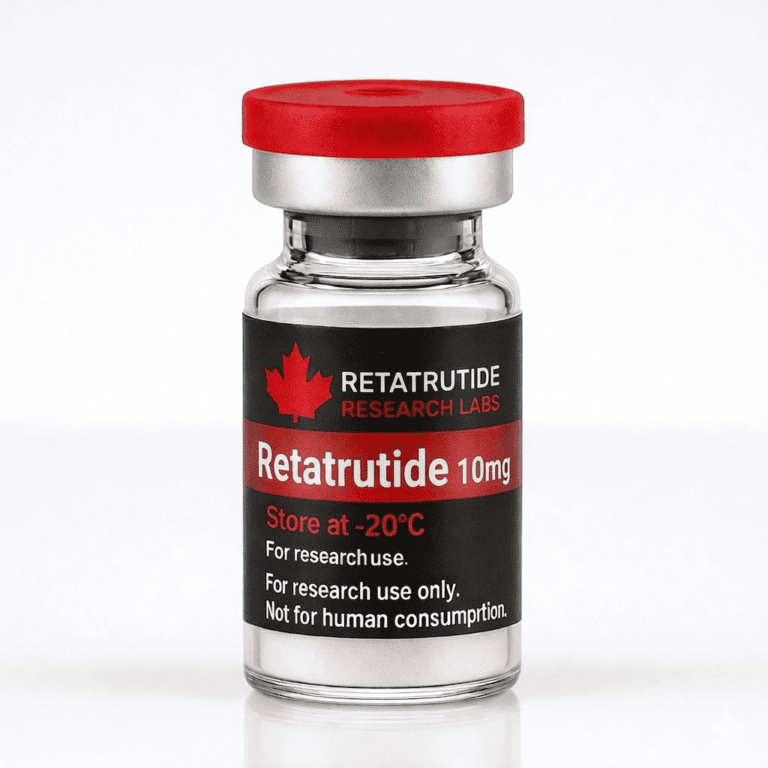 Retatrutide 10mg$89.99 CAD · research use onlyRetatrutide 20mg$149 CAD · research use onlyRetatrutide 30mg$199 CAD · research use only
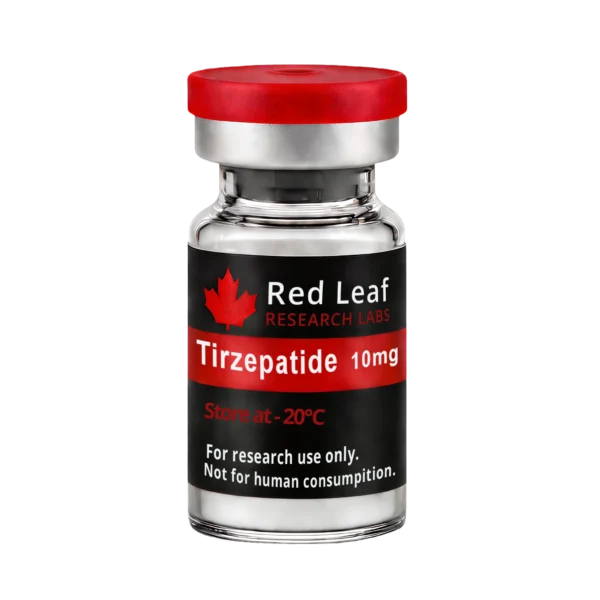 TirzepatideFrom $54 CAD · 10mg or 20mg
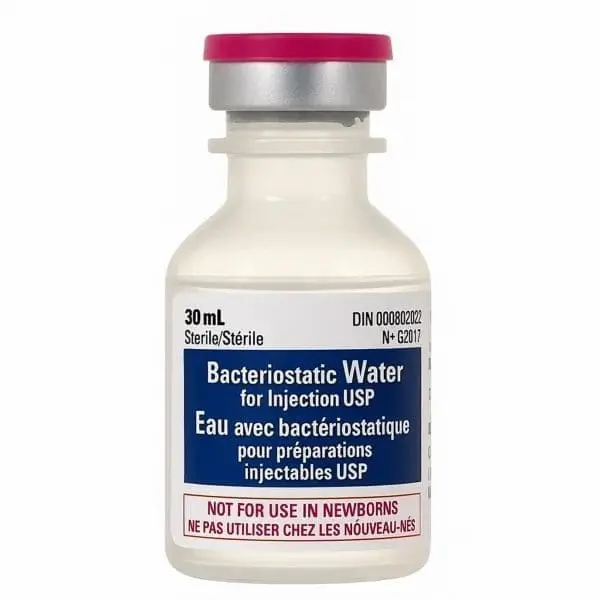 Bacteriostatic Water 30mlMixing liquid for lab work
 Research Pen Add-OnLab handling accessory
Other retatrutide guides on this site
Where to get retatrutide
The full buyer’s guide for labs, with supplier checks.
Availability in Canada
Where the rules stand and what approval would take.
Retatrutide cost in Canada
Price per mg, per vial and per size, with the full math.
Side effects in the research
What the trials reported, without turning it into advice.
Retatrutide vs Ozempic
Three receptors against one, on the published numbers.
Sema vs tirze vs reta
One, two and three receptors, side by side.
Freeze-dried research material with outside lab reports you can read before you buy.
Research and buying information only. Not medical advice. Not dosing advice. Not a recommendation for human use. Retatrutide from Red Leaf Research Labs is lab research material and is not approved by Health Canada for injection, ingestion, or any human or animal use. Prices and shipping terms change; check the live product page. Reviewed September 5, 2026 by Baba Kahn, founder of Red Leaf Research Labs.