Owned and operated by Baba Kahn, a CF veteran


One receptor, two, or three. Two of these you can be prescribed in Canada. One you cannot. Here is the honest split.
- 1 vs 2 vs 3 receptors
- -20.2% tirzepatide head-to-head
- -13.7% semaglutide
- Reta: not approved
Semaglutide works on one receptor. Tirzepatide works on two. Retatrutide works on three. In Canada you can be prescribed semaglutide or tirzepatide. Retatrutide is not approved anywhere. In the only head-to-head trial, tirzepatide beat semaglutide, 20.2% against 13.7% at 72 weeks. Retatrutide has bigger numbers but from its own separate trials. So it cannot be lined up against either.
- Key takeaways
- At a glance
- Which one fits which Canadian …
- Three related but different re…
- Semaglutide vs tirzepatide is …
- What is actually available in …
- Effectiveness is more than the…
- Side effects and safety shape …
- Access and affordability
- Retatrutide is promising, and …
- Decision summary
- Common questions
- The short version
If you are comparing these three in Canada, the real choice is between two of them.
Semaglutide and tirzepatide both have Canadian-authorised obesity brands. You can be prescribed either one. Retatrutide is investigational. promising, with the biggest trial numbers of the three. And not available to anyone outside a clinical trial.
This page covers how the three differ, where the semaglutide versus tirzepatide question matters. And what to ask a doctor.
Updated September 2026. Teaching only. Not medical advice.
Key takeaways
- Semaglutide and tirzepatide are the only two you can be prescribed in Canada. Retatrutide is still in testing everywhere.
- Tirzepatide beat semaglutide head-to-head. SURMOUNT-5 reported average weight change of −20.2% versus −13.7% at 72 weeks, in 751 adults with obesity.
- Retatrutide has the highest trial numbers so far. An average of 28.3% on 12mg over 80 weeks in Phase 3. But no head-to-head data, and no approval anywhere.
- A filing is not expected until 2027. A Canadian launch would come later than that.
- Side effects overlap a lot. Gut effects lead for all three. The reasons not to take them are similar too.
- Online research peptides are not the same as a prescription product from a licensed pharmacy.
At a glance
| Feature | Semaglutide | Tirzepatide | Retatrutide |
|---|---|---|---|
| Receptors targeted | GLP-1 | GIP + GLP-1 | GIP + GLP-1 + glucagon |
| Canadian brands | Wegovy (obesity); Ozempic, Rybelsus (diabetes) | Zepbound (obesity); Mounjaro (diabetes) | None |
| Canadian status (Aug 2026) | Approved. Prescription only | Approved. Prescription only | Still in testing. Not approved |
| Average weight loss in trials | −13.7% at 72 weeks (SURMOUNT-5) | −20.2% at 72 weeks (SURMOUNT-5) | −28.3% at 80 weeks, 12 mg (TRIUMPH-1) |
| Dosing | Weekly shot. Daily tablet for Rybelsus | Once-weekly injection | Weekly shot, trials only |
| Most common side effects | Nausea, vomiting, diarrhea, constipation and belly pain. Usually worst while the dose is going up | ||
| Best described as | The established option | The strongest approved option | A future option to watch |
Which one fits which Canadian patient?
Short version. Semaglutide if you want the settled one-path option. Tirzepatide if a two-path option suits. Retatrutide not at all, because you cannot get it.
Health Canada lists semaglutide brands (Ozempic, Rybelsus, Wegovy) and tirzepatide brands (Mounjaro, Zepbound) as prescription drugs. They are approved for type 2 diabetes and weight. Regulators have warned Canadians not to buy unapproved GLP-1 products online.
- Discuss semaglutide first if you and your clinician want a GLP-1 receptor agonist with an obesity-specific Canadian brand, a familiar dosing pathway. And the largest base of clinical and real-world experience.
- Discuss tirzepatide first if you want to consider a dual GIP and GLP-1 agonist for chronic weight management, particularly where a broader incretin mechanism may suit your health profile.
- Do not choose retatrutide outside a clinical trial. It is investigational, in Phase 3, and not a prescription option in Canada.
This page is teaching, not personal advice. The right choice depends on your BMI, your other conditions, your diabetes status, your other drugs, pregnancy plans, side effects, coverage, supply. And the goals you set with a doctor.
Three related but different receptor strategies
All three affect appetite and how your body handles sugar. What splits them is how many hormone paths each one switches on.
That difference shapes how much weight comes off, how well people put up with it, what happens to blood sugar. And how happy doctors are to prescribe it for years.
Semaglutide is a GLP-1 receptor agonist. Wegovy is authorised in Canada as an adjunct to reduced-calorie diet and increased physical activity for chronic weight management in adults with obesity, or overweight plus at least one weight-related condition.
Tirzepatide activates GIP and GLP-1. The Canadian product monograph for Zepbound describes it as a GIP and GLP-1 receptor agonist, indicated for once-weekly use alongside diet and activity in eligible adults.
Retatrutide adds glucagon on top. The Phase 2 obesity trial in the New England Journal of Medicine describes it as a GIP-GLP-1-glucagon triple agonist. Our explainer on what retatrutide is made from covers the structure.
Semaglutide vs tirzepatide is the comparison that matters now
For most Canadians this is not a three-way question. It is a two-way question, with retatrutide in the background.
Semaglutide and tirzepatide have prescription routes, official labels, pharmacy rules and safety data a doctor can use today. Retatrutide has none of that.
Regulatory status. Semaglutide has obesity-specific authorisation through Wegovy. And there may be generic semaglutide products authorised depending on current listings. your pharmacist can confirm. Tirzepatide has obesity authorisation through Zepbound. Retatrutide has published early results and announced later-stage results. And no authorisation.
Mechanism. Semaglutide, GLP-1. Tirzepatide, GIP plus GLP-1. Retatrutide, both of those plus glucagon – which is why it gets called next-generation.
Best current use. Semaglutide and tirzepatide are options to discuss with a prescriber. Retatrutide is a research-stage compound to watch, not something to buy from a peptide vendor.
Certainty. Semaglutide has the longest mainstream use and the most clinician familiarity. Tirzepatide has rapidly growing data. Retatrutide has striking trial results and no post-approval experience at all, because there has been no approval.
What is actually available in Canada right now
Semaglutide and tirzepatide. That is the list.
To check whether a product is approved and on sale, look it up in the Drug Product Database or ask a pharmacist for the DIN.
- Semaglutide. Obesity brand: Wegovy. Diabetes brands include Ozempic and Rybelsus – and a diabetes indication is not an obesity indication. Generic semaglutide may be authorised for specific uses; confirm with a licensed pharmacy.
- Tirzepatide. Obesity brand: Zepbound. Diabetes brand: Mounjaro. The Canadian monograph sets out the BMI and comorbidity criteria for chronic weight management in adults.
- Retatrutide. No Canadian prescription brand. Legitimate access is through authorised clinical research where applicable. Our guide to retatrutide availability in Canada tracks the status. Anything sold online for personal use should be treated as high risk.
Effectiveness is more than the headline number
Trial averages are useful. They do not tell you what will happen to one person.
Obesity Canada’s 2025 pharmacotherapy guideline makes the point directly: individual response varies. And the choice should account for health conditions, side effects, formulation, dosing frequency, interactions and cost.
For semaglutide, authorisation rests on Phase 3 randomised trials showing significantly greater weight loss than placebo, plus improvements in cardiometabolic endpoints. Doses are raised gradually to reduce gut side effects.
For tirzepatide, the Zepbound information describes the SURMOUNT programme in adults with obesity or overweight plus a weight-related condition, with diet and activity counselling. Nausea, diarrhea, constipation and vomiting lead the adverse reactions in weight-management trials.
For retatrutide, the numbers are attention-grabbing and the interpretation should be cautious. Early efficacy and safety results were peer-reviewed and Phase 3 results have been reported. and it remains investigational, not authorised in Canada or anywhere else. Its developer does not expect to file until 2027.
What the head-to-head and latest trial data show
SURMOUNT-5 is the only large randomised trial that put tirzepatide and semaglutide against each other.
Among 751 adults with obesity and without type 2 diabetes, average weight change at 72 weeks was −20.2% with tirzepatide (about 22.8 kg) versus −13.7% with semaglutide (about 15.0 kg). Waist circumference fell 18.4 cm versus 13.0 cm.
For retatrutide, Phase 3 TRIUMPH-1 results reported in May 2026 showed average weight loss of 19.0% at 4 mg, 25.9% at 9 mg and 28.3% at 12 mg after 80 weeks. Participants starting at a BMI of 35 or higher averaged 30.3% after 104 weeks on 12 mg.
Now the important sentence. Retatrutide has never been tested head-to-head against tirzepatide. So none of those numbers proves one is stronger in the same patients. They come from different trials with different people. Putting them side by side does not make them comparable. Our retatrutide vs Ozempic comparison explains why in more detail.
Side effects and safety shape the decision
These are not beauty shortcuts. They are prescription drugs for medical conditions. They need screening, monitoring, and a plan for when side effects show up.
Canadian health bodies have warned about known GLP-1 risks. Bad gut problems. Pancreatitis. Worse kidney injury. Low blood sugar, especially with certain other drugs. For the triple agonist specifically, see our breakdown of retatrutide side effects, and the wider look at peptide side effects.
The useful question is not “which is strongest”. It is “which balances benefit, side effects, safety and access for this person”.
So anyone with diabetes, gallbladder history, bad gut symptoms, kidney worries, eye risk, pregnancy plans or a long drug list needs a proper review before starting or switching.
What to raise:
- Gut tolerance. Nausea, vomiting, diarrhea, constipation, reflux, abdominal pain and dehydration all affect whether you can stay on it and how fast the dose can rise.
- Blood sugar. Anyone on insulin or sulfonylureas may need closer monitoring, because these drugs raise hypoglycemia risk in combination.
- Contraindications. Tirzepatide products for weight management are contraindicated with a personal or family history of medullary thyroid carcinoma or MEN 2. And in pregnancy. Similar class concerns apply across the monographs.
- Mental health. Some labels and Canadian guidance discuss monitoring mood changes with weight-management medication.
- Nutrition and lean mass. When appetite drops sharply, protein intake, resistance training, micronutrients and follow-up all matter more, not less.
Access and affordability
In Canada, authorisation and access are two different things.
A drug can be approved and still be hard to get. Pharmacy supply. Provincial lists. Insurance rules. Paperwork. Finding a prescriber. Or simply the cost. Even when generics arrive, price and coverage vary by province and plan.
Work through it in this order:
- Confirm the indication. Wegovy and Zepbound are the obesity brands. Ozempic, Rybelsus and Mounjaro sit under diabetes indications depending on the product and the prescription.
- Check your benefits before you start. Many private plans want a special authorisation form, BMI documentation, comorbidity information and previous therapy history.
- Ask the pharmacy about supply. A medication you cannot refill consistently creates interruptions and dose confusion, which is worse than not starting.
- Avoid unauthorised online sellers. Regulators advise obtaining prescription drugs only through licensed providers. Counterfeit products may contain the wrong amount, contaminants, or something else entirely.
- Plan for the long term. Obesity Canada notes these are part of a long-term strategy. And that stopping leads to weight regain and loss of the benefits.
Retatrutide is promising, and should not drive today’s decision
It deserves the attention. Three receptor paths instead of one or two. And studies suggest it could become an important weight drug.
But “future option” and “safe to buy now” are not the same thing.
Be especially careful with online research-peptide marketing. If a product has no Canadian approval, no DIN. And no licensed pharmacy behind it, it is not a prescription medicine. Before-and-after photos on social media do not change that. Unapproved injectables also carry dirt and sterility risks no product page mentions. There is more on this in our note on handling and preparation.
A practical way to hold it:
- Worth watching? Yes. Phase 3 results and a regulatory submission may change the landscape.
- Worth asking your clinician about? Yes, especially regarding trials or future planning.
- Worth buying online without a prescription? No.
- Equivalent to semaglutide or tirzepatide today? No. It has none of the approval, prescribing, pharmacy or post-market framework they have.
Decision summary
For a real conversation in Canada, start with semaglutide and tirzepatide. Semaglutide is the settled GLP-1 option. Tirzepatide is the two-receptor option with better head-to-head numbers. Retatrutide belongs in “watch closely” until a regulator has reviewed it.
A final checklist before choosing a path:
- Medical fit. Do you meet the Canadian indication criteria for chronic weight management?
- Comorbidities. Type 2 diabetes, sleep apnea, hypertension, dyslipidemia, cardiovascular disease, fatty liver. any of these can change the choice.
- Safety. Contraindications, pregnancy plans, severe gut disease, pancreatitis history, kidney concerns, or medicines that raise hypoglycemia risk.
- Practical access. Available at a licensed pharmacy, covered by your plan, and refillable.
- Long-term plan. Nutrition, activity, behavioural support, monitoring and maintenance built in from the start.
- Product legitimacy. A DIN, a licensed pharmacy, and a product that matches your prescription exactly.
For most people the next step is not picking a name off a comparison page. It is booking a talk, bringing your drug list and insurance details. And asking which option fits your goals and your risks.
Common questions
What is the difference between semaglutide, tirzepatide and retatrutide?
How many hormone receptors each one activates. Semaglutide targets GLP-1. Tirzepatide targets GIP and GLP-1. Retatrutide targets GIP, GLP-1 and glucagon. More pathways has meant greater average weight loss in trials – and less long-term safety data.
Which is better for weight loss, semaglutide or tirzepatide?
Tirzepatide, in the only large head-to-head trial. SURMOUNT-5 randomised 751 adults with obesity and without type 2 diabetes. And reported −20.2% with tirzepatide versus −13.7% with semaglutide at 72 weeks. Individual results vary widely. And tolerability, cost, coverage and medical history still decide what is appropriate.
How much weight loss has retatrutide produced in trials?
In Phase 3 TRIUMPH-1 results reported in May 2026: an average of 19.0% at 4 mg, 25.9% at 9 mg and 28.3% at 12 mg after 80 weeks. The earlier Phase 2 trial reported roughly 24% at 48 weeks. Trial averages, not guarantees.
Is retatrutide approved in Canada?
No – and not in any other major market as of August 2026. Its developer has said it does not expect to file for approval until 2027. Anything sold today as retatrutide has not been assessed by a drug regulator.
When will retatrutide be available in Canada?
There is no confirmed date. With a filing expected in 2027, Canadian authorisation and a pharmacy launch would follow only after that review. That typically takes a year or more. Treat any specific date quoted online as speculation.
Is retatrutide stronger than tirzepatide?
The trial averages point that way. And the two have never been compared head-to-head. Cross-trial comparisons break on differences in populations, baseline weights, trial lengths and protocols. Retatrutide also has far less long-term and real-world data. That matters as much as peak efficacy for something taken for years.
Do you need a prescription for semaglutide or tirzepatide in Canada?
Yes. Both are prescription-only and must be dispensed by a licensed pharmacy. A prescriber assesses BMI, weight-related conditions, contraindications and other medications before starting, then supervises the dose escalation.
Are online research-peptide versions safe to use?
No, not in a person. They are not authorised medicines, carry no DIN and do not come from a licensed pharmacy. They can be mislabelled, under- or over-dosed, non-sterile or contaminated. Canadian regulators have repeatedly warned against buying unauthorised injectable weight-loss products online.
What are the most common side effects?
Gut effects, for all three: nausea, vomiting, diarrhea, constipation and abdominal pain. Usually worst during dose escalation and often easing with time. Less common but more serious: pancreatitis, gallbladder disease, kidney injury from dehydration. And low blood sugar when combined with insulin or sulfonylureas.
The gallbladder part of that list has been measured across 76 trials. We broke down what it showed, and what it means for someone with no gallbladder, in GLP-1s, retatrutide and gallbladder risk.
Who should not take semaglutide or tirzepatide?
They are contraindicated with a personal or family history of medullary thyroid carcinoma or MEN 2. And in pregnancy. Extra caution or specialist input is needed with a history of pancreatitis, severe gut disease, gallbladder disease, significant kidney impairment, diabetic retinopathy or an eating disorder. Go through the Canadian monograph with a prescriber.
Can you switch between semaglutide and tirzepatide?
Yes. But prescriber-directed. The doses are not interchangeable. different units, different escalation schedules. so a clinician restarts titration on the new drug rather than converting. Common reasons to switch: a plateau, side effects, supply problems, or a change in coverage.
Do you have to stay on these long term?
Obesity is treated as a chronic condition, so yes, they are intended for long-term use. Obesity Canada notes that stopping commonly leads to weight regain and loss of the metabolic benefits. Some people taper with close support, but that should be planned alongside nutrition, activity and behavioural strategies.
Do these drugs cause muscle loss?
A meaningful share of the weight lost is lean mass. as happens with any substantial weight loss, rather than being unique to these drugs. Adequate protein, resistance training, slower escalation and body composition checks are the usual ways clinicians protect muscle.
Which is better if you also have type 2 diabetes?
Both have diabetes-indicated products in Canada: Ozempic and Rybelsus for semaglutide, Mounjaro for tirzepatide. The choice depends on A1C targets, cardiovascular and kidney history, other glucose-lowering medicines, injection preference and coverage. Retatrutide is still being studied in diabetes and is not an option outside a trial.
How much do semaglutide and tirzepatide cost in Canada?
Out-of-pocket for the obesity brands typically runs into the hundreds of dollars a month. And public drug plans rarely cover weight-management indications. Private plans often require special authorisation with BMI and comorbidity documentation. Ask the pharmacy for the cash price and your insurer for the exact criteria before starting.
What does triple agonist mean?
Three hormone receptors activated at once. Retatrutide targets GIP and GLP-1. That cut appetite and improve glucose control, plus the glucagon receptor. That is thought to raise energy expenditure. That added glucagon activity is the main reason it has produced larger average weight loss than single or dual agonists in trials.
Is retatrutide stronger than semaglutide?
Its trial averages are bigger. But the two have never been tested against each other, so “stronger” has not been measured.
Which is cheapest as research material?
Tirzepatide costs less per milligram than retatrutide right now. Our cost guide has the full per-milligram maths.
Can I buy any of these three without a prescription?
Not as medicines. Semaglutide and tirzepatide are prescription only in Canada. Retatrutide has no approved product at all.
What does GLP-3 mean?
Nothing. There is no GLP-3 receptor. It is internet slang for retatrutide, which hits GIP, GLP-1 and glucagon.
The short version
- Two of these three are available in Canada. Retatrutide is not, anywhere.
- Tirzepatide beat semaglutide in the only head-to-head trial: −20.2% versus −13.7% at 72 weeks.
- Retatrutide’s 28.3% is from a different trial with different people. It cannot be lined up against the other two.
- A 2027 filing means a Canadian launch is years away at best.
- The side effects overlap heavily – gut symptoms, worst while the dose is rising.
- Access in Canada is decided by coverage and supply as much as by approval.
- Nothing sold online as retatrutide is equivalent to a prescription product.
Semaglutide and tirzepatide are today’s practical choices. Retatrutide is a future possibility worth following. and following is all anyone can honestly do with it right now.
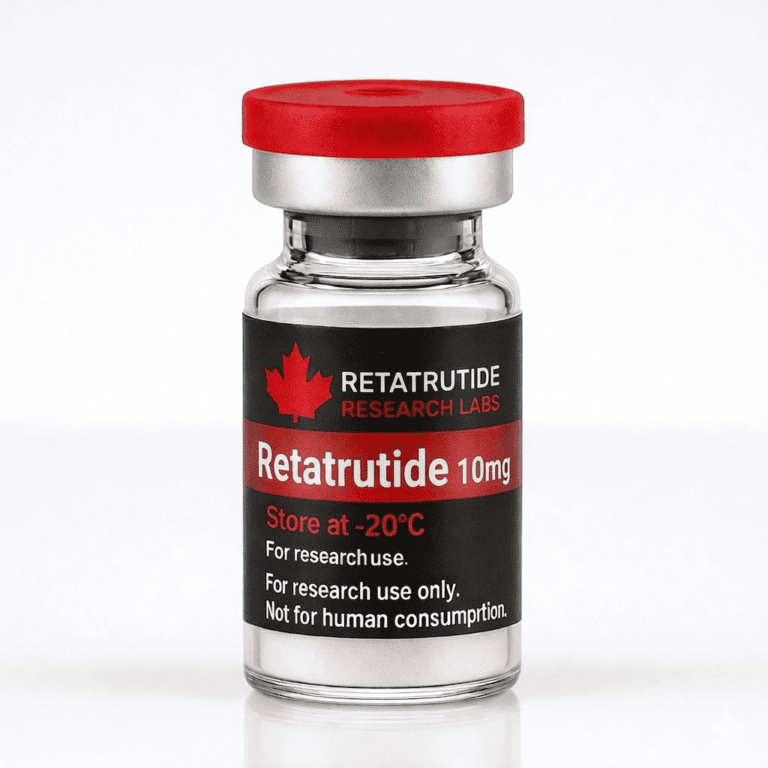 Retatrutide 10mg$79.99 CAD · research use onlyRetatrutide 20mg$149 CAD · research use onlyRetatrutide 30mg$199 CAD · research use only
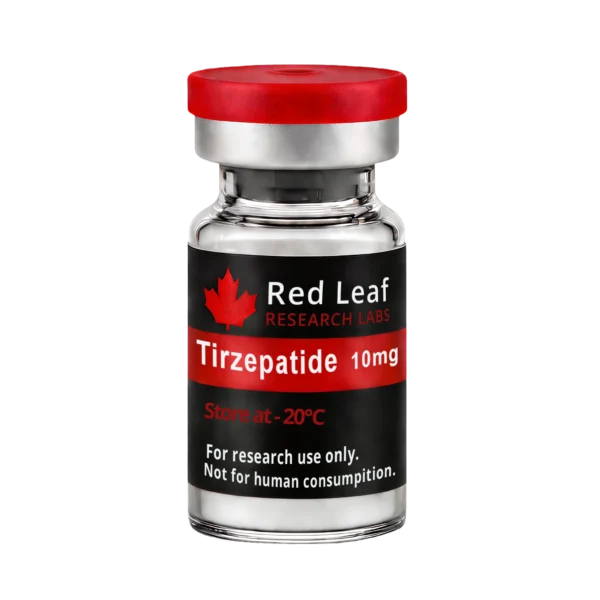 TirzepatideFrom $54 CAD · 10mg or 20mg
 Bacteriostatic Water 30mlMixing liquid for lab work
 Research Pen Add-OnLab handling accessory
Other retatrutide guides on this site
Where to get retatrutide
The full buyer’s guide for labs, with supplier checks.
Availability in Canada
Where the rules stand and what approval would take.
Retatrutide cost in Canada
Price per mg, per vial and per size, with the full math.
Side effects in the research
What the trials reported, without turning it into advice.
Retatrutide vs Ozempic
Three receptors against one, on the published numbers.
Sema vs tirze vs reta
One, two and three receptors, side by side.
Sold for lawful lab research only. Neither is a medicine, and neither replaces a prescription.
Research and buying information only. Not medical advice. Not dosing advice. Not a recommendation for human use. Retatrutide from Red Leaf Research Labs is lab research material and is not approved by Health Canada for injection, ingestion, or any human or animal use. Prices and shipping terms change; check the live product page. Reviewed September 5, 2026 by Baba Kahn, founder of Red Leaf Research Labs.