
 Owned and operated by a cf veteran


The dose arms used in the published retatrutide trials, set out as a reference. These are trial settings, not instructions.
- 1, 4, 8, 12mg arms
- 48 to 80 weeks
- Not a protocol
- Not approved anywhere
The published retatrutide trials used once-weekly arms of 1mg, 4mg, 8mg and 12mg, with the dose raised in steps over 48 to 80 weeks. Higher arms produced more weight change and more side effects. And more people dropped out. These are trial settings recorded for reference. They are not a dosing schedule, not advice. And retatrutide is not approved anywhere.
- Retatrutide dosing chart: the …
- The quick answer
- What is retatrutide?
- Retatrutide clinical-trial dos…
- How to interpret a dosing chart
- What the phase 2 obesity trial…
- Why more does not simply mean …
- Safety and harm reduction
- Why a dosing calculator or uni…
- How to evaluate a chart you se…
- Retatrutide versus semaglutide…
- What responsible clinical moni…
- Research-use-only is not a cat…
- Common misinformation patterns
- Common questions
- The short version
- Trial-dose questions
Retatrutide dosing chart: the short answer
Every retatrutide number you have seen online describes a clinical trial group. None of them describes a person.
Retatrutide is still investigational. Trial protocols come with eligibility screening, gradual escalation, monitoring and predefined rules for stopping. and a chart contains none of that.
Medical and research disclaimer: this article is education and harm reduction. It is not a prescription, a personal dosing plan, medical advice, or an instruction to use, inject, mix or reconstitute anything. The quantities below describe controlled clinical-trial groups. Do not use a research product in a person or an animal. Anyone considering a metabolic treatment should speak to a licensed clinician who can look at medical history, medications, lab results and the current regulatory position.
Searches for a dosing chart have grown as trial results circulate. The problem is that most charts strip out the context that made the numbers mean anything.
A dose used in a randomised trial was chosen for a specific protocol, population, formulation, escalation design and monitoring plan. Take it out of that and it does not automatically stay appropriate. It does not even automatically stay safe.
This guide explains what the published dose groups actually mean, why no chart can determine an individual dose, what the researchers measured. And which warning signs need urgent attention. It also explains why milligrams and syringe “units” are not the same thing. And why reconstitution calculators are unreliable for an unverified vial.
The quick answer
The best-known human data comes from a 48-week phase 2 obesity trial. Participants were assigned to placebo, or to once-weekly retatrutide groups with nominal maintenance doses of 1 mg, 4 mg, 8 mg or 12 mg. Several of the higher-dose groups started lower.
Around all of that sat things a chart cannot show you. Investigators monitored participants. They controlled the study product. They recorded adverse events. And they could intervene when protocol criteria were met.
Those are research arms, not dosing instructions. No universal chart can safely tell anyone how much to take.
A real clinical decision would need a product confirmed as authorised and appropriate, contraindications and interactions reviewed, a verified formulation. And ongoing monitoring. An unlabelled vial, a seller’s calculator and a social-media graphic supply none of those.
Harm-reduction bottom line: do not translate milligrams into syringe units, do not copy a trial arm. And do not inject a product labelled research use only. If someone has already used an unknown product and develops severe or persistent symptoms, contact emergency services or a poison centre. and tell them what was used, when, how much was believed to be used. And what else was taken.
What is retatrutide?
A long-acting investigational molecule built to activate three hormone receptors: GIP, GLP-1 and glucagon. Those pathways handle appetite, glucose regulation and energy balance, among other things.
Three targets, hence “triple agonist”. That nickname describes receptor activity. It does not predict a result for anyone.
Published studies have looked at adults with obesity, adults with overweight plus weight-related conditions. And adults with type 2 diabetes. Participants met detailed eligibility criteria. Researchers used a specified product, randomised the assignment, masked participants and study teams where applicable. And measured outcomes on a schedule.
None of which resembles buying an unverified vial and following a chart you found.
One more separation. A label listing a chemical name and a concentration establishes nothing about identity, sterility, potency, stability or suitability for injection.
Even an analytical purity percentage cannot demonstrate sterility, absence of endotoxin, correct fill quantity, proper storage or clinical safety. It is one measurement answering one question. Our page on certificates of analysis covers what each test actually shows.
Retatrutide clinical-trial dosing chart
The table below summarises the main dose groups from the phase 2 obesity publication.
It is a study-design reference. It deliberately contains no injection instructions, no reconstitution volumes, no syringe-unit conversions and no week-by-week escalation schedule. Those omissions are the point.
| Published trial group | Protocol context | Treatment period | What the label means |
|---|---|---|---|
| Placebo | Inactive comparison under the same study framework | 48 weeks | Established a reference for efficacy and safety comparisons |
| 1 mg once weekly | Fixed nominal study group | 48 weeks | A randomized research arm, not a recommended starting dose |
| 4 mg once weekly | Separate groups used different protocol-defined starting conditions | 48 weeks | Allowed researchers to examine dose and tolerability patterns |
| 8 mg once weekly | Separate groups used lower starting conditions before the nominal maintenance level | 48 weeks | Compared outcomes and adverse events under controlled escalation |
| 12 mg once weekly | Used a lower protocol-defined starting condition before the nominal maintenance level | 48 weeks | The highest nominal arm in this particular phase 2 obesity study |
For the source: the peer-reviewed phase 2 obesity trial enrolled 338 adults across once-weekly groups of 1 mg, 4 mg, 8 mg and 12 mg, with lower initial conditions in several groups. Read the PubMed record for the phase 2 obesity trial and the ClinicalTrials.gov record NCT04881760 for the design.
Those primary sources are safer than any copied chart, including this one.
Why this is not a personal schedule
A trial arm answers a research question. It does not tell you what is medically appropriate for anybody.
“Maintenance dose” is also misleading outside a protocol. In a study it names the randomised group. It does not mean every participant received every scheduled administration unchanged, or completed treatment, or tolerated it, or would be assigned the same thing in ordinary care.
Protocols contain discontinuation rules, dose-management rules, prohibited medications, lab assessments and adverse-event reporting. A four-row graphic contains none of those. That is what makes it a graphic rather than a protocol.
How to interpret a dosing chart
1. Start with the population
The phase 2 obesity trial studied adults with a BMI of at least 30, or 27 to under 30 plus at least one weight-related condition. There were exclusions and clinical screening.
It was not a general-population experiment. And the results should not be stretched to adolescents, pregnancy, breastfeeding, people seeking cosmetic weight change, or people with complex illness. There is no evidence for any of those groups because none of them were studied.
2. Separate the nominal dose from the escalation
“The 8 mg group” names the randomised target. It does not describe how that group got there.
The phase 2 design compared different starting conditions for some groups specifically to study gut tolerability. The publication reported that gut events happened mostly during escalation, were generally mild to moderate, increased with dose. And were partly reduced by starting lower.
That shows escalation design matters. It is not permission to invent one.
3. Keep the frequency attached to the trial
The obesity study used once-weekly administration. That frequency belongs to that formulation and that protocol.
It does not transfer to an unknown product whose identity, concentration, degradation and sterility are unestablished. More frequent use, microdosing, stacking and catch-up doses were not validated by anything. a copied chart least of all.
4. Read the outcomes with uncertainty attached
Group averages are not forecasts. Some participants lost more, some less, and some stopped.
Trial results also carry confidence intervals, missing-data methods and prespecified analyses that never make it onto a graphic. An impressive average does not mean everyone got it. And it does not mean risks vanish at lower numbers.
5. Check the date and the study phase
This research is still moving. A chart should name the study, the phase, the population, the publication date and the source.
If it does not, it may be mixing obesity and diabetes trials, confusing starting conditions with maintenance groups, or presenting a commercial guess as established medicine. Check the registries and the literature rather than assuming an old graphic still reflects reality.
What the phase 2 obesity trial reported
At 24 weeks, mean percentage changes in body weight were roughly −7.2% in the 1 mg group, −12.9% in the combined 4 mg groups, −17.3% in the combined 8 mg groups and −17.5% in the 12 mg group. Placebo was −1.6%.
At 48 weeks: approximately −8.7%, −17.1%, −22.8% and −24.2%, against −2.1% for placebo.
These get reposted constantly without their limits, so here are the limits.
They are group-level estimates from one controlled phase 2 trial. The study ran in the United States, most participants were White. And only a small proportion had overweight rather than obesity. The paper itself noted the limits on generalisability.
The results justified more research. They did not create a consumer dosing chart.
The most common adverse events were gut ones. nausea, diarrhea, vomiting, constipation. more frequent in higher-dose groups and mostly during escalation. Some participants in retatrutide groups stopped because of adverse events. Heart rate rose in a dose-dependent pattern, peaking around week 24 before declining. A minority reported altered or increased skin sensation. There is a fuller list of retatrutide side effects and of peptide side effects generally.
A separate randomised phase 2 study in adults with type 2 diabetes used a different population, duration, comparator structure and set of dose arms. Merging the two into one universal chart is not scientifically defensible. diabetes medication, baseline glucose control and hypoglycemia risk all change how symptoms and labs get read. The PubMed record for the type 2 diabetes trial is the place to look for that population.
Why more does not simply mean better
Search pages line the doses up low to high, next to progressively bigger average weight changes. It looks like a ladder.
It is not a ladder.
The real benefit-risk relationship includes tolerability, how many people quit, heart-rate changes, hydration, nutrition, lean mass, other conditions and other medicines. A bigger group-level effect can arrive alongside a higher rate of adverse events. And often does.
Rapid weight loss needs clinical context too. Body weight on its own does not tell you whether someone is eating enough, whether they are dehydrated, what is happening to their lean tissue, or whether their other medications need adjusting. Anyone on glucose-lowering or blood-pressure medicines may need monitoring. Because changes in eating and weight change what those drugs are doing.
There is one more pattern worth naming. Online communities sometimes treat side effects as proof the product is working.
That is a dangerous assumption. Severe vomiting, persistent abdominal pain, fainting, confusion and being unable to keep fluids down should never be normalised. Those can signal dehydration, electrolyte disturbance, gallbladder disease, pancreatitis, serious gut complications, allergy, an interaction, or something else entirely.
Safety and harm reduction
Know when to seek urgent help
Call emergency services for trouble breathing, swelling of the face or throat, collapse, severe confusion, seizure, chest pain, signs of shock, or a severe allergic reaction.
Get urgent medical assessment for severe or persistent abdominal pain, repeated vomiting, being unable to keep fluids down, black or bloody stool, very little urine, yellowing of the skin or eyes, a heartbeat that stays fast or irregular, or signs of dangerously low blood sugar. sweating, shaking, confusion, loss of consciousness.
If an unknown or research-labelled product has already been used, say so. Do not hide it from clinicians; it changes what they look for.
Bring the vial or a photograph if it is safe to. Note the believed amount, the time, the route, storage. And anything else taken. Contact a poison centre for case-specific guidance. And do not induce vomiting unless a professional says to.
Do not stack metabolic compounds
Combining retatrutide with another GLP-1, a GIP/GLP-1, another glucagon-targeting compound, an insulin secretagogue, a stimulant, a diuretic, a laxative or an unverified fat-loss product creates overlapping effects. and makes it impossible to work out what caused what when something goes wrong.
There is no reliable online calculator that converts one of these into another or works out an equivalent amount. The comparison between retatrutide and Ozempic explains why milligram-for-milligram conversion does not work.
Do not compensate for a missed amount
Doubling up, shortening the interval or improvising a catch-up increases risk.
Missed-dose instructions are specific to a product and its authorisation. A research-labelled vial does not come with validated instructions of any kind. Because nobody wrote any. For a legitimate prescribed treatment or an enrolled study participant, the clinician or the trial site is the source.
Watch hydration and nutrition
Nausea, vomiting, diarrhea and eating less all pull in the same direction: dehydration and electrolyte imbalance.
Warning signs are marked dizziness, fainting, confusion, dry mouth, very dark urine, urinating less, weakness or a fast heartbeat. People with kidney disease, older adults. And anyone on diuretics or certain blood-pressure medicines are more vulnerable.
And drinking a lot of plain water is not the fix people assume. it does not address a serious electrolyte problem. And it can make one worse. That needs professional assessment.
Protect against contamination and mislabelling
A research peptide can come with a certificate showing a purity result and still have no evidence of sterile manufacturing, endotoxin control, validated concentration, container integrity or cold-chain stability.
Mixing at home adds contamination and measurement risk on top. Particles, cloudiness, discoloration, a damaged stopper or a missing label are all reasons not to use something.
But note the asymmetry: those signs tell you when something is wrong. A clear-looking solution does not tell you anything is right. Contamination is usually invisible. Our guides to sourcing quality peptides and choosing a supplier cover what documentation should exist.
Why a dosing calculator or units chart can be dangerous
Three different things get confused here, so it is worth separating them.
Milligrams are mass. Millilitres are volume. Syringe units are markings on one particular syringe scale.
Converting between them requires an independently verified concentration and an exact preparation volume. Get any input wrong. the vial content, the dilution volume, the syringe type, the product identity, or the arithmetic. and the unit number can be wrong by a large factor. Not slightly wrong. Multiples.
A reconstitution calculator assumes the label is accurate and the preparation was done correctly. Neither assumption holds for an unapproved or research-labelled product.
And the calculator cannot detect degradation, contamination, counterfeit content, a different peptide entirely, endotoxin, or a vial filled at the wrong strength. It just does arithmetic on whatever numbers you feed it, confidently.
That is why this article gives no dosing chart in units and no instructions for a 10 mg vial with 1 ml of bacteriostatic water. Those would create an appearance of precision while leaving every real uncertainty untouched. which is worse than giving nothing. Because it feels like an answer.
The safer response is not a better calculator. It is not injecting research material. And getting regulated, supervised care. Our peptide calculator and our note on reconstitution exist for laboratory work with verified material, not for planning personal use.
How to evaluate a chart you see online
- Find the primary source. Does it name a trial registration number or a peer-reviewed paper?
- Check the population. Obesity and type 2 diabetes studies are not interchangeable.
- Check the formulation and setting. A controlled investigational product is not an online research vial.
- Separate starting conditions from nominal groups. Charts routinely flatten a multi-stage protocol into one number.
- Look for monitoring and stopping rules. If they are not mentioned, the chart is incomplete by definition.
- Reject guaranteed outcomes. Trial averages cannot promise anyone a result.
- Reject syringe-unit instructions. Units without a verified concentration are not a dose.
- Reject sales pressure. Scarcity claims, coupon codes and “limited stock” have nothing to do with medical legitimacy.
- Check conflicts and dates. Science moves, and commercial pages present the results that suit them.
- Ask a qualified clinician. Someone who can look at the whole picture rather than a target weight.
Retatrutide versus semaglutide or tirzepatide charts
These molecules are not interchangeable. Different receptor combinations, different evidence, different approved uses depending on where you are and when you ask.
A dose in milligrams for one does not convert to the same effect in another. Half the milligrams does not mean half as strong. And the number of receptors does not give you a conversion ratio. There is no ratio.
Head-to-head conclusions need head-to-head trials. Cross-trial comparisons break on differences in participants, duration, adherence, analysis and background care. A table listing peak average weight changes from unrelated trials generates clicks and tells you very little.
And a direct note for anyone currently on a prescribed metabolic medicine: do not stop, switch, combine or change it because of this article. Sudden changes affect glucose, appetite, hydration and whatever else you are managing. That conversation belongs with the prescriber, including goals, side effects, pregnancy plans and any upcoming procedures.
What responsible clinical monitoring may consider
Monitoring is individual. But a clinician would weigh medical history, medications, weight trajectory, blood pressure, heart rate, hydration, kidney and liver status, glucose control, gut symptoms, nutrition and pregnancy potential.
A trial protocol adds electrocardiograms, lab panels, a visit schedule and adverse-event reporting on top. none of which appears in internet advice.
One specific thing worth knowing. Because it catches people out. Before elective procedures or anesthesia, tell the care team about every medicine and metabolic agent. Slowed gastric emptying affects procedural planning. And a stomach that has not emptied is a real anesthetic risk.
Do not follow a generic stopping interval off social media. The right answer depends on the medicine, the symptoms, the procedure and current professional guidance.
Research-use-only is not a category of medicine
“For research use only” means the product is not offered as a medicine for human or veterinary administration.
It is not a loophole. It is not a weaker class of prescription. And it is not evidence that self-experimentation is safe. if anything it is the opposite. Because it marks material that was never made to be used in a person.
Laboratory identity and purity testing serve completely different purposes from clinical authorisation, sterile drug manufacturing and patient monitoring. There is more in our guide to where to get peptides in Canada.
Harm reduction starts with saying that plainly. Online demand moves faster than reliable supply chains and clinical evidence. And people deserve to know it.
They also deserve support without shame if they have already used something unknown. A non-judgemental call to a clinician or a poison centre prevents delay when symptoms are serious. And delay is what actually harms people.
Common misinformation patterns
“It is safe because it is based on a published study.” A paper can accurately describe what researchers did and still be unusable as personal instructions. Getting from evidence to care requires authorisation, product labelling, clinical assessment and professional judgement. The study is one input, not the whole chain.
“Low amounts are harmless.” Risk does not go to zero because a number is small. Product substitution, contamination, allergy, interaction and measurement error are not fixed by picking the first row of a chart. And some reactions are not predictable from dose at all.
“Any side effect can be managed by escalating more slowly.” That overstates it. Lower starting conditions reduced some gut events in a study population. Individuals still had serious symptoms. And some situations call for stopping and getting assessed rather than pushing through.
Common questions
What is the standard retatrutide dose?
There is not one. And no chart can responsibly give you one. Published studies used protocol-defined research groups under monitoring. Regulatory status, individual risks, interactions and formulation all matter. And a licensed clinician. not a search result. should guide anything involving an authorised metabolic treatment.
What doses were studied in the phase 2 obesity trial?
Nominal once-weekly groups of 1 mg, 4 mg, 8 mg and 12 mg over 48 weeks, with lower starting conditions in several groups. Historical study groups, not instructions. The trial also had placebo, screening, scheduled monitoring, adverse-event reporting and protocol rules that copying the final number does not reproduce.
Can I use a retatrutide 20 mg dosing chart?
A vial size is not a dose. It tells you nothing about what amount is appropriate, whether the content is accurately labelled, or whether it is sterile. This article does not provide instructions for administering, mixing or dividing a research vial.
How many syringe units equal a retatrutide dose?
There is no safe universal conversion. Units are volume markings; milligrams are mass. Any conversion depends on a verified concentration, an exact preparation volume and the right syringe scale. and for an unverified vial every one of those is uncertain. A unit number here would be false precision that could cause a serious error.
How do I reconstitute retatrutide?
Do not reconstitute or inject a product labelled for research use. Home preparation adds contamination, concentration and measurement risk. A regulated medicine should be used in its authorised form, per a qualified prescriber and pharmacist. A clear-looking liquid proves nothing about concentration, sterility or endotoxin.
Is retatrutide taken every day or every week?
The published trials studied once-weekly investigational administration. That belongs to those formulations and protocols. Do not change frequency, split amounts or build a microdosing plan from trial summaries. more frequent administration changes exposure in ways no chart predicts.
What happens if a retatrutide dose is missed?
Do not double up or improvise. A trial participant contacts the study team and follows the protocol. Someone on an authorised prescribed medicine follows that product’s instructions and asks their clinician or pharmacist. Advice written for a different drug does not transfer.
Can retatrutide be combined with semaglutide or tirzepatide?
Not without explicit specialist oversight. Overlapping effects raise the risk of gut problems, dehydration and glucose abnormalities. And make everything harder to attribute. There is no validated equivalence calculator. And similar marketing language does not make products interchangeable.
What side effects were common in trials?
Nausea, diarrhea, vomiting and constipation led the list. The obesity study also reported dose-related heart-rate increases and altered skin sensation in some participants. Monitoring in a trial does not remove risk; it means someone notices and acts. Severe, persistent or unusual symptoms need assessment, not normalisation.
When should someone seek emergency care?
Difficulty breathing, facial or throat swelling, collapse, seizure, severe confusion or chest pain. Also urgent: severe persistent abdominal pain, repeated vomiting, being unable to keep fluids down, signs of dehydration, jaundice, bloody stool, or a sustained abnormal heartbeat. If an unknown product was used, bring the packaging or a photo when it is safe to.
Does a certificate of analysis prove a vial is safe?
No. A certificate answers limited analytical questions. It does not prove sterile manufacturing, endotoxin control, accurate fill, stability, correct storage or suitability for injection. and the result itself needs a verifiable laboratory, method, date and matching lot. Purity alone is not a safety evaluation.
Why do online retatrutide charts disagree?
Some mix different trials. Some confuse starting conditions with maintenance groups. Some omit escalation entirely. And some convert unverified concentrations into syringe units. Others are simply commercial content built around a vial size. A trustworthy summary names the study, population, duration, source and limits. and says plainly that study arms are not directions.
Is a lower amount always safer?
No. Some effects are dose-related. But contamination, mislabelling, allergy, interactions and contraindications matter at any amount. Measurement errors also mean the believed quantity and the actual quantity may differ. Lower on a chart does not mean suitable. And it does not mean safe to self-administer.
Can trial results predict my weight loss?
No. Published percentages are group averages under controlled conditions. Individual responses vary, some people discontinue. And outcomes depend on baseline characteristics, adherence, other care and how the analysis was done. Focusing on scale weight alone also misses the nutritional and medical picture.
Is retatrutide the same as a GLP-1 medicine?
Not quite. It activates the GLP-1 receptor along with GIP and glucagon. So calling it a GLP-1 drug is incomplete. That wider receptor profile is one reason dose conversion from another drug is invalid. similar side-effect language does not mean equivalent potency or instructions.
Is this a dosing chart, or medical advice?
Neither. It is a harm-reduction explanation of published study arms. It cannot diagnose anything, choose a treatment, calculate a dose or replace a clinician. Leaving out syringe units and mixing instructions is a safety decision, not an oversight.
Is there an official retatrutide dosing chart?
No. There is no approved product, so there is no approved dose. What exists are the arms used in trials.
What doses did the trials use?
Once-weekly arms of 1mg, 4mg, 8mg and 12mg, reached by stepping up from a lower starting point.
Why did trials raise the dose slowly?
Gut side effects were worst while the dose was going up. Starting lower and moving slowly reduced them in the reported data.
Does a bigger dose mean better results?
Bigger arms showed more weight change and also more side effects and more dropouts. Both went up together.
How do I work out volumes from a vial?
That is arithmetic based on vial size and the strength you want. Our peptide calculator does it. It is maths, not a recommendation.
The short version
- 1 mg, 4 mg, 8 mg and 12 mg describe phase 2 obesity trial arms. They are not a personal schedule.
- Starting conditions, escalation, monitoring and stopping rules are the parts that make those numbers meaningful. And charts leave them out.
- Milligrams cannot be safely converted to syringe units without a verified concentration. And a calculator cannot verify a vial.
- Research-use-only material should not be injected, into anyone or anything.
- Severe abdominal symptoms, repeated vomiting, dehydration, allergic symptoms, chest pain, collapse or neurological changes need help now.
- More is not simply better. bigger average effects came with more adverse events and more people quitting.
- Primary sources beat copied charts, influencer posts and sales pages, every time.
Editorial note: this page summarises peer-reviewed and registry information available at the time of writing. And will be reviewed as more evidence appears. Including a study amount does not endorse off-label use, self-treatment, compounding or administration of a research product.
Trial-dose questions
Is a clinical-trial dosing chart a prescription?
No. It documents a research design. It cannot determine what is appropriate or safe for an individual.
Why do trial protocols escalate gradually?
To study tolerability and adverse events under supervision. That is not permission for self-directed use.
Can research material substitute for an authorized medicine?
No. Research-use material is not an authorised therapeutic product and is not intended for human or veterinary administration. There is more background on this in our research compound guides.
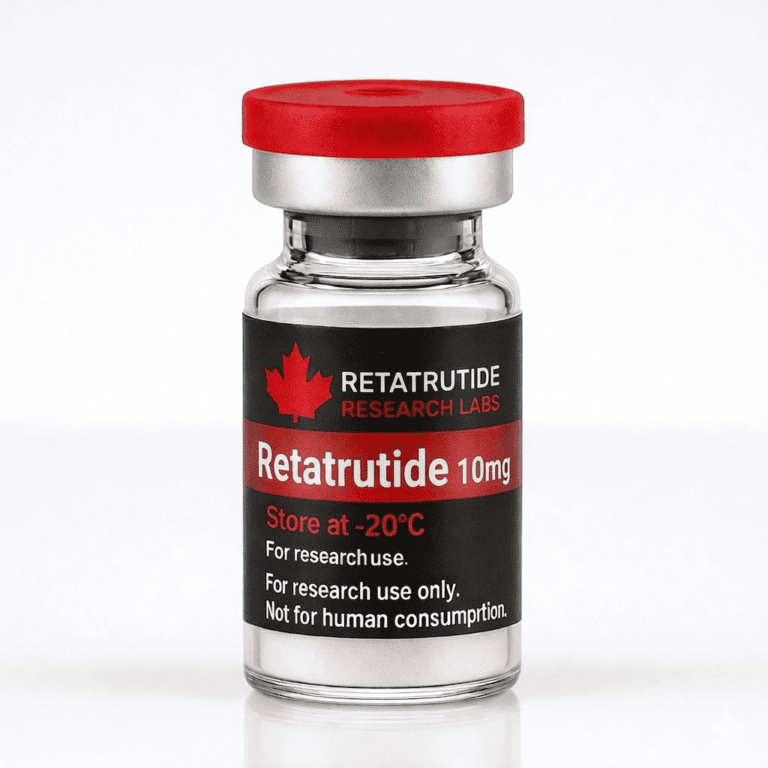 Retatrutide 10mg$89.99 CAD · research use onlyRetatrutide 20mg$149 CAD · research use onlyRetatrutide 30mg$199 CAD · research use only
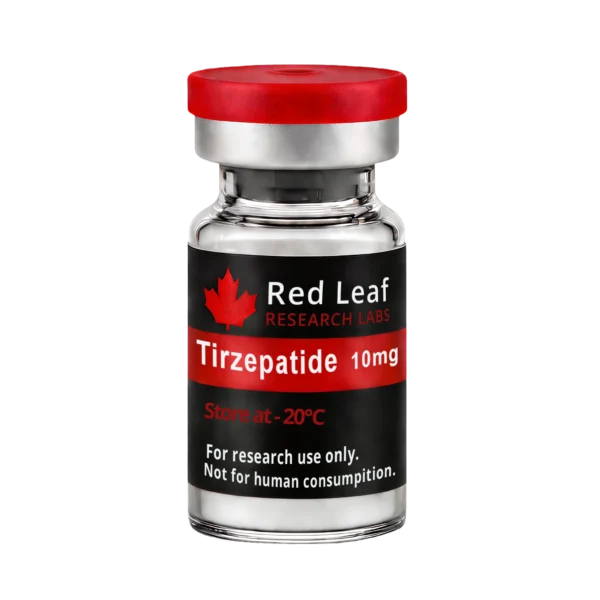 TirzepatideFrom $54 CAD · 10mg or 20mg
 Bacteriostatic Water 30mlMixing liquid for lab work
 Research Pen Add-OnLab handling accessory
Other retatrutide guides on this site
Where to get retatrutide
The full buyer’s guide for labs, with supplier checks.
Availability in Canada
Where the rules stand and what approval would take.
Retatrutide cost in Canada
Price per mg, per vial and per size, with the full math.
Side effects in the research
What the trials reported, without turning it into advice.
Retatrutide vs Ozempic
Three receptors against one, on the published numbers.
Sema vs tirze vs reta
One, two and three receptors, side by side.
Sold for lawful lab research only. No dosing guidance is provided with it. And none should be inferred from trial data.
Research and buying information only. Not medical advice. Not dosing advice. Not a recommendation for human use. Retatrutide from Red Leaf Research Labs is lab research material and is not approved by Health Canada for injection, ingestion, or any human or animal use. Prices and shipping terms change; check the live product page. Reviewed September 5, 2026 by Baba Kahn, founder of Red Leaf Research Labs.