
 Owned and operated by a cf veteran


What the GLOW stack is, what each part is studied for. And why stacking research peptides is a lab question and not a shopping list.
- GHK-Cu skin research
- BPC-157 repair models
- TB-500 repair models
- Research use only
GLOW is a nickname for a combination of GHK-Cu, BPC-157 and TB-500 that gets talked about alongside retatrutide. Each one is studied separately in its own research area. None of them is an approved medicine, none is proven to work together. And there is no trial testing the combination. Everything here is research material for lab use only.
- Reta and GLOW at a glance
- What does “Reta and GLOW” mean?
- Why Canadians are searching fo…
- Retatrutide: one peptide, thre…
- What the human research has sh…
- What is in a GLOW blend?
- GHK-Cu: the copper peptide
- BPC-157: preclinical, and ofte…
- TB-500 and the thymosin beta-4…
- Has the complete GLOW blend be…
- Reta versus GLOW: the evidence…
- Why combining compounds create…
- Canadian climate and peptide h…
- What a meaningful certificate …
- Red flags to watch for
- How to read the claims critica…
- Common questions
- The short version
- Research references
Short answer: “Reta and GLOW” means retatrutide plus a GLOW blend. They are not comparable things. Retatrutide is one defined peptide with large controlled human trials behind it. GLOW is a vendor name for a mixture. usually GHK-Cu, BPC-157 and TB-500. that has never been tested as a combination in humans at all.
Reta and GLOW at a glance
- Reta: shorthand for retatrutide, which activates GIP, GLP-1 and glucagon receptors.
- GLOW: a commercial blend name, usually GHK-Cu, BPC-157 and TB-500.
- Typical ratio: 50 mg GHK-Cu, 10 mg BPC-157, 10 mg TB-500. though formulations vary.
- The evidence gap: retatrutide has controlled human trial data. GLOW claims are extrapolated from studies of the individual ingredients, mostly in animals and cells.
- Combination evidence: none. No controlled human study has tested retatrutide with a fixed-ratio GLOW blend.
- What to verify: composition, lot-specific identity, purity, quantity, shipping conditions, storage documentation.
What does “Reta and GLOW” mean?
Nothing official. There is no scientific protocol by that name.
It is internet shorthand that puts two very different things in one phrase. Sometimes people mean two separate research interests. Sometimes they mean two products being compared. Sometimes they mean an informal stack somebody is promoting.
Retatrutide is a defined molecule, LY3437943 in the literature, built to act on the GIP, GLP-1 and glucagon receptors. Three receptors, one molecule, hence “triple agonist”.
GLOW is not a molecule. It is a product name applied to a mixture. The commonly advertised vial holds 50 mg GHK-Cu, 10 mg BPC-157 and 10 mg TB-500. 70 mg total. but other ratios exist. And nothing stops a supplier using the name for something else.
So a label saying GLOW tells you what the seller called it. It does not tell you what is inside.
That is the first lesson here. One is a compound with compound-specific trial data. The other is a category whose evidence has to be assessed ingredient by ingredient. And batch by batch.
Why Canadians are searching for this
Metabolic peptide research has moved fast, copper peptides stayed prominent in tissue research. And social platforms compress complicated names into short ones. “Reta” beats typing retatrutide. “GLOW” turns three technical names into something friendly.
Convenient, and it creates a real problem.
Short posts mix human clinical findings for retatrutide with animal findings for GHK-Cu, BPC-157 or thymosin peptides. Read quickly, it sounds like one body of evidence supporting one combined approach.
It is not. Every claim traces back to a specific compound, in a specific model, by a specific route, at a specific endpoint. and those do not transfer.
The search results are not much help either. Plenty of pages answer “what is in GLOW?” Far fewer mention that the blend has no direct clinical validation. Plenty of retatrutide pages quote impressive weight numbers without the trial design, population, duration or adverse events that go with them.
Retatrutide: one peptide, three targets
Retatrutide activates GIP, GLP-1 and glucagon receptors from a single molecule. Those systems overlap but do different jobs across glucose regulation, appetite, nutrient handling and energy balance.
GLP-1 handles glucose-dependent insulin release, slower stomach emptying and appetite signalling. GIP also affects nutrient-responsive insulin secretion. Glucagon is the complicated one. liver energy metabolism and energy expenditure, plus effects on blood sugar that have to be counterbalanced.
The design is about balancing all three, not maximising any one of them.
Which is why calling retatrutide “another GLP-1” is wrong. The GLP-1 part matters. But the actual scientific question is whether hitting all three changes the size, pattern or durability of the effect. That gets settled by trials, not by reasoning about mechanism.
What the human research has shown
The randomised Phase 2 obesity trial enrolled adults with obesity, or overweight plus at least one weight-related condition.
At 24 weeks, mean body weight change ran from 7.2% in the 1 mg group to 17.5% in the 12 mg group. Placebo was 1.6%.
At 48 weeks the 12 mg group was at 24.2%, against 2.1% for placebo.
Group averages from a controlled trial. Not predictions for anybody.
The same study reported gut adverse events as the most common problem, more frequent at higher doses, plus increases in heart rate. And the trial used structured dose escalation with clinical monitoring throughout. which is exactly the part that gets stripped out when a headline figure travels to a product page.
Retatrutide has also been studied in people with type 2 diabetes, where Phase 2 looked at blood sugar, weight and safety across several dose and escalation groups. Phase 3 has since taken it into larger and more specific populations. And separate studies have examined liver fat, cardiovascular risk and kidney disease.
So: retatrutide has substantial human research behind it. That is a statement about the molecule. It is not a statement about any vial. And research status and commercial availability are entirely separate questions.
What is in a GLOW blend?
Usually three freeze-dried components:
- GHK-Cu: a copper complex of the tripeptide glycyl-L-histidyl-L-lysine.
- BPC-157: a synthetic 15-amino-acid peptide studied in gut, vascular and connective-tissue models.
- TB-500: a commercial name generally associated with a thymosin beta-4-related fragment.
The advertised 50:10:10 ratio makes GHK-Cu the dominant component by mass.
By mass. Which is not the same as by molar amount. And definitely not the same as by biological activity. The three have different molecular weights, structures, stability profiles and testing requirements. Comparing them in milligrams tells you almost nothing about how they behave together.
GLOW also needs separating from things with similar names. Some suppliers use different ratios. Some substitute a different thymosin beta-4 form. Some add another peptide such as KPV and give it another nickname.
Never infer identity from a vial colour, a product nickname, or a generic certificate.
GHK-Cu: the copper peptide
GHK is a naturally occurring tripeptide that binds copper. The complex gets written GHK-Cu or Cu-GHK.
It has been studied around extracellular-matrix signalling, fibroblast behaviour, collagen organisation, angiogenesis, inflammatory pathways and wound models.
Recent biomaterials research has built Cu-GHK into hydrogels and peptide nanofibres, with reported effects on cell migration, fibroblast density, collagen remodelling and wound closure.
Here is the catch. And it applies to a lot of peptide marketing. The delivery system was part of the experiment. A peptide engineered into a designed hydrogel is not scientifically interchangeable with the same peptide freeze-dried into a multi-component vial. The hydrogel study did not test the vial.
GHK-Cu also turns formulations blue. Because of the copper. Blue is consistent with a copper complex being present. It is not an identity test, a purity test or a quantity test. And it is trivially easy to fake.
When a page tells you GHK-Cu is proven to rejuvenate skin or regenerate tissue, it has compressed a mixed evidence base into a promise. The defensible version: GHK-Cu has shown biologically interesting effects in cell, biomaterial and animal research. And the outcome depends heavily on formulation and model.
BPC-157: preclinical, and often oversold
A 15-amino-acid peptide with a large preclinical literature. rodent models of gut injury, tendon and ligament damage, muscle injury, burns and vascular signalling. Older animal studies reported differences in granulation tissue, angiogenesis, collagen formation and tensile strength.
All of which gets wildly overstated online.
Animal findings do not establish anything about humans. A result in one injury model does not carry to every tissue. And study quality, replication, dose selection and what gets published all shape what that literature looks like.
BPC-157 is a research compound with preclinical signals. It is not an established healing treatment. And no amount of forum enthusiasm changes that.
One study is worth singling out. A recent rat trial tested BPC-157 and TB-500 separately and together after a standardised Achilles tendon injury. Some histological measures improved in the treatment groups. and the combined group showed no clear extra benefit over either compound alone.
Sit with that for a moment. Because it is the entire GLOW premise being tested directly. Combining ingredients that each have interesting findings did not produce synergy. It produced roughly what each did on its own.
TB-500 and the thymosin beta-4 problem
This is where the terminology falls apart.
Thymosin beta-4 is a naturally occurring 43-amino-acid peptide involved in actin dynamics, cell migration and repair signalling. “TB-500” is the name commonly used for a synthetic product associated with an active fragment of it.
Commonly used, and not consistently. Suppliers differ on sequence and form, and many do not specify either.
That has a direct analytical consequence. A certificate reporting “TB-500 purity” without the tested sequence, the molecular mass and the identity method has left the important question unanswered. Pure what? You should be able to tell whether the vial holds full-length thymosin beta-4, a shorter fragment, or something else.
The related research covers cell migration, angiogenesis, corneal repair, dermal wounds and cardiac injury models. Those are not interchangeable endpoints either. Actin sequestration gives a decent reason to study it. A reason to study something is not a result.
Has the complete GLOW blend been studied?
No. And this is the question most pages selling it manage not to ask.
The individual ingredients have research histories. The GHK-Cu / BPC-157 / TB-500 blend, as a fixed three-component formulation, has no comparable controlled human evidence. What you will find searching is supplier guides, product pages, anecdotal protocols and studies of the separate components. None of those is a trial of the blend.
Even BPC-157 plus TB-500 cannot be assumed additive. the rat tendon study above found no advantage from combining them on its measured outcomes. That does not settle every possible model. It does directly contradict the casual claim that more components means more effect.
Adding GHK-Cu raises further questions nobody has answered. Does copper coordination affect either peptide during storage? Are all three stable together once reconstituted? Does one chromatogram actually separate and quantify all three? Does the fixed ratio suit the experiment you are running?
If you want the numbers for a specific vial, our peptide reconstitution calculator does the arithmetic: concentration, draw volume in mL, and the matching mark on a U-100 syringe.
Those are formulation and analytical questions. Marketing language cannot answer them, and mostly does not try.
Reta versus GLOW: the evidence is not symmetrical
| Research feature | Retatrutide (“Reta”) | GLOW blend |
|---|---|---|
| Material | One defined investigational peptide | Vendor-named multi-peptide formulation |
| Main targets | GIP, GLP-1 and glucagon receptors | Depends on GHK-Cu, BPC-157 and TB-500 components |
| Human evidence | Randomized phase 2 and phase 3 trials | No comparable controlled human evidence for the fixed blend |
| Key research area | Metabolic disease, obesity and related outcomes | Matrix, cell-migration and tissue-repair models |
| Standardization | Defined trial molecule | Ratios and even component definitions may vary |
| Major interpretation risk | Applying trial results to unverified online material | Treating component studies as proof of blend synergy |
Different research questions, different evidence levels, different analytical problems. Writing them as one protocol is the mistake.
Why combining compounds creates new questions
A stack is not the sum of its labels.
Run several compounds at once and you get interactions. how they act, how they behave chemically together. And how you interpret the result.
If an endpoint moves. That component moved it? If something goes wrong, what caused it? If the formulation degrades, do the ingredients on the label still describe what reached the assay?
Retatrutide already engages three receptor families on its own. A GLOW blend adds three more materials with their own proposed pathways. Put them together and you have six variables and no way to separate them.
A useful protocol would need controls, predefined endpoints, analytical confirmation, enough samples. And a reason for the timing and exposure chosen. Claims about complementary “metabolic” and “repair” effects are not a substitute for any of that.
And to say it plainly: there is no clinical evidence establishing the safety, effectiveness or synergy of retatrutide used with a GLOW formulation. The pairing is a comparison, not a recommendation.
Canadian climate and peptide handling
A parcel here can go from summer heat in southern Ontario to a frozen depot on the Prairies, through trucks, sorting centres, community mailboxes and unheated loading bays.
Express shipping helps. Speed alone does not prove anything stayed inside a validated temperature range.
Freeze-drying makes material more stable than a solution. But it does not make a peptide immune to heat, moisture, oxygen or repeated temperature cycling. Copper-containing material may need its own handling.
Cold packs are not the universal answer people assume. They warm up before delivery. And in a Canadian winter, an uncontrolled pack can push a parcel towards freezing rather than protecting it from heat.
What actually matters is a defined process: packaging suited to the season, tamper-evident containers, clear lot identification, prompt transfer into proper storage. And a procedure for what happens when something goes wrong instead of hoping it did not.
What a meaningful certificate should show
A certificate is useful when you can connect it to the vial and the method answers the right question.
For retatrutide: lot-specific identity and purity, expected molecular mass, test date, method details. And an independent laboratory report where one exists.
For a GLOW blend, one overall purity percentage is close to meaningless. Purity of what – the mixture? A report worth reading identifies each component separately:
- Identity of GHK-Cu, BPC-157 and the exact TB-500-related sequence
- Quantity of each component, not just total vial mass
- Chromatographic separation actually suited to a mixture
- Mass-spectrometric confirmation for each peptide
- A lot number matching the vial label
- The testing date and the name of the laboratory
- Appearance, and where it matters, water content, residual solvents, bioburden, endotoxin or sterility
Purity and quantity are different measurements. A sample can show a high main peak and still contain less material than the label claims. Identity, purity and content are three questions. And one number cannot answer all three.
Red flags to watch for
Be careful with any page that:
- calls retatrutide approved, proven or guaranteed without current regulatory context
- uses the Phase 2 weight headline as a promise to buyers
- presents GLOW as clinically validated without a study of the actual blend
- claims synergy just because the ingredients have different proposed mechanisms
- gives personal-use schedules while labelling the product research-only
- shows one recycled certificate for every lot, or hides which laboratory tested it
- uses “99% purity” in place of identity and net-content testing
- never defines what its TB-500 actually is at the sequence level
- treats a blue vial as proof of authentic GHK-Cu
- ships without lot traceability, tamper evidence or storage instructions
Good sourcing is deliberately boring. Clear records, consistent labels, traceable lots, defensible methods. And claims that stop where the data stops.
How to read the claims critically
Four steps, in order.
Identify the evidence layer. Human randomised trials sit above anecdotes for questions about outcomes. Animal models generate hypotheses and cannot establish human benefit. Cell studies are useful for pathway questions and are further removed again.
Check the material matches the claim. A Cu-GHK hydrogel study did not test a GLOW vial. A full-length thymosin beta-4 paper may not describe what is sold as TB-500. A retatrutide trial does not validate an online product that shares its name.
Look at the endpoint. Percentage body-weight change, collagen staining, fibroblast migration and tendon load-to-failure are four completely different measurements. They cannot be added together into “improves everything”.
Notice what is missing. Replication. Long-term follow-up. Formulation stability. Combination controls. Adverse-event reporting. Independent analysis. Absences should lower your confidence even when the biological story sounds good. and the story usually sounds good. Because that is what it was written for.
Common questions
Is Reta the same thing as retatrutide?
In peptide discussions, yes. it is the nickname. A nickname is not an analytical identity. And the contents of a vial still need lot-specific documentation and testing.
What peptides are normally in GLOW?
Usually GHK-Cu, BPC-157 and TB-500, commonly at 50 mg / 10 mg / 10 mg. The name is not standardised. So verify the actual label and certificate rather than the name.
Is GLOW one peptide?
No. It is a blend name. The three components differ in sequence, molecular mass, proposed mechanism and evidence base.
Has GLOW been proven to work as a combination?
No. There is no controlled human trial of the marketed fixed-ratio blend. The claims are extrapolated from studies of individual components or related molecules.
Has retatrutide been studied in humans?
Yes – randomised Phase 2 studies and Phase 3 programmes. That evidence belongs to retatrutide. It does not transfer to GLOW or to unverified material.
Does evidence for each ingredient prove synergy?
No. Ingredients can each have interesting findings and produce nothing extra together. which is exactly what the rat tendon study found for BPC-157 and TB-500. Synergy has to be tested directly, with individual-component and combination controls.
Can vial colour confirm GLOW quality?
No. Copper turns things blue. That is all blue tells you. It says nothing about identity, quantity, purity, sterility or stability. And it is easy to imitate.
What should Canadian laboratories prioritise when sourcing?
Lot traceability, component-specific identity and quantity testing, independent documentation, packaging suited to the season, clear storage conditions. And claims that stay inside the evidence.
What is the main difference between Reta and GLOW?
One is a defined investigational peptide with triple-receptor activity. The other is a product name for a mixture. Different mechanisms, different evidence levels, different quality-control requirements.
Is “Reta and GLOW” an established research protocol?
No. It is a search phrase. Any combined experiment would need its own rationale, controls, analytical verification and ethics review.
Why is GLOW commonly described as a 70 mg blend?
Because the common formulation is 50 mg GHK-Cu, 10 mg BPC-157 and 10 mg TB-500. That totals 70 mg by mass. Other formulations exist. So verify the product rather than trusting the number.
Does retatrutide research prove an online vial is authentic?
No. Published trials describe the trial material under controlled conditions. They authenticate nothing about a third-party vial. Identity, purity and content have to be verified for that specific lot.
What tests are most useful for a GLOW blend?
Anything that identifies and quantifies all three components separately. component-resolving HPLC, mass spectrometry, net-content testing, plus whatever the intended work requires. One overall purity percentage is not enough.
Why is TB-500 identity important?
Because suppliers use the name inconsistently, for thymosin beta-4 or for a fragment of it. The exact sequence and expected molecular mass should be in the documentation. So there is no ambiguity about what was tested.
Is a blue GLOW vial automatically high quality?
No. GHK-Cu makes things blue. Colour cannot confirm the identity or amount of any ingredient. And it cannot establish purity, sterility, endotoxin status or stability.
What is the best evidence-based conclusion?
Retatrutide has meaningful human research as a single compound. The GLOW components have varying preclinical evidence. The complete blend. And especially its combination with retatrutide, is unvalidated in controlled human research.
What does GLOW stand for?
It is a nickname for a GHK-Cu, BPC-157 and TB-500 combination. It is not an official name and no regulator recognises it.
Is there research on the GLOW stack together?
No published trial tests the three together. What exists is separate research on each one.
Can you run GLOW with reta?
There is no study of that combination. Anyone telling you a schedule is inventing it.
Are these approved in Canada?
No. GHK-Cu, BPC-157, TB-500 and retatrutide are all research materials, not approved medicines.
Where do the lab reports live?
Every product page links its batch report. And they all sit on our testing page with a verify link.
The short version
- Reta and GLOW are not comparable. One is a molecule with human trials; the other is a product name for a mixture.
- The GLOW blend has never been tested as a blend in humans. Every claim about it is extrapolated from its parts.
- When BPC-157 and TB-500 were tested together in rats, the combination beat neither compound alone.
- A hydrogel study of GHK-Cu did not test a freeze-dried vial. The delivery system was part of the experiment.
- Blue means copper. It does not mean quality, identity or quantity.
- “TB-500” is used inconsistently. If the sequence is not documented, you do not know what you have.
- One purity percentage cannot describe a three-component mixture.
Retatrutide has substantial controlled human research. GLOW does not, and combining the two has none at all.
Separate human evidence from animal evidence. Separate a defined molecule from a commercial blend. Separate purity from identity and quantity. And separate a plausible mechanism from a demonstrated benefit. because that last gap is where most of this marketing lives.
Verify the composition, match every vial to its own certificate, account for what Canadian shipping does to a parcel, document your storage. And never assume that two separately studied compounds become validated by sharing a vial.
Research-use notice: this article is educational and intended for qualified laboratory research discussion. It gives no medical advice, personal-use instructions, dosing guidance or recommendation to combine compounds. Research materials described here are not intended for human or veterinary use.
Research references
- Triple-Hormone-Receptor Agonist Retatrutide for Obesity: A Phase 2 Trial.
- Retatrutide for people with type 2 diabetes: randomized phase 2 trial.
- Retatrutide in type 2 diabetes: randomized phase 3 trial.
- Retatrutide for metabolic dysfunction-associated steatotic liver disease: phase 2a trial.
- Cu-GHK peptide nanofibres in a wound-healing hydrogel model.
- BPC-157 effects in experimental healing models.
- BPC-157 in an experimental burn-wound model.
- BPC-157 and TB-500 in a rat Achilles tendon-healing model.
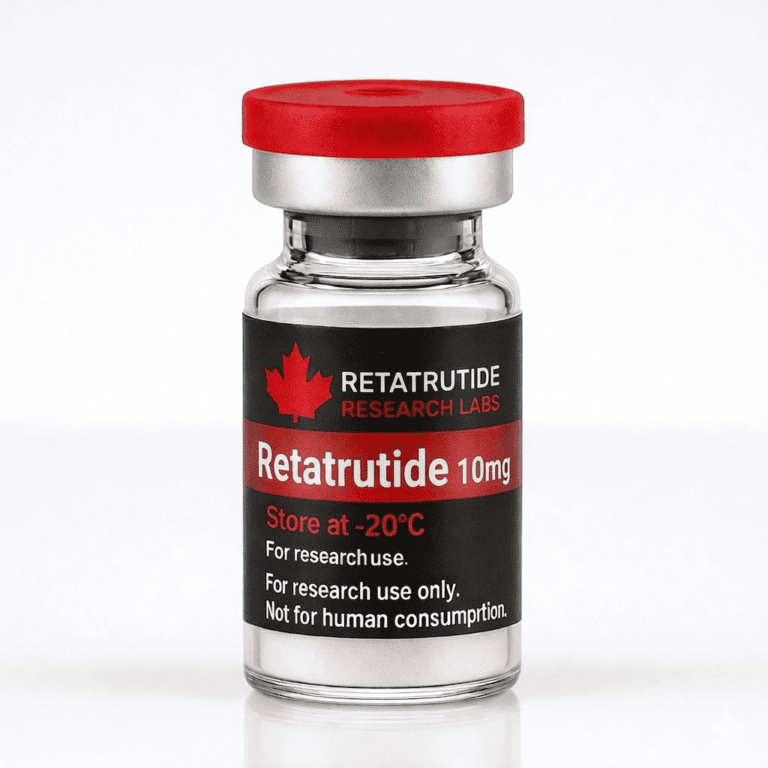 Retatrutide 10mg$89.99 CAD · research use onlyRetatrutide 20mg$149 CAD · research use onlyRetatrutide 30mg$199 CAD · research use only
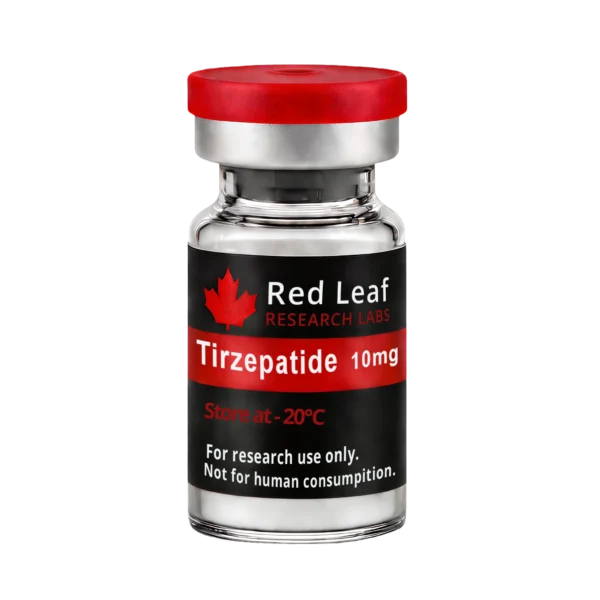 TirzepatideFrom $54 CAD · 10mg or 20mg
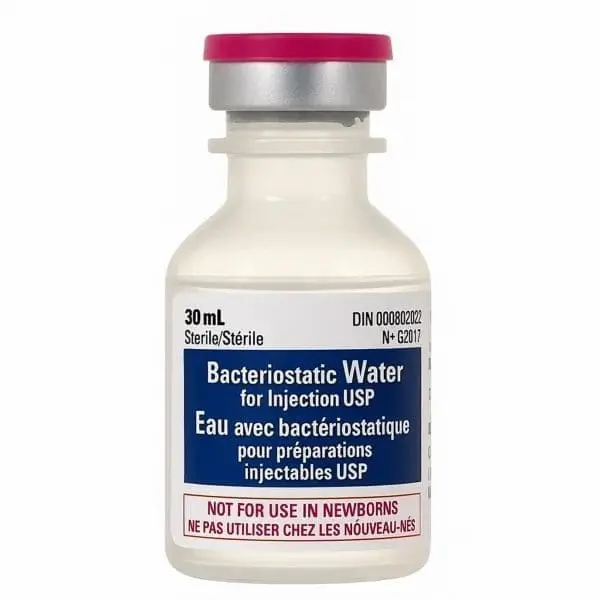 Bacteriostatic Water 30mlMixing liquid for lab work
 Research Pen Add-OnLab handling accessory
Other retatrutide guides on this site
Where to get retatrutide
The full buyer’s guide for labs, with supplier checks.
Availability in Canada
Where the rules stand and what approval would take.
Retatrutide cost in Canada
Price per mg, per vial and per size, with the full math.
Side effects in the research
What the trials reported, without turning it into advice.
Retatrutide vs Ozempic
Three receptors against one, on the published numbers.
Sema vs tirze vs reta
One, two and three receptors, side by side.
GHK-Cu, BPC-157 and TB-500, each with an outside lab report. Sold for lawful lab research only.
Research and buying information only. Not medical advice. Not dosing advice. Not a recommendation for human use. Retatrutide from Red Leaf Research Labs is lab research material and is not approved by Health Canada for injection, ingestion, or any human or animal use. Prices and shipping terms change; check the live product page. Reviewed September 5, 2026 by Baba Kahn, founder of Red Leaf Research Labs.