
 Owned and operated by a cf veteran


Quick guide
Semax is a lab-made peptide used in brain and cell research. This guide explains what labs study and where the facts are still not clear.
- Some work looks at focus, stress, and brain signals.
- Study methods and results can vary.
- Many claims need more strong data.
- Lab results may not apply to people.
Semax sold here is for lab research only. It is not approved to treat or cure a health issue. Read the source, study size, and limits before you draw a claim from the data.
How to read the research
Start with the question a study asks. Check the test model, group size, time frame, and end points. Look for a control group. Note what the study does not prove. These steps can help you read the data with less bias.
Keep a clear lab record
Write down the item name, lot code, date, and storage state. Note each tool and each step. Record what you saw, even when the test did not go as planned. Clear notes help a second team check the work. They also help you spot a gap or source of error.
Key terms in plain language
A study model is the type of test. It may use cells, tissue, or animals. A control group gives the test a base for a fair check. An end point is the result that the team tracks. A small group can miss rare effects. A short test may miss a slow change.
Keep claims in scale with the facts. One small study is a clue, not final proof. A clear result should be seen more than once and in more than one type of test.
What Is Semax?
The Semax Peptide is a synthetic peptide originally developed by researchers in Russia. It is derived from a fragment of adrenocorticotropic hormone (ACTH) but does not produce the hormonal effects associated with ACTH itself.
Over the years, Semax has become one of the most studied nootropic peptides because of its potential effects on cognition, memory, learning, and neuroprotection.
Researchers have investigated Semax for its possible role in:
- Cognitive function
- Focus and attention
- Memory formation
- Learning processes
- Neuroprotection
- Brain health
Today, Semax remains an important area of neuroscience and peptide research.
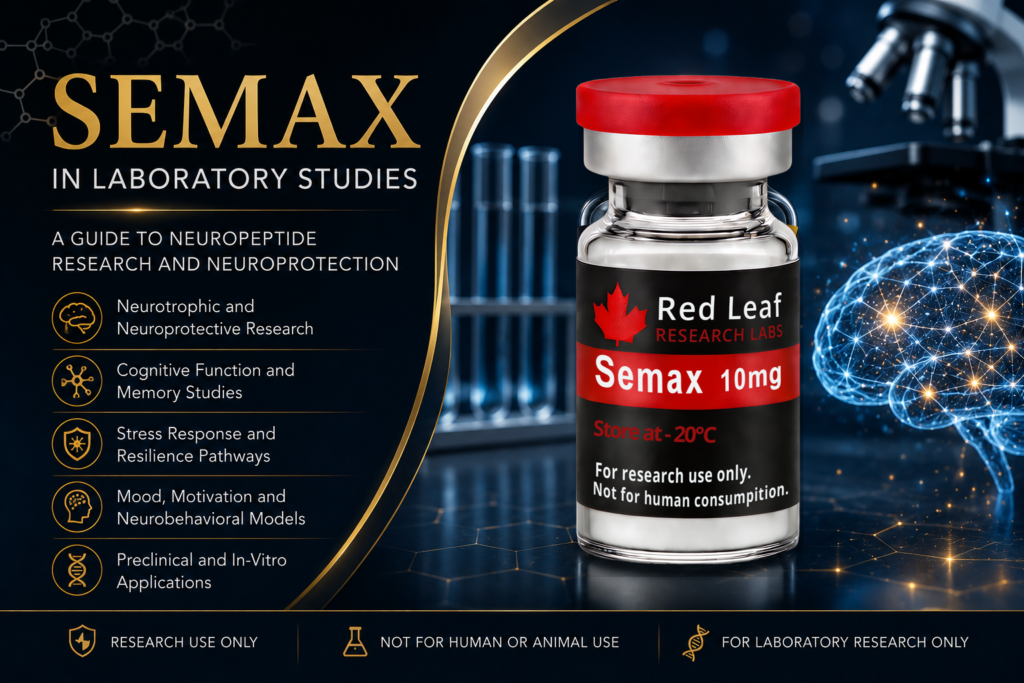
How Does Semax Peptide Work?
Semax appears to influence several pathways involved in brain function and cellular communication.
Research suggests Semax may affect:
- Brain-derived neurotrophic factor (BDNF)
- Nerve growth factor (NGF)
- Dopamine signaling
- Serotonin pathways
- Neural plasticity
Scientists believe these mechanisms may contribute to the peptide’s observed effects on learning, memory, and cognitive performance.
Potential Benefits of Semax
1. May Support Cognitive Function
One of the primary areas of Semax research involves cognitive performance.
Researchers have investigated how Semax influences brain signaling pathways associated with learning, information processing, and memory formation.
Potential research findings include:
- Enhanced cognitive performance
- Improved information processing
- Increased mental clarity
- Support for learning-related pathways
Because of these effects, Semax is often categorized as a nootropic peptide in scientific literature.
2. May Support Memory Formation
Memory formation relies on healthy neural communication and plasticity.
Research suggests that Semax may influence proteins involved in the development and maintenance of neural connections, including BDNF.
Scientists continue to study how these effects may support:
- Memory consolidation
- Learning capacity
- Neural adaptability
- Long-term cognitive function
3. May Promote Focus and Attention
Several studies have explored Semax’s potential effects on attention and concentration.
Researchers believe Semax’s influence on neurotransmitter activity may contribute to improvements in:
- Mental focus
- Sustained attention
- Cognitive efficiency
- Task performance
These findings have made Semax a significant subject in cognitive enhancement research.
4. May Support Neuroprotection
Neuroprotection refers to mechanisms that help preserve healthy brain cells and neural function.
Research has shown that Semax may influence cellular pathways involved in:
- Oxidative stress responses
- Inflammatory regulation
- Cellular recovery processes
- Neural resilience
Scientists continue to investigate its role in supporting healthy neurological function.
5. May Influence BDNF Levels
One of the most interesting aspects of Semax research is its relationship with Brain-Derived Neurotrophic Factor (BDNF).
BDNF is a protein that supports:
- Neuron survival
- Neural plasticity
- Learning
- Memory formation
Studies suggest Semax may increase the expression of BDNF-related pathways, which could contribute to its cognitive effects.
Semax and Brain-Derived Neurotrophic Factor (BDNF)
BDNF is often referred to as one of the brain’s most important growth factors.
Researchers have found that healthy BDNF activity supports:
- Learning
- Memory
- Cognitive flexibility
- Neural adaptation
Several studies indicate that Semax may positively influence BDNF signaling, making it a major focus of neuroscience research.
Semax and Neurotransmitters
Semax appears to interact with multiple neurotransmitter systems.
Research suggests potential effects on:
- Dopamine pathways
- Serotonin activity
- Neural signaling networks
- Communication between neurons
These interactions may help explain why Semax continues to be studied for cognitive performance and brain health.
Why Is Semax Popular in Nootropic Research?
Semax has attracted significant attention because it combines several research areas into a single peptide.
Scientists are particularly interested in its potential ability to support:
- Focus
- Memory
- Learning
- Neuroprotection
- Neural plasticity
Its unique mechanisms distinguish it from many traditional compounds studied for cognitive function.
Is Semax Approved for Human Use?
Semax remains an active area of scientific investigation.
Although it has been used in certain countries for medical purposes, researchers continue to study its mechanisms, safety profile, and long-term effects.
Additional clinical research is needed to fully understand its potential applications.
Key Takeaways
Semax is one of the most extensively researched nootropic peptides available today.
Research suggests Semax may:
- Support cognitive function
- Promote focus and attention
- Enhance memory-related pathways
- Influence BDNF activity
- Support neuroprotection
- Contribute to neural plasticity
As neuroscience research continues to evolve, Semax remains a promising peptide for understanding brain function, learning, memory, and cognitive performance.
References
- Ashmarin IP, et al. Semax: Neurobiological Mechanisms and Clinical Applications. Russian Academy of Sciences.
- Kolomin TA, et al. Effects of Semax on Gene Expression and Neurotrophic Factors in the Brain. Molecular Biology Reports.
- Levitskaya NG, et al. Semax and Brain-Derived Neurotrophic Factor Regulation. Neuroscience and Behavioral Physiology.
- Boyko OE, et al. Semax and Cognitive Function Research. Neuroscience Research Communications.
- Medvedeva EV, et al. Molecular Mechanisms of Semax Action in the Central Nervous System. Frontiers in Neuroscience.
- Volkova AV, et al. Semax-Induced Changes in Neurotransmitter and Neurotrophic Systems. Journal of Molecular Neuroscience.
- https://www.alzdiscovery.org/uploads/cognitive_vitality_media/Semax-Cognitive-Vitality-For-Researchers.pdf
Practical Applications of Peptides in Research
The versatility of peptides makes them invaluable tools across multiple scientific disciplines. Currently, synthetic peptides are deployed in several cutting-edge research applications:
Receptor Binding Assays: Researchers use tagged peptides to map receptor distribution on cell surfaces, helping to identify novel targets for future pharmaceuticals.
Tissue Engineering: Peptides are integrated into hydrogels and biomaterial scaffolds to promote cell adhesion and direct the differentiation of stem cells in artificial tissue grafts.
Drug Delivery Vectors: Cell-penetrating peptides (CPPs) are being researched as “molecular delivery trucks.” Scientists are attaching these peptides to larger molecules, or even nanoparticles, to force them past cellular barriers that normally reject them.
Immunology and Vaccine Development: Peptide antigens are utilized to study immune responses and form the basis of synthetic vaccines designed to target highly specific viral epitopes or cancer markers.
Disclaimer: The products and information referenced above are strictly intended for laboratory research and development purposes only. These compounds are not FDA-approved for human consumption, clinical application, or therapeutic use. Handle with strictly enforced laboratory safety protocols.
